
The Case Against Generation for Retrieval: Why Discriminative LLMs are the Future of Web-Scale Recommendation
The Case Against Generation for Retrieval: Discriminative Language Models as Effective Retrievers
This paper introduces an LLM-native two-tower framework for large-scale industrial retrieval, adapting pretrained LLMs (e.g., Qwen3) as discriminative semantic backbones rather than generative engines. By combining shared encoding, EOS pooling, and latent reasoning with knowledge distillation from a cross-encoder teacher, the system achieves SOTA-comparable results on Amazon benchmarks and significant gains in Meta's production environments.
TL;DR
Meta researchers have proposed a shift away from the current trend of Generative Retrieval (decoding item IDs) toward a revitalized Discriminative Two-Tower architecture. By using LLMs as semantic encoders rather than text generators, they achieved SOTA results on public benchmarks and significant efficiency gains in production, proving that the classic dual-encoder paradigm is far from obsolete in the LLM era.
The "Generative" Bottleneck in Retrieval
Recent academic trends have pushed for "Recommendation as Language Generation," where models like P5 or TIGER decode item titles or semantic IDs. While conceptually elegant, these models fail in the real world for three reasons:
- Latency: Autoregressive decoding is too slow for the "top-K" retrieval phase.
- Grounding: Models often hallucinate tokens that don't correspond to real products.
- Efficiency: The structural separation between token generation and item indexing leads to alignment errors.
The authors argue that the Two-Tower (TT) architecture remains the cornerstone of industry because it allows item embeddings to be precomputed and served via Approximate Nearest Neighbor (ANN) search. The goal: Give the TT architecture the "brain" of an LLM.
Methodology: Building a Smarter Two-Tower Model
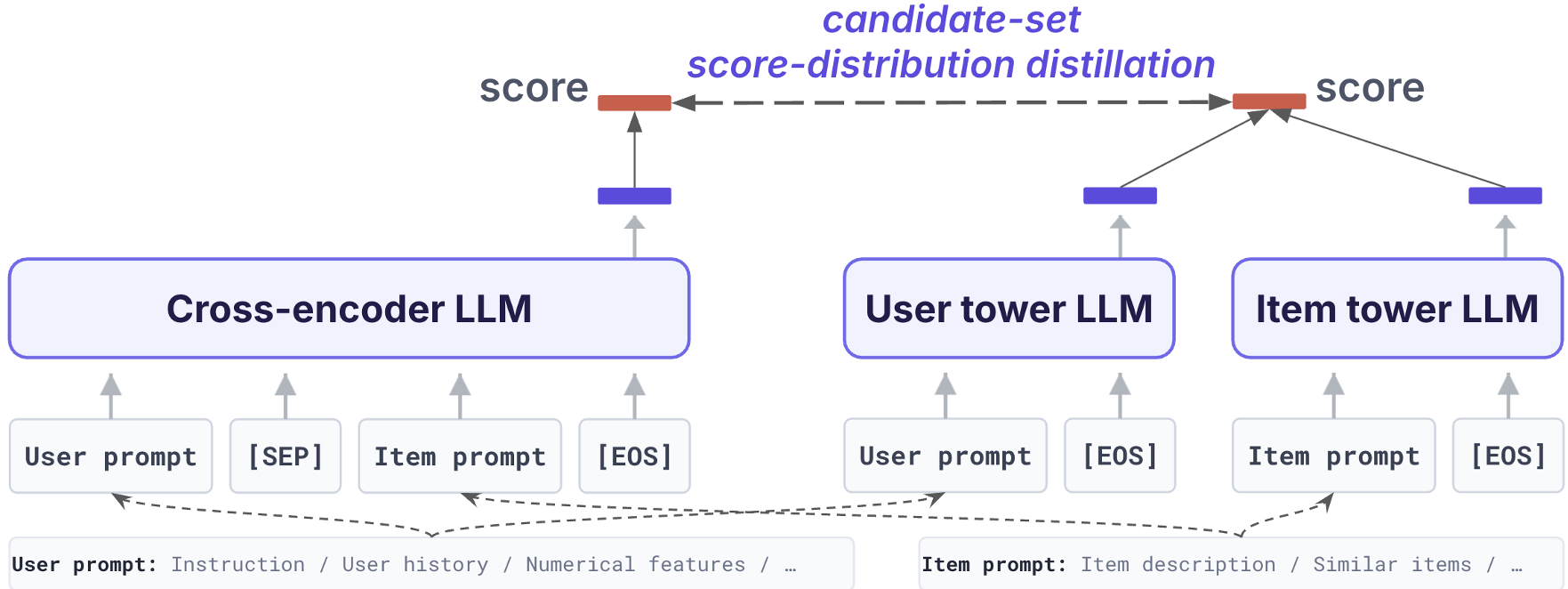
The framework employs a Teacher-Student setup to bridge the gap between high-quality ranking and high-speed retrieval.
1. The Super-Teacher: Improved Cross-Encoder (CE)
The teacher model sees the user history and the item simultaneously. The authors improved it by:
- Verbalized Scoring: Asking the model "Is this item relevant?" and calculating the score based on the logit difference between "Yes" and "No" tokens.
- User-Conditioned NTP: Adding an auxiliary loss where the model predicts item descriptions given the user's history, forcing the model to learn how item attributes satisfy user preferences.
2. The Efficient Student: LLM-Native Two-Tower
The student uses a shared LLM backbone (Qwen3-0.6B) but processes users and items separately.
- EOS Pooling: Using the final "End of Sentence" token hidden state as the embedding.
- Latent Reasoning: Inspired by "Coconut" reasoning, the user tower performs one extra "thought step" in the hidden space to refine the user's intent. Because this happens only on the user side, item embeddings remain static and indexable.
Experimental Breakthroughs
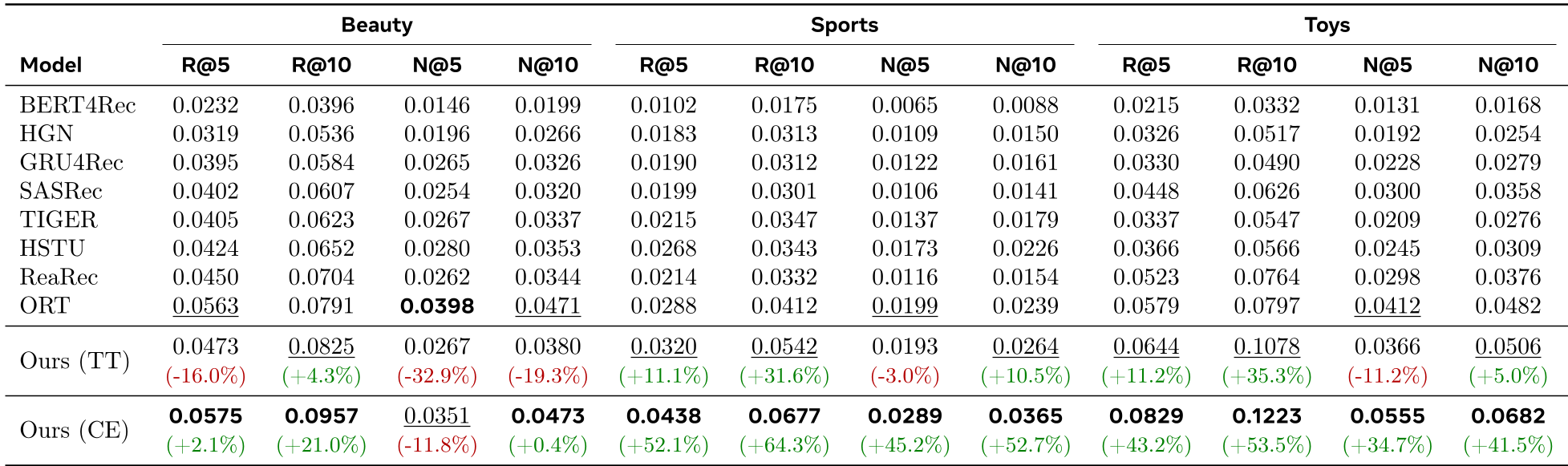
The results across Amazon Beauty, Sports, and Toys datasets show a clear dominance:
- Public Benchmarks: The Cross-Encoder (CE) outperformed
OneRec-Think(which uses a much larger 8B parameter model) by over 60% in Recall@10 on the Sports dataset. - Production Scaling: In Meta's internal systems, the LLM-native model reached the performance of a heavily tuned production DLRM using only 0.5% of the data.
- Resilience to Staleness: Unlike ID-based models that degrade quickly as new items appear, the LLM-native model remains robust because it understands semantics rather than just IDs.
Deep Insight: Semantic vs. ID-based Learning
The most striking takeaway is the Data Efficiency. Traditional Deep Learning Recommendation Models (DLRMs) rely on massive embedding tables for Item IDs. When a new item arrives, the model is "blind" until it sees thousands of interactions. The LLM-native approach, by grounding items in a stable semantic vocabulary, allows for "Zero-shot" style generalization. It treats recommendation as a deep semantic matching problem, which is inherently more robust than the "ephemeral" nature of ID-based lookups.
Conclusion & Future Work
The paper effectively argues that we don't need to generate text to benefit from LLMs in recommendation. By staying within the discriminative, two-tower framework, we can achieve the best of both worlds: the reasoning power of Transformers and the sub-millisecond efficiency of ANN search.
Limitations: The primary challenge remains the serving cost of the LLM encoder itself. While the authors proposed optimizations like layer pruning and quantization, running a 600M+ parameter model for every user request is still more compute-intensive than traditional shallow MLP towers. Future research will likely focus on further distilling these heavy LLMs into even smaller, specialized architectures.