
Discriminative Pruning: Why Less is More in Deep Neural Networks
Discriminative neural network pruning in a multiclass environment: A case study in spoken emotion recognition
This paper introduces a discriminative post-training pruning method for Restricted Boltzmann Machines (RBMs) in multiclass classification environments. By ranking hidden neurons using statistical measures like Fisher Score and ReliefF, the authors successfully prune up to 95% of the network while simultaneously reducing the classification error rate in tasks such as spoken emotion recognition and chemical gas sensing.
TL;DR
Researchers have developed a way to make Deep Learning models—specifically Restricted Boltzmann Machines (RBMs)—much smaller and more accurate by treating hidden neurons as "features" and pruning those that don't help distinguish between classes. In some cases, they've reduced models by over 90% while improving accuracy on complex tasks like emotion recognition.
Background: The Redundancy Trap
The prevailing wisdom in Artificial Intelligence has been "bigger is better." Deeper and wider networks are capable of mapping complex problems into more manageable feature spaces. However, this comes at a massive computational cost. More importantly, not every neuron "earns its keep." In supervised tasks, many neurons end up being redundant or even noisy.
The central challenge addressed in this paper is: How do we identify the "valuable" neurons in a pre-trained network and discard the rest without the need for expensive retraining?
The Core Insight: Neurons as Discriminators
Instead of just looking at the weight magnitude (as in standard pruning), the authors treat the output of each hidden neuron as a feature. By looking at how these outputs vary across different classes (e.g., Sadness vs. Anger in speech), they can apply classical statistical measures to rank them.
The Pruning Workflow
- Unsupervised Pre-training: Train a large RBM to learn the data distribution.
- Discriminative Ranking: Evaluate each neuron using measures like the Fisher Score or ReliefF.
- Iterative Pruning: Remove low-ranked neurons and test the classification performance.
- Zero Retraining: Unlike methods like Optimal Brain Surgeon, this approach requires no further weight updates after pruning.
 Note: Algorithm showing the estimation of discriminative values and subsequent ranking.
Methodology: The "Best" Discriminative Measures
The paper tests eight different statistical tools to measure a neuron's "worth." Two emerged as the clear winners:
- Fisher Score: It favors neurons that show high variance between classes but low variance within the same class.
- ReliefF: A more robust measure that considers the "nearest neighbors" of data points, making it highly effective for complex, non-linear boundaries.
Experimental Battleground
The team tested their theory across three distinct datasets:
- Interface Dataset (Spanish Emotion Recognition)
- Berlin Dataset (German Emotion Recognition)
- Gas Sensor Dataset (Chemical identification)
Results That Defy Intuition
Usually, pruning is a trade-off: you lose accuracy to gain speed. Here, the authors found a synergistic effect.
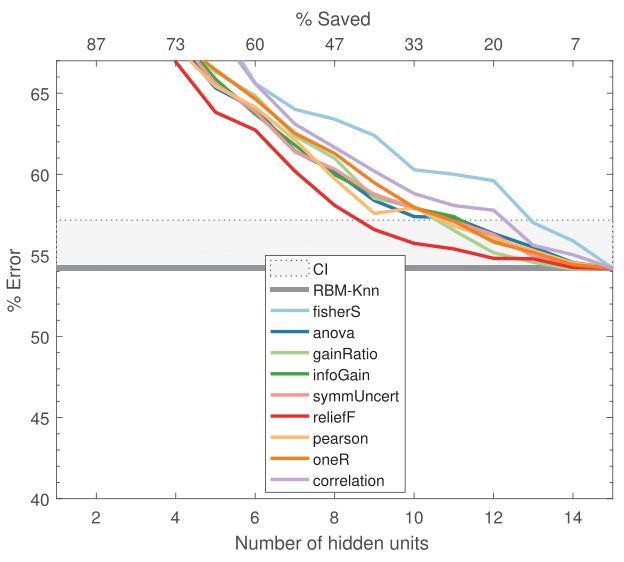 Fig: Performance curves on the INTERFACE corpus. Notice how the error rate (y-axis) often dips below the baseline (solid line) as the number of neurons is reduced.
Key Findings:
- In the Gas Sensor task, the error rate dropped to 0.43% with just 11 neurons, whereas the previous state-of-the-art using SVMs was roughly 5.08%.
- On the Berlin Speech Dataset, they achieved up to 95% savings in neurons without losing significant performance.
- The rule of thumb: If you start with more hidden neurons than visible (input) neurons, pruning is almost guaranteed to find a more efficient sub-structure.
Critical Analysis & Takeaways
Why does this work?
By pruning based on discrimination, the authors are essentially performing a form of supervised dimensionality reduction inside the latent space of the network. This removes the "dead wood" that confuses the final classifier (in this case, a K-Nearest Neighbor model), thereby improving the Signal-to-Noise ratio.
Limitations
- Metric Selection: There is no "one size fits all" metric. While Fisher Score worked best here, other datasets might require different statistical distances.
- Architecture Specificity: The study focuses on RBMs. While the logic is sound, its application to modern attention-based architectures (Transformers) would require adapting the ranking to account for multi-head dynamics.
The Big Picture
This paper reinforces a powerful trend in modern AI: Over-parameterization is a tool for training, not necessarily for inference. By training a "fat" network and then surgically removing the less discriminative parts using statistical heuristics, we can create models that are not only faster but fundamentally more robust at identifying the categories that matter.
Conclusion
The study proves that in the context of multiclass classification, the "importance" of a neuron is best measured by its ability to separate classes. For engineers and researchers, this means that structural pruning should be a supervised process whenever class labels are available.