
Beyond Objects: Fusing Content and Style for Deep Image Emotion Recognition
Exploring Discriminative Representations for Image Emotion Recognition With CNNs
This paper introduces a novel CNN framework for Image Emotion Recognition (IER) that fuses high-level semantic content with low-level stylistic features. By integrating Gram-matrix-based style representations and a uncertainty-aware loss function, the model achieves a state-of-the-art accuracy of 71.77% on the Image Emotion Dataset.
TL;DR
While AI is excellent at recognizing what is in an image, it often struggles with how an image makes us feel. This paper argues that standard CNNs miss the "style" (colors, textures, shapes) that triggers emotional responses. The authors propose a hybrid ResNet-152 model that extracts content from deep layers and style from shallow layers using Gram matrices, while introducing a new loss function to handle the inherent subjectivity of human emotions.
Background: The Content-Emotion Gap
In the world of Computer Vision, we have mastered object recognition. However, Image Emotion Recognition (IER) is a different beast. An abstract painting of red streaks might evoke "Anger" without containing a single recognizable object.
Current SOTA models rely on deep features which are highly semantic. While "seeing a cake" might suggest "Amusement," the actual emotional impact often comes from the lighting, the grain of the film, or the color palette—features that typically get discarded as noise in the deeper layers of a standard CNN.
Methodology: The Synthesis of Content and Style
1. The Dual-Representation Architecture
The researchers utilized a ResNet-152 backbone but modified the feature extraction process:
- Content Representation: Extracted from the final fully connected layer (2048-D vector). This captures the high-level objects and scenes.
- Style Representation: Extracted from shallow blocks. To isolate "style" from "spatial content," they calculated Gram Matrices (feature correlations). This technique, borrowed from Neural Style Transfer, captures textures and color distributions regardless of where they appear in the image.
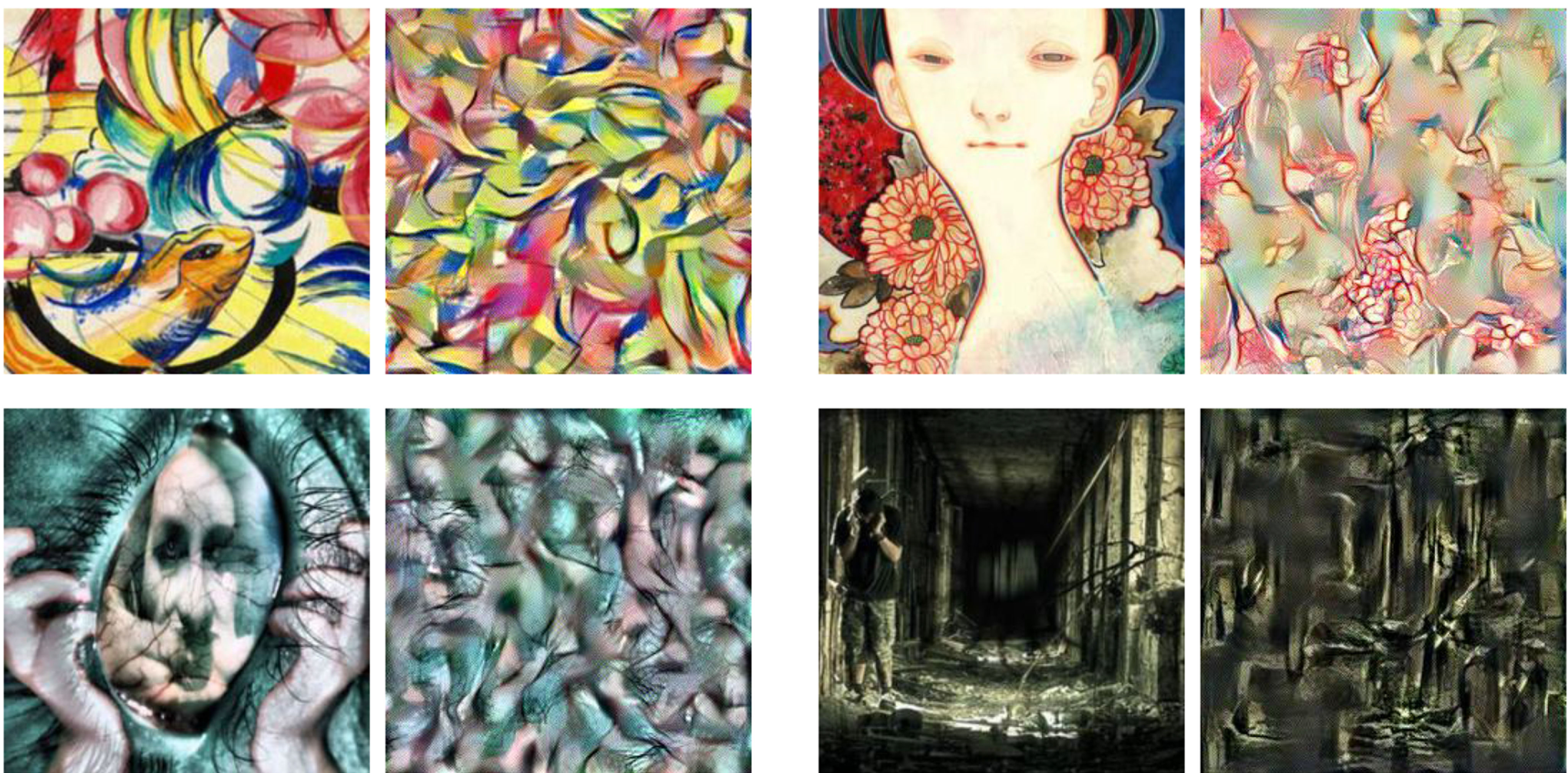 Figure 1: The proposed inference model integrating Gram-based style features from lower layers with semantic features from deep layers.
2. Solving Subjectivity with Weighted Loss
One of the most profound insights in this paper is the treatment of Label Uncertainty. In the Image Emotion Dataset, images were labeled by 5 different people. Some images had a 5/5 consensus (Strong signal), while others were 3/5 (Weak/Ambiguous signal).
Instead of treating all labels as ground-truth "Hard Labels," the authors introduced a second loss term () that minimizes the distance between the model's prediction and the actual vote distribution. This effectively "smooths" the labels and forces the model to focus more on high-consensus samples.
Experimental Performance
The model was tested against several benchmarks, including the large-scale Image Emotion Dataset and smaller sets like "Abstract Paintings."
- Baseline ResNet-152: 68.07%
- Proposed (Content + Style + New Loss): 71.77%
The ablation study revealed that style features from the very first stages (S1, S2, S3) provided the most significant boost, whereas style features from deep layers (S4, S5) actually hurt performance due to overfitting on high-dimensional correlations.
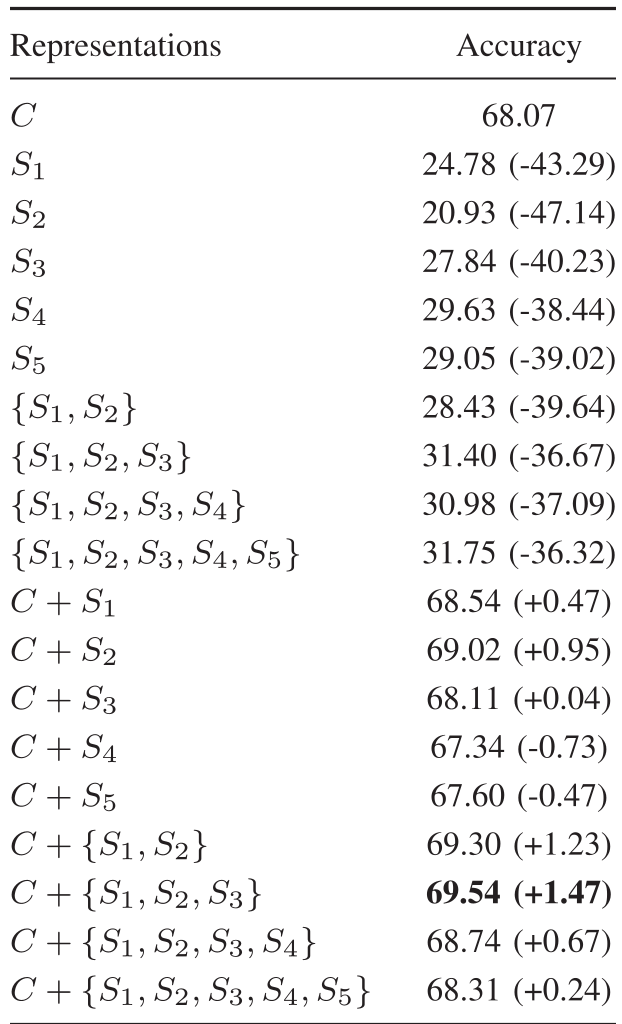 Table: Synergistic effect of combining Content (C) and Style (S) features.
Visualizing the "Why"
Why does this work? The authors used gradient descent to visualize what the layers "see." Shallow layers maintain photographic details, while deep layers become increasingly abstract, focusing only on the "objectness." By re-injecting the shallow Gram matrices, the model regains the ability to "feel" the brushstrokes of a painting or the gloom of a dark, blue-tinted landscape.
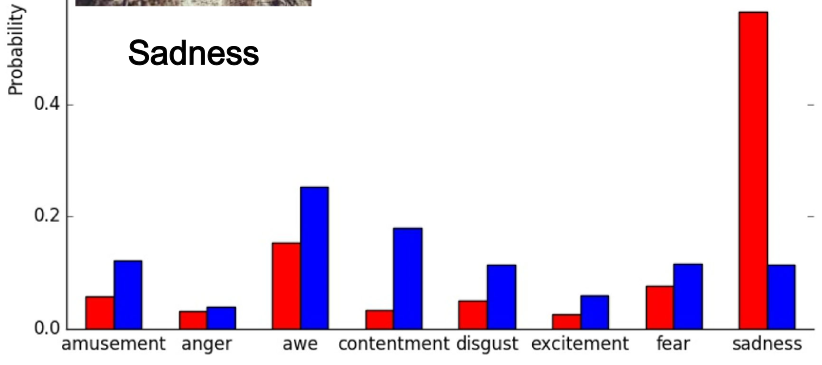 Figure 2: Examples where the base CNN failed but the Style-aware model correctly identified emotions like 'Awe' or 'Sadness' based on visual aesthetics.
Critical Insight & Conclusion
This paper successfully bridges the gap between Art Theory and Deep Learning. It proves that for subjective tasks like emotion recognition, we cannot treat the image as just a collection of objects. The "texture of the pixels" matters just as much as the "meaning of the objects."
Future Directions: While the Gram matrix is powerful, it is computationally expensive ( matrix). Future research could explore more efficient "style" descriptors or attention-based mechanisms that selectively weight stylistic cues based on the image type (e.g., giving more weight to style in abstract art vs. content in news photos).