
DRL: Mastering the Art of Trust and Distrust in Signed Social Networks
Disentangled Link Prediction for Signed Social Networks via Disentangled Representation Learning
The paper introduces Disentangled Representation Learning (DRL) for signed social networks to solve the Disentangled Link Prediction (DLP) problem. It proposes two models, DRL-C and DRL-R, which separate a signed network into positive and negative sub-networks to jointly learn two distinct node representations for predicting trust and distrust links simultaneously.
TL;DR
Predicting who will become friends is a classic problem, but predicting who will become enemies is far more complex. This paper introduces Disentangled Representation Learning (DRL), a framework that splits signed networks (containing both '+' and '-' links) into two sub-networks. By learning distinct "trust" and "distrust" embeddings and refining them through a joint optimization process, the authors achieve massive performance gains, particularly in negative link prediction where traditional models often fail.
The "Enemy of My Enemy" Trap
Most graph embedding techniques (like DeepWalk or node2vec) are built on the Homophily Principle: similar nodes are close together in the latent space. While this works for "friend" links, it creates a paradox for "foe" links.
In a signed network, if Node A hates Node B, and Node C also hates Node B, the Weak Balance Theory suggests A and C might actually be friends. However, standard embeddings would try to push A closer to B and C closer to B because of their connection, mistakenly making A and C appear similar to their common enemy. This "conflation" of opposite signals is why existing SOTA models struggle with negative link prediction.
Methodology: Disentangle to Reconstruct
The authors propose a two-pronged solution:
1. The Disentanglement Strategy
The network is split into a Positive Sub-network and a Negative Sub-network .
- Positive Embedding (): Follows homophily (connected nodes = similar).
- Negative Embedding (): Follows "Anti-homophily" (connected nodes = different).
2. The Refinement Mechanism (DRL-C vs. DRL-R)
To ensure the models don't just learn in isolation, they introduce a reconciling matrix to link the two spaces:
- DRL-C (Connection): Treats the node itself as having an "implicit edge" across the two embeddings, forcing the positive and negative representations of the same user to be similar through a sigmoid-based loss.
- DRL-R (Regularization): Uses a co-regularization term to minimize the distance between the two spaces via a linear transformation matrix .
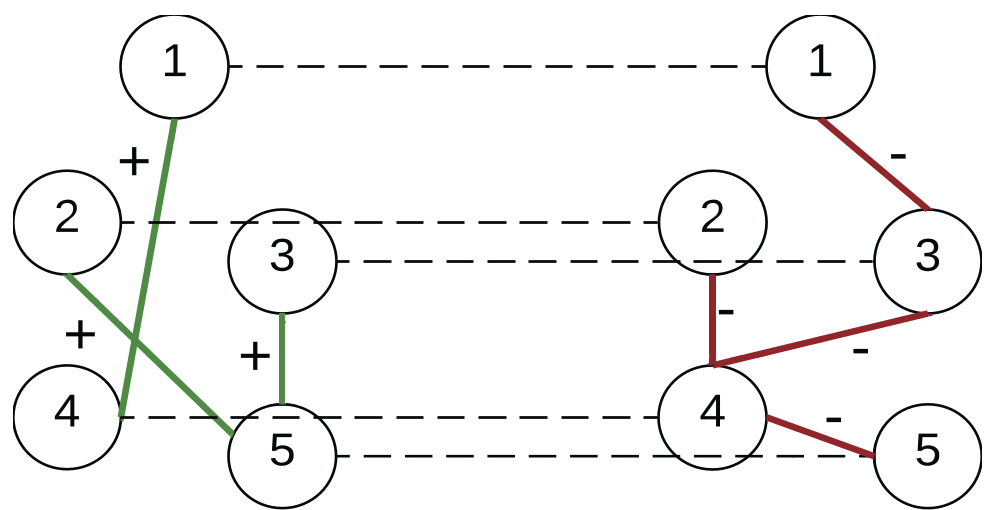 Fig 1: The architecture showing the disentanglement of a signed network into positive and negative layers.
Experiments & Results
The researchers tested their models on three heavyweights: Epinions, Slashdot, and Wikipedia.
SOTA Comparison
The results were striking. In negative link prediction, where baselines like LINE or node2vec hovered around 60-70% AUC, the DRL models surged into the 85-95% range.
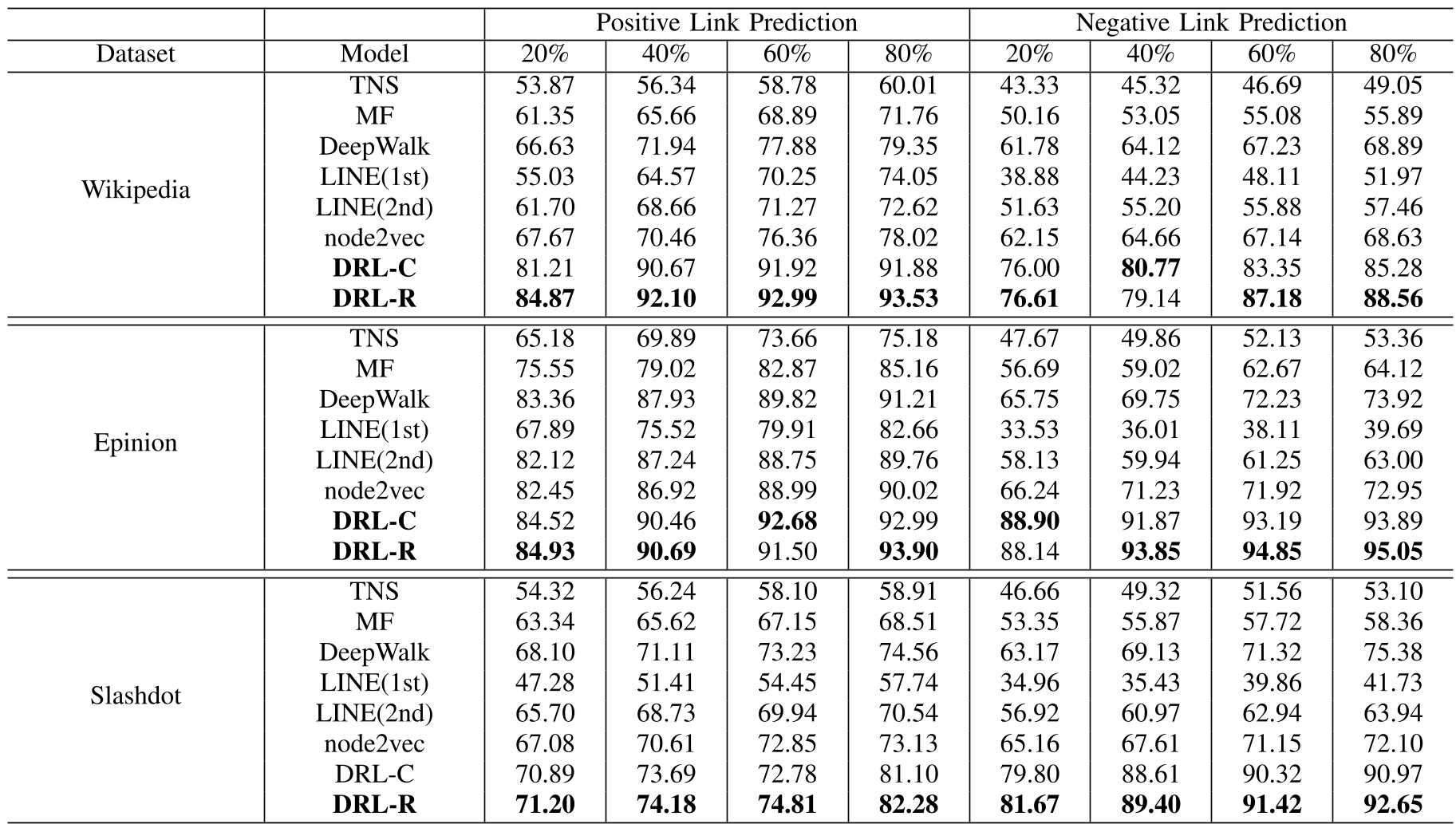 Table 2: Comparison of AUC scores. Notice the significant jump in Negative Link Prediction for DRL-C and DRL-R.
Visual Evidence: Does it actually work?
In the case study, the authors visualized the distribution of similarities. In the positive representation space, friends were clustered. In the negative space, enemies were explicitly pushed apart, confirming that the "Anti-homophily" objective was successfully reached.
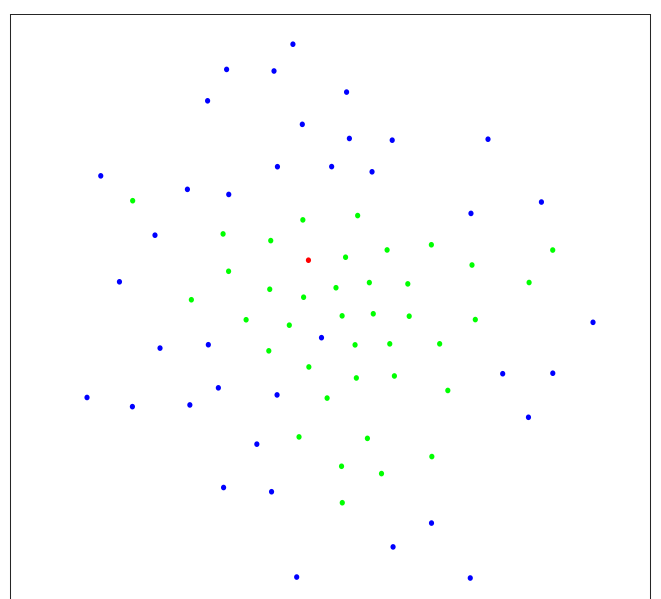 Fig 2: Distribution showing that negatively connected nodes are pushed to separate clusters.
Critical Insight & Conclusion
The genius of this work lies in recognizing that negative links are not just "low-probability positive links." They have a different social logic. By disentangling the representations, the authors allow the model to honor the "homophily" for friends while respecting the "structural balance" for enemies.
Takeaway for Practitioners: When dealing with multi-relational data where relations have opposite meanings (e.g., Like/Dislike, Buy/Return), do not force them into a single latent vector. Disentangle the representations and provide a bridge for joint learning to achieve the best of both worlds.