
Dispersing Instant Social Video: Breaking the Multi-Cloud Cost Barrier
Dispersing Instant Social Video Service Across Multiple Clouds
This paper investigates dispersion strategies for instant social video services across multiple cloud providers. It proposes a heuristic graph-partitioning algorithm that balances user performance preference with inter-cloud operational costs, achieving a 5/6 reduction in data transfer costs with only a 12% impact on user preference satisfaction.
Executive Summary
TL;DR: This paper tackles the economic and technical challenge of hosting short-video social networks (like TikTok or Vine) across multiple cloud providers. While multi-cloud hosting offers better global coverage, "egress" pricing—the cost of moving data between different clouds—is a major financial drain. The authors present a heuristic graph-partitioning algorithm that strategically maps users to clouds to satisfy performance needs while slashing inter-cloud traffic by 83%.
Strategic Positioning: This work bridges the gap between Cloud Economics and Social Network Analysis. It moves beyond simple "closest server" logic to a "propagation-aware" model, recognizing that in social media, data doesn't just flow from server to user—it ripples from friend to friend.
The "Tax" on Inter-Cloud Socializing
In the traditional cloud model, "Inbound" data (uploading a video) is usually free, but "Outbound" data (streaming it) is expensive. Critically, cloud giants like Amazon EC2 implement a pricing roadblock: sending data to another EC2 instance in the same region might cost 0.12/GB—a 6x markup.
For a social video app, this is a nightmare. If User A (on Amazon) shares a video with User B (on Tencent Cloud), the platform must pay that 6x premium. As the social graph grows more complex and global, these "inter-cloud taxes" can bankrupt a service.
Methodology: Graph Partitioning with Physical Intuition
The authors define a "Propagation-Weighted Social Graph" where nodes are users and edges represent the volume of video shares between them. The goal is to maximize User Preference (speed) while minimizing Replication Cost (money).
1. Two-Phase Heuristic Design
Since the problem is NP-hard, the authors use a clever two-step approach:
- Phase 1: Preference-Aware Selection: Every user is initially placed in their "ideal" cloud provider based purely on network latency for uploads and their friends' downloads.
- Phase 2: Propagation-Aware Re-hosting: The algorithm identifies "heavy" edges—friendship pairs that generate massive traffic. It then tries to "re-host" one or both users into the same cloud if the cost savings (lower egress fees) outweigh the slight loss in speed.
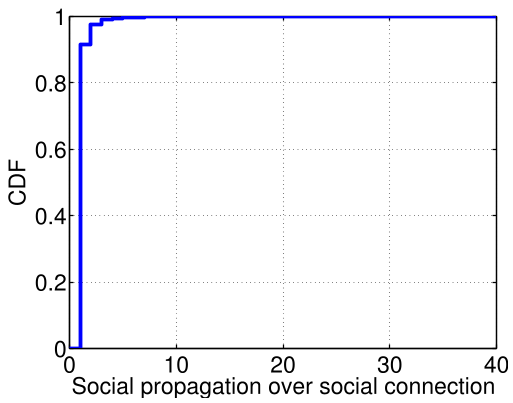 Figure 1: The multi-cloud hosting framework incorporating social propagation and cloud pricing.
2. The Logic of Gains
The re-hosting decision is governed by a gain function (). It evaluates four scenarios for any high-traffic pair :
- Scheme A: Keep them separate.
- Scheme B/C: Move one user to the other's cloud.
- Scheme D: Move both to a neutral third cloud.
Experimental Insights: The 80/20 Rule of Social Traffic
The study utilized real-world traces from Weishi (Tencent's short video platform) and Weibo.
Critical Findings:
- Heavy-Tailed Propagation: Most social connections are dormant. Only a tiny fraction of "active" connections cause the bulk of the traffic. By optimizing just the top 20% of social edges, the system captures almost all available cost savings.
- Efficiency: The heuristic algorithm achieves performance levels nearly identical to brute-force "optimal" solutions in small-scale tests, but scales linearly () to millions of users.
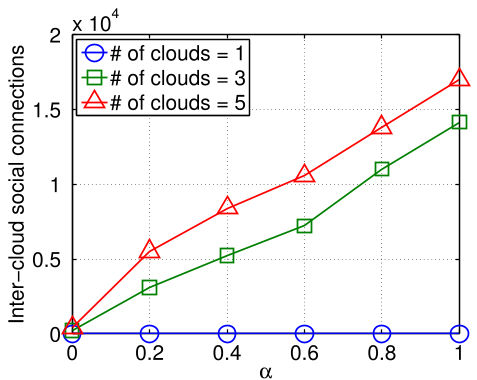 Figure 2: Our design (blue line) maintains low propagation costs compared to "Max-Preference" (hosting users only on their best servers) as more cloud providers are added.
Critical Analysis & Takeaways
The Strategic Value
This paper proves that Multi-cloud isn't just a technical choice; it's a social-geographic one. By treating users as "logical instances" that carry their content with them, the system simplifies the impossible task of tracking billions of individual video files.
Limitations
- Fixed Pricing: The model assumes cloud prices are static. In reality, tiered pricing (where it gets cheaper the more you send) could change the "Gain" calculation.
- User Mobility: The paper assumes users stay in one region. A traveler moving from China to the US might require a dynamic re-hosting strategy not fully explored here.
Conclusion
As the world moves toward "Multi-cloud" to avoid provider lock-in and improve global reach, this methodology provides a blueprint. The core takeaway? Follow the social heat. Don't just place data near users; place data where it will propagate most cheaply within their social circle.