
The Ghost in the Machine: Why Your Personality Dictates Your Social Media Habits
Dispositional Factors in the Use of Social Networking Sites: Findings and Implications for Social Computing Research
This study investigates how dispositional factors—specifically the Big Five personality traits, self-esteem, narcissism, and social support—influence the usage patterns of Social Networking Sites (SNSs). Using hierarchical regression analysis on a student sample, the research demonstrates that personality variables can predict 10% to 20% of the variance in specific SNS activities.
TL;DR
Why do some people use Facebook to find romance while others only use it when they are bored? This paper argues that the "social" in social computing is driven by deeply rooted personality traits. By analyzing factors like Extroversion, Neuroticism, and Narcissism, the research proves that individual psychology predicts up to 20% of how we use social networks—a finding that has massive implications for AI modeling and digital marketing.
Problem & Motivation: The Passive User Myth
In the world of social computing, we often design systems as if users were passive recipients of technology. However, the author argues that humans actively shape how they use tools based on their internal wiring.
Current engineering-based architectures often fail to explain why "viral" content doesn't always go viral. The missing link? Individual differences. If a model doesn't account for the fact that a conscientious person avoids "time-wasting" apps while a neurotic person seeks them out to alleviate anxiety, the model is fundamentally flawed.
Methodology: Mapping the Mind to the Feed
The study utilized a multi-dimensional psychological approach to profile 174 participants across several scales:
- The Big Five: Extroversion, Agreeableness, Conscientiousness, Stability, and Openness.
- Self-Esteem: Measuring the need for peer feedback.
- Narcissism: Specifically focusing on Power/Control and Exhibitionism.
- Social Support: Comparing offline vs. online support networks.
The author suggests that these traits should be used as parameters in cognitive architectures like CLARION, specifically within the "Motivational" and "Metacognitive" subsystems, to create more human-like social simulations.
(Note: This study refers to the CLARION architecture for parameterizing motivation and regulation based on personality traits.)
Experimental Insights: Who Does What?
The results revealed fascinating correlations between who we are and what we click:
- The Boredom Escape: Users low in Stability (higher in Neuroticism) are significantly more likely to use SNSs to "occupy time" (β = -.241). For these users, the screen is a shield against boredom and anxiety.
- The Exhibitionist Drive: Narcissism (Exhibitionism) was a major driver for seeking leisure interests and romantic communication (β = .280). If the platform allows for self-disclosure, the narcissist will dominate the space.
- The Conscientious Filter: Highly Conscientious individuals spend much less time seeking leisure interests on line (β = -.450), likely viewing it as a distraction from purposeful goals.
Key Data Table: SNS Usage Frequencies
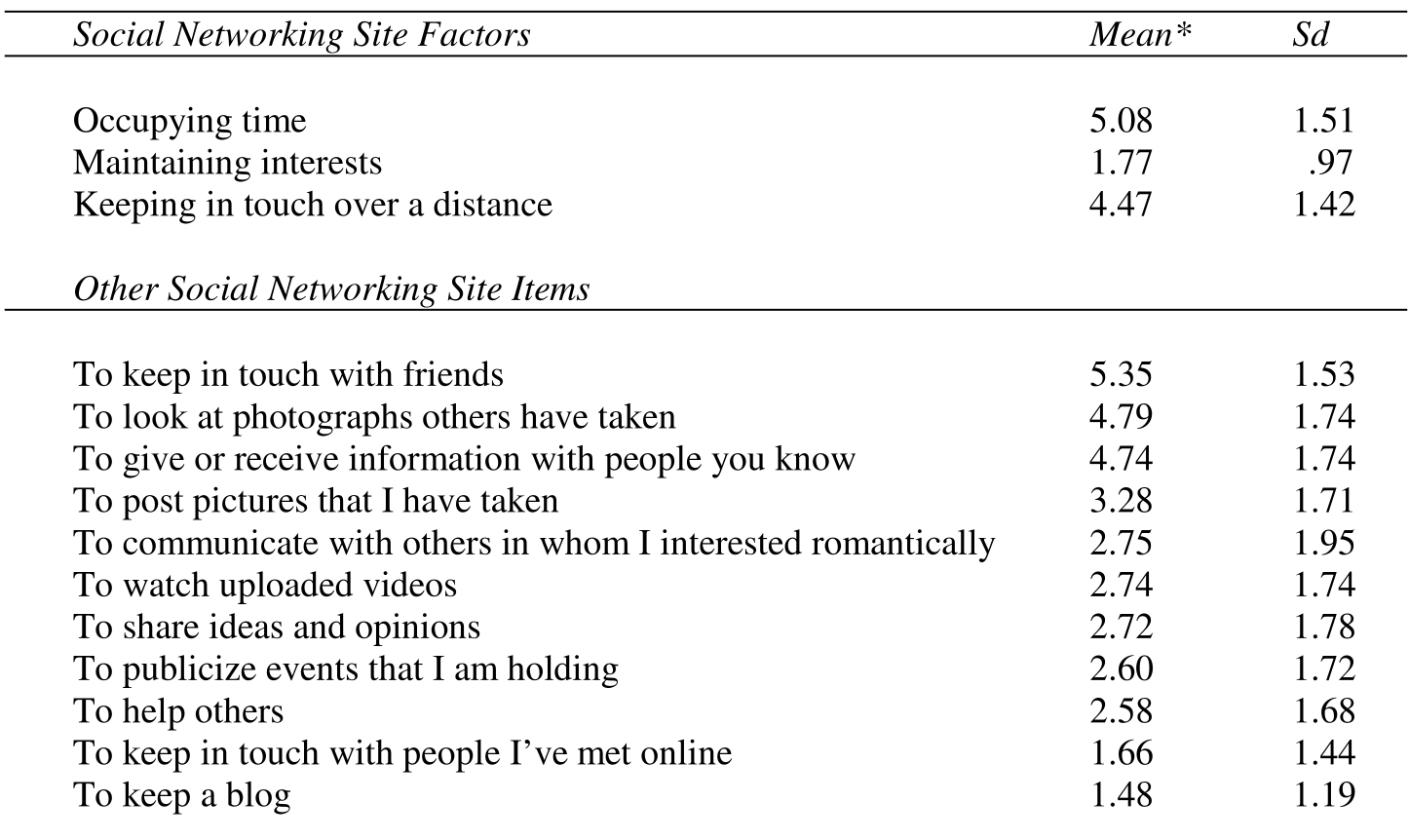 Table 1 illustrates that "Occupying Time" and "Keeping in Touch" are the most frequent activities, heavily moderated by the user's personality profile.
Critical Analysis: Why This Matters for the Future
This research provides a "Psychological Coordinate System" for social computing.
1. For Developers and Designers
If 10-20% of usage variance is tied to personality, then "Personalization" must go deeper than just tracking clicks. It must infer disposition. A user with low self-esteem might be harmed by certain types of social feedback; a socially responsible system should be able to predict and mitigate this.
2. For Economic Efficiency
The author notes the massive valuations of platforms like Facebook. To justify these costs, owners must move toward "Appropriate Marketing." Targeting an extrovert with a "private/solitary" product is an economic waste. Identifying personality types through computational behavior is the next frontier of "Economic Efficacy."
Limitations & Future Work
The study relies on a convenience sample of students, which may not represent the global population. However, the framework it provides—parameterizing psychology into AI—is a vital stepping stone toward creating social systems that truly understand their "social" components.
Conclusion
We are not just "users"; we are personalities. This paper serves as a call to action for the social computing community to integrate the "Motivational Subsystem" of the human psyche into the algorithms that govern our digital lives.