
SCPD: Maximizing Rewards in Interest-Centric Opportunistic Social Networks
Disseminating Authorized Content in Interest-Centric Opportunistic Social Networks
The paper introduces a novel framework for disseminating authorized content in Interest-centric Opportunistic Social Networks (IOSNs). It proposes the Social Connection Pattern (SCP) to predict user interests and potential connections, paired with the SCP-based Dissemination (SCPD) algorithm to maximize content provider rewards.
Executive Summary
TL;DR: This paper addresses the challenge of distributing "authorized content"—material that is costly to produce and limited in quantity—within opportunistic social networks. By introducing the Social Connection Pattern (SCP) and the SCPD algorithm, the authors provide a mathematical framework to predict which "strangers" are most likely to lead to high-value, interested users, boosting distribution efficiency by up to 40%.
Context: This work occupies a unique niche between social network analysis and opportunistic routing, shifting the focus from "reaching any node" to "reaching the most profitable node" under resource constraints.
The Core Problem: The Value of a Handshake
In an Opportunistic Social Network (OSN), nodes (mobile devices) connect via short-range signals like Wi-Fi or Bluetooth. When a Content Provider (CP) has a limited number of "authorized" items—like exclusive digital coupons or conference invites—every copy counts.
Existing solutions typically fall into two traps:
- Myopic Greed: Only looking at the interest of the person standing right in front of you.
- Blind Flooding: Distributing copies indiscriminately, which wastes limited resources on disinterested users or "dead-end" nodes.
The authors' insight is profound: Users move toward their interests. If a user has met marketing researchers in the past, they are statistically likely to meet similar people in the future. This "Social Connection Pattern" can be quantified and used as a roadmap.
Methodology: Mapping the Social Interest Landscape
1. The Social Connection Pattern (SCP) Matrix
The authors represent a user's potential via two structures:
- Probability Matrix (): Records the distribution of interests over hops.
- Counting Vector (): Tracks how many people a user connects to at each hop.
Instead of tracking individuals (which is privacy-invasive and computationally expensive), the SCP tracks patterns. The reward is maximized through a recursive update mechanism whenever two nodes meet, allowing the network to "learn" the interest topology.
2. The SCPD and Reward Maximization Algorithm (RMA)
When two users meet, the holder of content copies must solve a optimization problem: How many copies should I pass over to maximize the expected future reward?
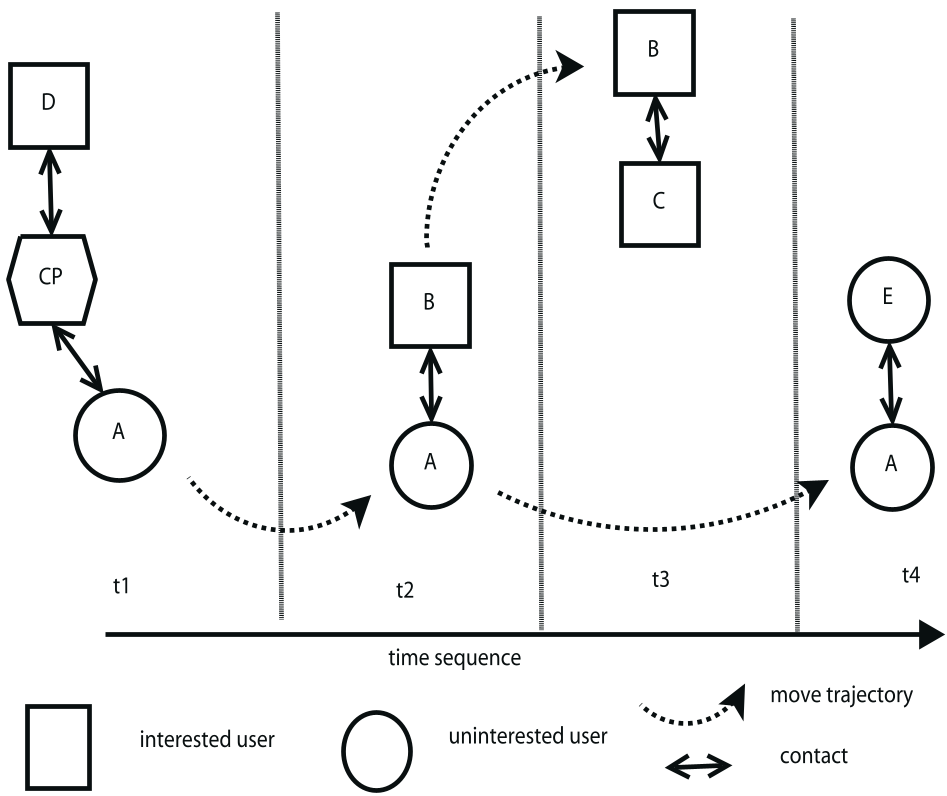 Fig 1: A Content Provider distributing varying copies based on the recipient's potential to reach others.
The paper uses a Branch and Bound method to solve the integer programming problem of copy allocation. It balances two factors:
- Direct Reward: Is the current contactor interested?
- Indirect Reward: Can this contactor reach other interested people within hops?
Experimental Analysis: Outperforming the Flood
Using the Infocom2006 and Sigcomm2009 datasets, the authors compared SCPD against traditional Flooding.
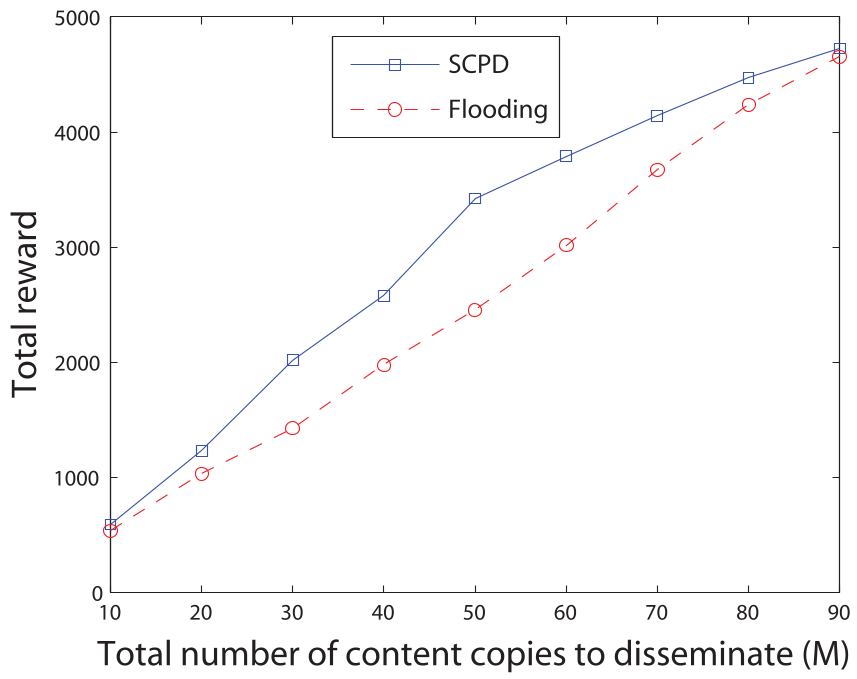 Fig 2: Total reward achieved by SCPD vs Flooding on the Infocom dataset.
Key Findings:
- Significant Gains: SCPD consistently yields higher rewards, particularly when the number of copies () is approximately half of the network size.
- Stability: The algorithm maintains performance even with shorter "training" windows (10,000 vs 30,000 contacts), proving the social patterns are robust.
- Critical Forwarders: Analysis of the distribution (Fig 7 in the paper) shows that SCPD identifies "super-nodes" who receive large batches of content for efficient downstream distribution, unlike Flooding which scatters copies thinly.
Critical Insight & Conclusion
The true value of this paper lies in its probabilistic approach to social trajectories. It moves away from the "six degrees of separation" as a static concept and treats it as a dynamic resource for content marketing.
Limitations: The model assumes users are incentivized to cooperate and that interests remain relatively static over the duration of the dissemination. Future work might explore "adversarial" nodes that consume rewards without forwarding or dynamic interest shifts.
Takeaway: For any decentralized system managing scarce resources, the SCPD provides a blueprint for leveraging "interest-centric" mobility to achieve global optimization through local, opportunistic encounters.