
DBLP2: Reimagining Location Privacy as a Spectrum of Social Trust
Distance-based location privacy protection in social networks
The paper introduces DBLP2 (Distance-Based Location Privacy Protection), a novel system that modulates location precision in social networks using a Differential Privacy framework. It dynamically adjusts the granularity of shared location data—ranging from specific buildings to entire countries—based on the "friendship distance" between the user and the requester.
TL;DR
Social networks currently force us into a binary choice: share your exact location with everyone on your friends list or hide it entirely. DBLP2 (Distance-Based Location Privacy Protection) breaks this mold by using Differential Privacy to "blur" your location based on how close you are to the person asking. Family sees the building; casual friends see the city; strangers see the country.
Background: The Rigidity Problem
In contemporary Geo-Social Networks (GeoSNs), privacy is a zero-sum game. If you are my "friend," you might see my spatiotemporal tags with terrifying one-meter accuracy—tools like the "Marauders Map" extension have already demonstrated how easily this data can be weaponized for stalking.
The authors identify the Rigidity Problem: current systems lack a "sliding scale." Furthermore, by blocking data access entirely for non-friends, we lose the "Data Utility" that researchers need for computing useful global statistics.
The Core Insight: Friendship Distance
The fundamental intuition of DBLP2 is that privacy requirements are inversely proportional to social proximity. The authors define a Friendship Distance (), a metric representing social closeness.
To transform this into a privacy guarantee, they map to the privacy parameter (epsilon) in a Differential Privacy framework using an exponential decay function: This ensures that as the social distance grows, gets smaller, which in the world of Differential Privacy means more noise and higher protection.
Methodology: The Two-Stage Blur
DBLP2 doesn't just throw random numbers at a map. It follows a logical two-step process to ensure the results are both private and "human-readable."
1. Noise Injection Mechanism (NIM)
The system takes your raw GPS coordinates and injects Laplace-distributed noise. The "strength" of this noise is dictated by your social distance to the requester.
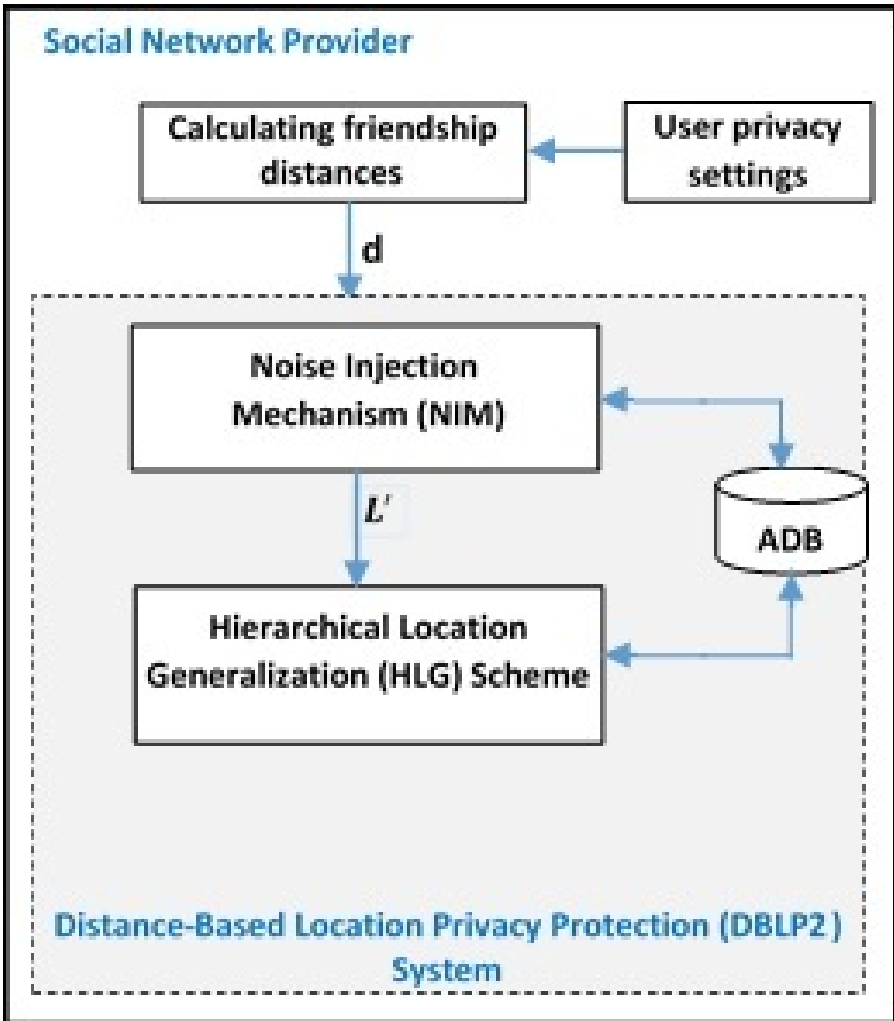
2. Hierarchical Location Generalization (HLG)
Raw noisy coordinates might place you in the middle of a river or a sensitive location (like a clinic) you didn't intend to share. HLG solves this by mapping the noisy point back to a Hierarchical Address Space:
- Building (High Accuracy)
- Street
- Suburb
- City
- State
- Country (High Privacy)
If the noise moves your "sanitized location" outside of your suburb but keeps it within your city, the system will report your location as "Somewhere in Melbourne."
Experiments: Performance Analysis
The authors validated the system by simulating a spectrum of users. They calibrated the regression coefficients () to ensure that for a distance of (Family), the relocation is practically zero (less than 10m).
As the friendship distance increases, we see a clear step-function behavior in location mapping:
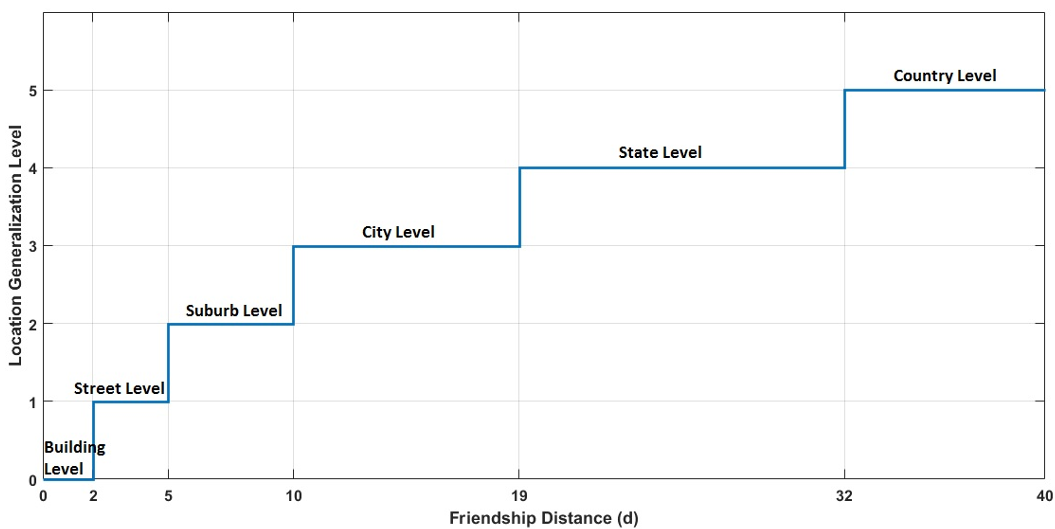
Key finding: Only immediate inner circles receive "Building" or "Street" level data. The "Stranger" category is effectively capped at a "Country" or "State" level, providing the ultimate privacy shield while still allowing the system to log that someone is active in that general region.
Critical Insight & Conclusion
Why this matters
The brilliance of DBLP2 lies in its semantic compatibility. Instead of giving a requester a "fake" coordinate that looks suspicious or broken, it provides a "generalized" truth. This maintains the "social vibe" of the network—you know your friend is in London, but you don't need to know they are at a specific coffee shop.
Limitations & Future Work
The paper assumes a "trusted" social network provider holds the raw data. In an era of increasing distrust in Big Tech, the next evolution of this work would likely involve Local Differential Privacy (LDP), where the noise is added on the user's device before it even reaches the server.
Ultimately, DBLP2 proves that we don't have to sacrifice our social connectivity for the sake of our location security—we just need a smarter, more "distant-aware" way to share.