
Dystemo: Transforming Static Lexicons into Dynamic Emotion Classifiers
15187_o Distant Supervision Method for Multi-Category Emotion Recognition in Tweets.
Dystemo is a distant supervision framework for fine-grained, 20-category emotion recognition in tweets that eliminates the need for manual annotation. It utilizes existing emotion lexicons and a novel Balanced Weighted Voting (BWV) algorithm to achieve a micro-F1 improvement of up to 236% over initial lexicons.
TL;DR
The challenge of teaching machines to recognize fine-grained human emotions usually hits a bottleneck: the "Annotation Wall." In their paper, “Dystemo: Distant Supervision Method for Multi-Category Emotion Recognition in Tweets,” Valentina Sintsova and Pearl Pu break this wall. They present Dystemo, a framework that takes simple emotion lexicons and uses them to "self-train" powerful classifiers on massive, unlabeled Twitter data. By introducing a novel balancing algorithm (BWV), they achieve over 2x performance gains in emotion detection accuracy.
The "Annotation Wall" and Why Hashtags Aren't Enough
Standard supervised learning for emotion recognition is a victim of its own granularity. If you want a model to distinguish between "Pride," "Contentment," and "Joy" (rather than just "Positive"), you need thousands of labeled examples for each.
While some researchers use #hashtags (like #happy) as labels, this approach is limited:
- Sparse Coverage: Only a tiny fraction of tweets (approx. 0.16% in this study) use explicit emotional hashtags.
- Domain Bias: People use hashtags differently in sports vs. politics.
- The Neutral Problem: Most distant supervision ignores "Neutral" tweets, causing models to hallucinate emotions in boring, factual statements.
Methodology: The Dystemo Pipeline
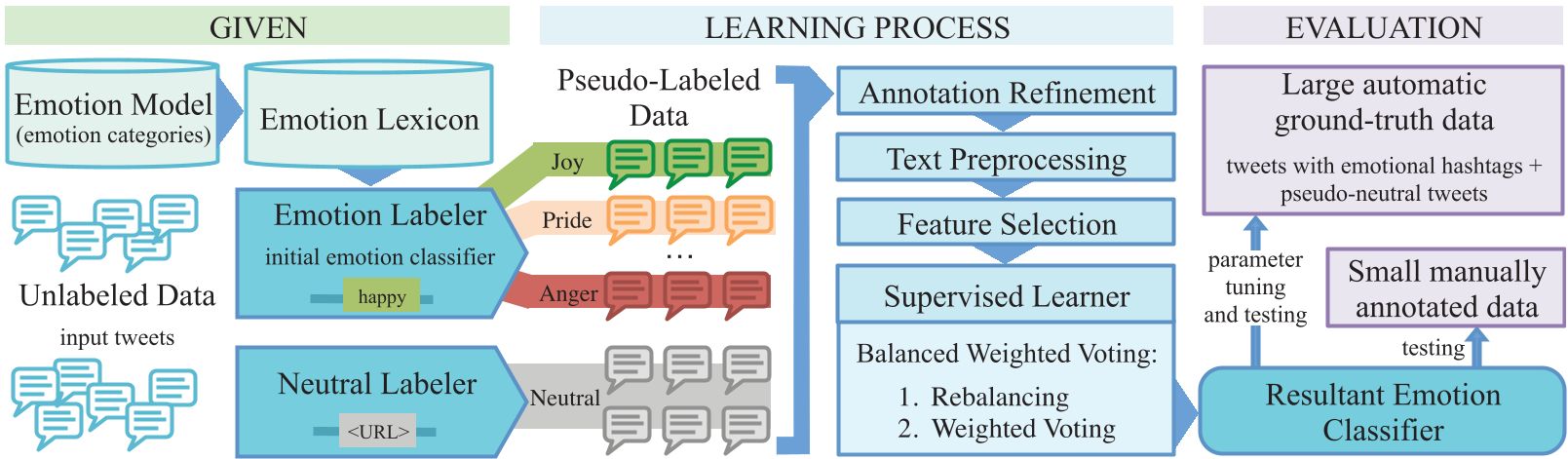
Dystemo treats existing emotion lexicons (like GALC or WordNet-Affect) not as the final solution, but as a seed.
1. Pseudo-Labeling
The system scans millions of unlabeled tweets. If a tweet contains words from the "Pride" lexicon (e.g., "proud"), it is pseudo-labeled as "Pride."
2. Balanced Weighted Voting (BWV)
This is the "secret sauce." In any natural dataset, "Happiness" will likely outnumber "Guilt." A standard classifier would learn to guess the dominant emotion most of the time. BWV introduces a rebalancing coefficient (): By applying a logarithmic penalty to frequent emotions, the model remains sensitive to rare, fine-grained categories.
3. Neutral Heuristics
To stop the model from being "overly emotional," the authors identified neutral tweets using structural cues: the presence of URLs (news sharing) and the absence of personal pronouns or intensifiers (e.g., "!").
Experimental Results
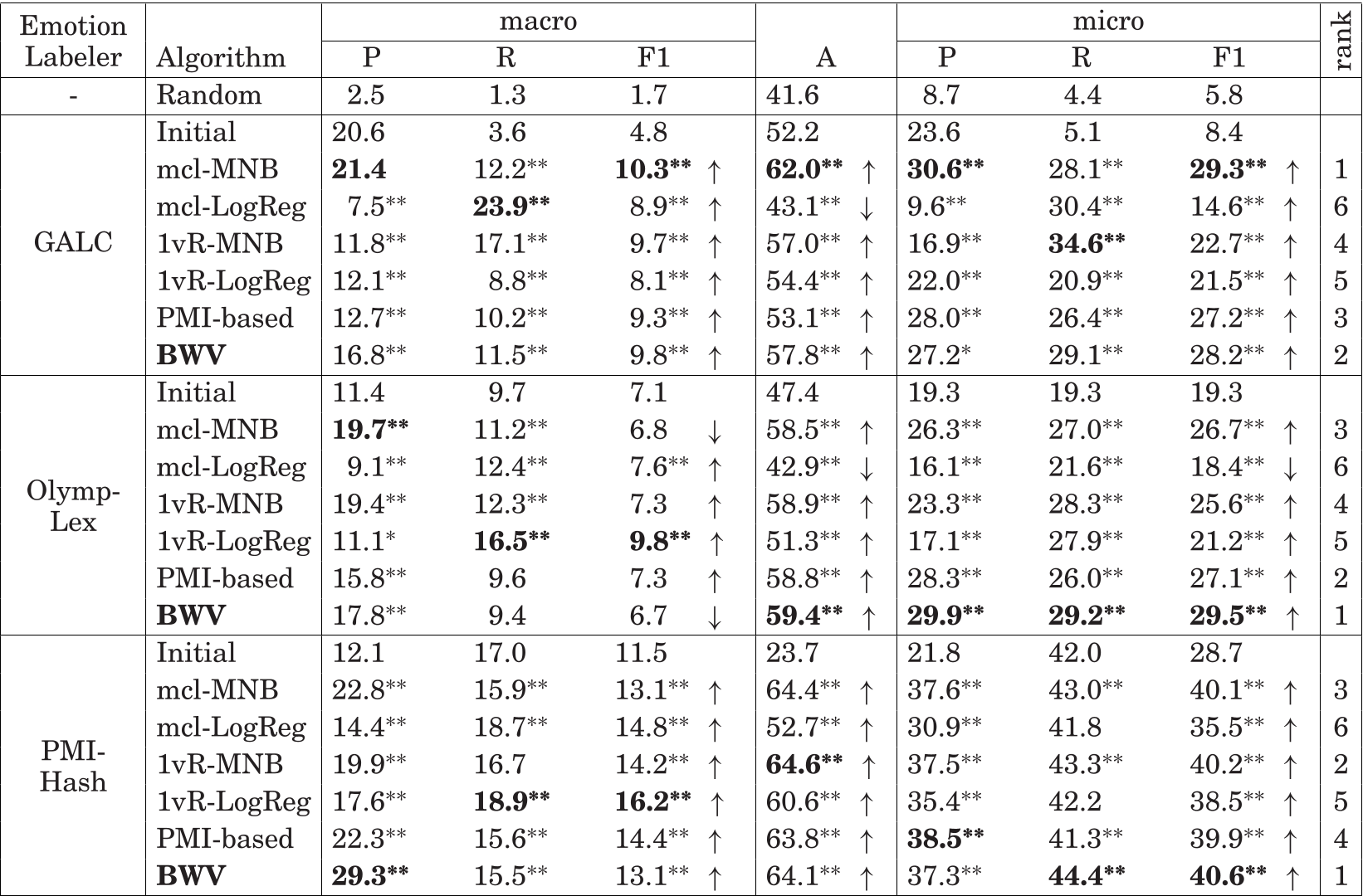
The authors tested Dystemo on a massive dataset of 33.2 million tweets from the 2012 London Olympics, targeting 20 distinct emotion categories based on the Geneva Emotion Wheel (GEW).
- Performance Spike: When starting with the narrow GALC lexicon, Dystemo increased the Micro-F1 score by 236%.
- Precision and Recall: Surprisingly, the method didn't just find more emotional tweets (Recall); it also improved the accuracy of the labels (Precision) by correcting the distributions found in the initial noisy lexicons.
- The Power of Neutrality: Without the "Neutral" training data, accuracy dropped significantly because the model tried to force an emotion onto every news headline it read.
Critical Insight: Why Does This Work?
The brilliance of Dystemo lies in Co-occurrence. If a tweet says, "So proud of Team GB, well done!", and the lexicon knows "proud" = Pride, the algorithm eventually learns that "well done" is also a strong indicator of Pride in a sports context. It dynamically expands its own vocabulary while using BWV to keep the "loudest" emotions from drowning out the "quiet" ones.
Conclusion & Future Outlook
Dystemo proves that we don't always need "Better Data" (expensive manual labels) if we have "Smarter Algorithms" (distant supervision with rebalancing). While the paper focuses on tweets, the logic is universal: any domain with a basic dictionary and a massive pile of text can use this to build a high-fidelity emotion engine.
Limitations to Watch: The model still struggles with complex linguistics like sarcasm or long-range dependencies that simple n-grams can't catch. The next frontier? Combining this distant supervision with Large Language Model (LLM) embeddings for even deeper semantic understanding.