
DGC: Refining the Pulse of Social Networks through Distilled Graph Clustering
Learning Distilled Graph for Large-Scale Social Network Data Clustering
The paper introduces Distilled Graph Clustering (DGC), a novel framework for large-scale social network analysis that merges graph construction and feature selection into an iterative unified process. By leveraging both content and link data, DGC outperforms state-of-the-art methods like NetFS and NDFS in community discovery tasks.
TL;DR
Social network data is notoriously "messy"—users have sparse connections, and their content is filled with irrelevant tags and noise. Distilled Graph Clustering (DGC) solves this by iteratively cleaning the "graph" and the "features" at the same time. It transforms a complex NP-hard problem into a solvable convex optimization, achieving state-of-the-art accuracy on large-scale datasets like Flickr and BlogCatalog while remaining remarkably robust to noise.
The "Noise" Problem in Social Analytics
In modern social network analysis, we typically rely on two signals: Links (who follows whom) and Content (tags, posts, bios). However, both are flawed:
- Content Noise: High-dimensional features often contain "junk" data, leading to the curse of dimensionality where Euclidean distances become meaningless.
- Link Incompleteness: Humans don't have time to connect with everyone they should, leading to a "sparse" and often inaccurate affinity matrix.
Prior SOTA methods usually pick features first and build a graph second (or vice versa). This paper argues that these two tasks are a "chicken and egg" problem that must be solved together.
Methodology: The Art of Iterative Distillation
The core innovation of DGC is the Alternating Distillation Scheme. Instead of using all features to build a static graph, it asks: "Which features best explain the current graph, and which graph best represents these features?"
1. Unified Affinity Matrix
DGC begins by combining the content-based Laplacian () and the link-based Laplacian () using a leverage parameter :
2. Feature Selection via Convex Relaxation
To identify the most "representative" features, the authors map the high-dimensional data to pseudo-labels via a weight matrix . By introducing a binary indicator vector , they formulate a feature selection task. Since binary optimization is NP-hard, they utilize a Convex Quadratically Constrained Linear Programming (QCLP) relaxation and the Cutting-Plane method to solve it efficiently for big data.
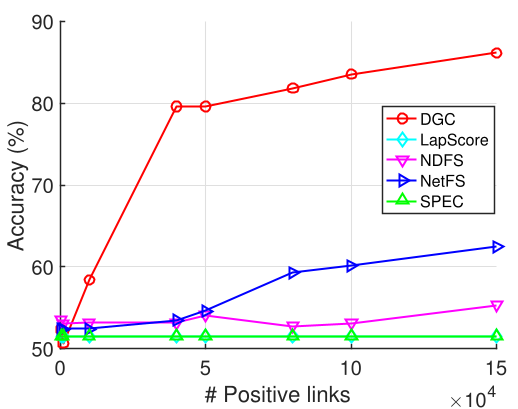 Figure 1: The evolution of the similarity matrix. Note how the graph becomes significantly clearer and more structured from the initial sparse link data to the 10th iteration.
Experiments: Performance Under Pressure
The researchers tested DGC against heavyweights like NetFS and NDFS.
Resilience to Noise
In synthetic tests, the team flooded the system with up to 15,000 noisy features. While baseline algorithms saw their accuracy plummet to random-chance levels (~50%), DGC maintained a robust accuracy of over 85%. This is due to its "distillation" property—it effectively ignores features that do not align with the emerging graph structure.
Real-World Benchmarks
On real social data, DGC consistently outperformed others:
- BlogCatalog: Achieved an Accuracy of 53.98% (a significant margin over LapScore and SPEC).
- Flickr: Reached peak NMI and Accuracy, proving that the synergy between link and content data is more powerful than using either alone.
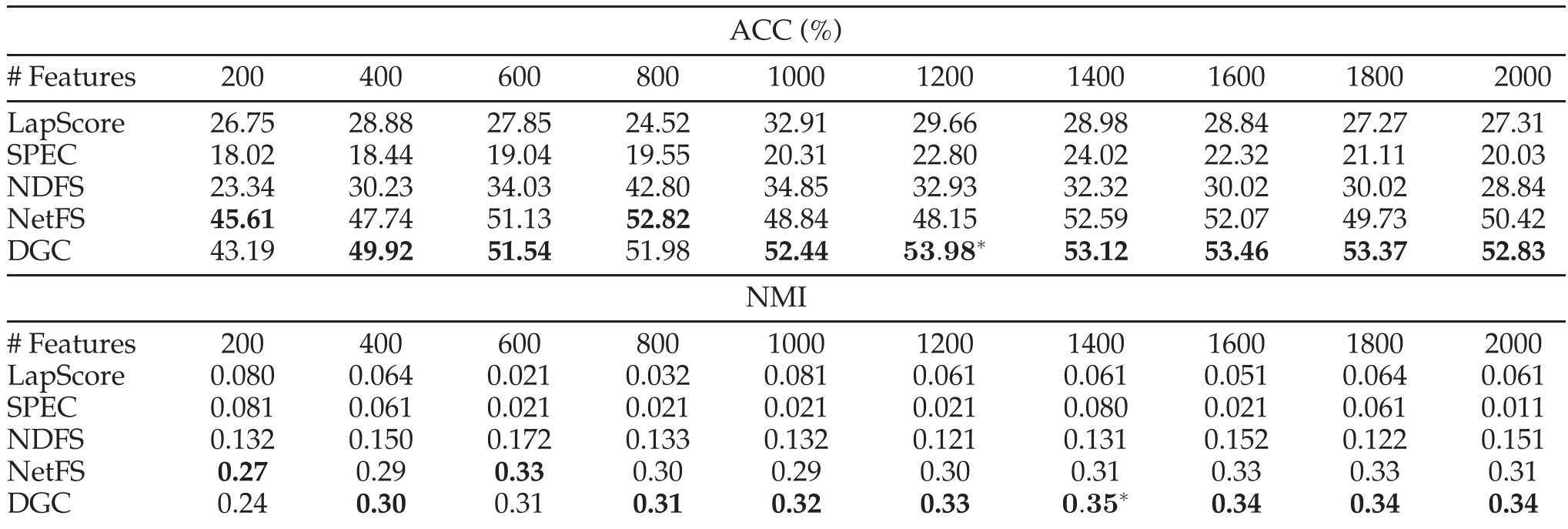 Table 1: Quantitative results on BlogCatalog. DGC (bottom row) consistently leads across various feature counts.
Scalability & Complexity
Computational efficiency is a "make or break" for social network algorithms. DGC utilizes the Accelerated Proximal Gradient (APG) method and Moreau Projection to ensure that each sub-problem is solved in closed-form or highly efficient steps. The total complexity is roughly , which scales linearly with the number of features () and instances (), making it viable for large-scale deployments.
Critical Insight: Why it Works
The "magic" of DGC lies in its ability to use link data as a Regularizer for Content Data. If a tag appears in two nodes that are linked, DGC assigns it higher importance. If a link exists between nodes with vastly different "distilled" features, DGC can eventually treat that link as noise. This bi-directional filtering is what makes the resulting "Distilled Graph" so potent for clustering.
Conclusion
DGC represents a significant step forward in unsupervised learning for networked data. By treating graph construction not as a precursor to clustering, but as a living variable to be optimized alongside feature selection, the authors have provided a robust framework for discovering communities in the noisy, high-dimensional reality of modern social media.