
Refined Social Graphs: Leveraging Distinct Collective Inference for Behavior Prediction
Distinct Collective Inference Learning in Social Networks
This paper introduces a "Distinct Collective Inference" framework for predicting user behavior in social networks by combining graph-based clustering with constrained Laplacian rank learning. By optimizing a similarity matrix to have exactly connected components, the method enables direct extraction of social dimensions for high-accuracy behavioral prediction.
TL;DR
Understanding how individuals influence each other in massive social networks is a cornerstone of modern data science. This paper presents a novel framework that doesn't just look at who is connected to whom, but actively reconstructs the social graph to reveal hidden cliques. By enforcing a mathematical constraint on the graph's "Laplacian Rank," the authors can partition users into distinct clusters with unprecedented accuracy, leading to significantly better predictions of collective behavior.
The Challenge: Noise in the Social Fabric
In a world dominated by platforms like Twitter and WeChat, social networks have become "colossal." However, raw social data is messy—filled with "weak ties," noise, and heterogeneous interactions.
Existing methods, like Edge-Centric Clustering, often struggle because:
- Input Sensitivity: If the initial graph is noisy, the resulting clusters are junk.
- Post-Processing Overhead: Most algorithms require secondary steps (like K-means) to make sense of the groups, which adds latency and error.
The authors' core insight is that we shouldn't take the initial graph at face value. Instead, we should learn a refined similarity matrix that is mathematically guaranteed to reflect the underlying social structure.
Methodology: The Power of Rank Constraints
The heart of this paper is a shift from simple "relational learning" to "structural optimization." The authors utilize a property from Spectral Graph Theory: The number of zero eigenvalues in a Laplacian matrix corresponds exactly to the number of connected components in a graph.
1. Optimization Goal
They seek to find a new similarity matrix that is as close as possible to the original matrix (minimizing the Frobenius norm) while satisfying a strict rank constraint: where is the number of nodes and is the target number of communities.
2. The Workflow
By iterating between updating the similarity matrix and computing the eigenvectors of the Laplacian, the algorithm converges on a graph where the communities are clearly separated.
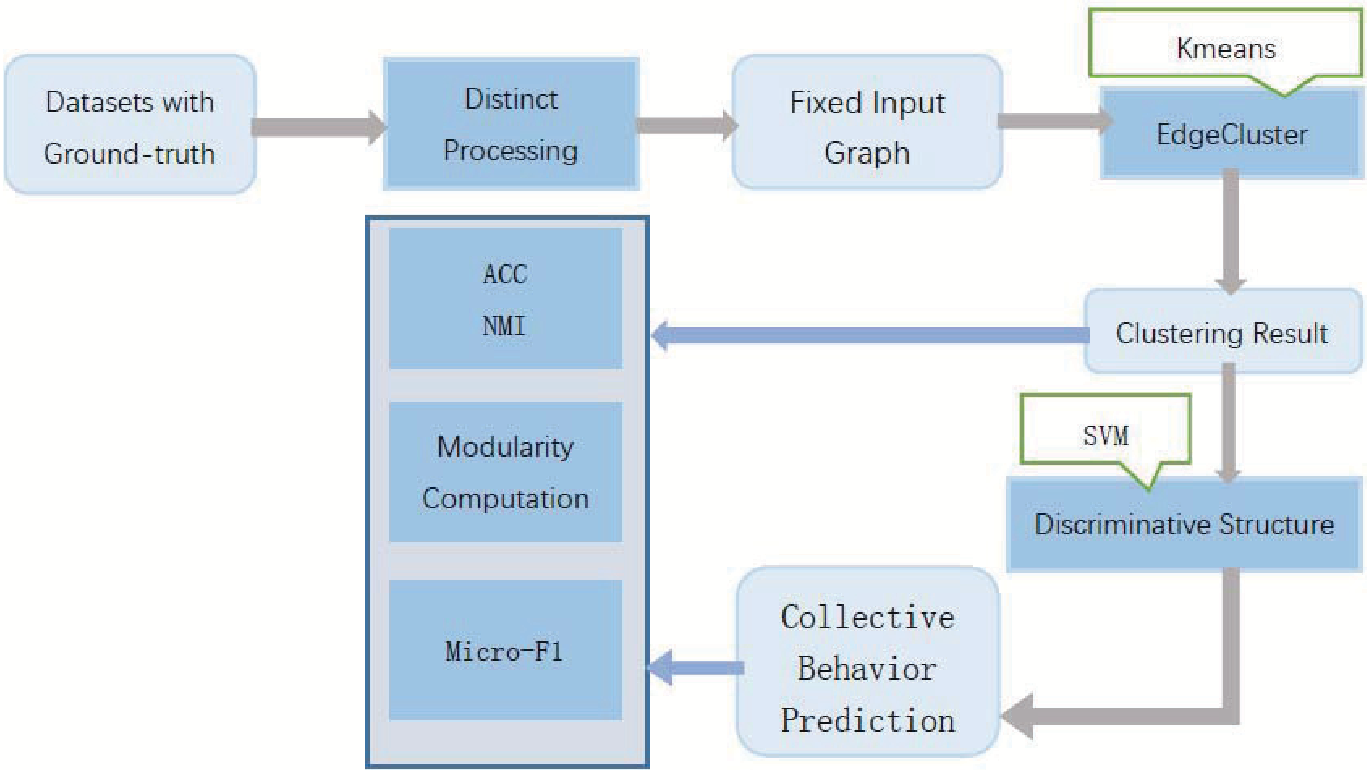 Figure 1: The framework overview showing the transition from raw network data to distinct social groups.
Experiments: Breaking the SOTA
The researchers tested their approach on four classic datasets: football, school6, school7, and dolphins. They measured success using Modularity, ACC (Accuracy), and Micro-F1 scores.
Key Performance Hits:
- Modularity Growth: The proposed method achieved a 44.7% improvement over the standard EdgeCluster on the football dataset.
- Community Detection: On the dolphins dataset, the method achieved a perfect score of 1.0 in both ACC and NMI, suggesting it perfectly recovered the social structure.
| Dataset | EdgeClustering (Modularity) | Our Method (Modularity) | Growth |
|---|---|---|---|
| Football | 0.2814 | 0.4071 | +44.7% |
| School7 | 0.2975 | 0.3608 | +37.2% |
Behavior Prediction
The ultimate test was "Inference"—predicting the labels of unknown nodes based on their social group. As seen in the Micro-F1 results, the blue line (the authors' method) consistently sits above the red line (baseline), especially as more labeled data becomes available.
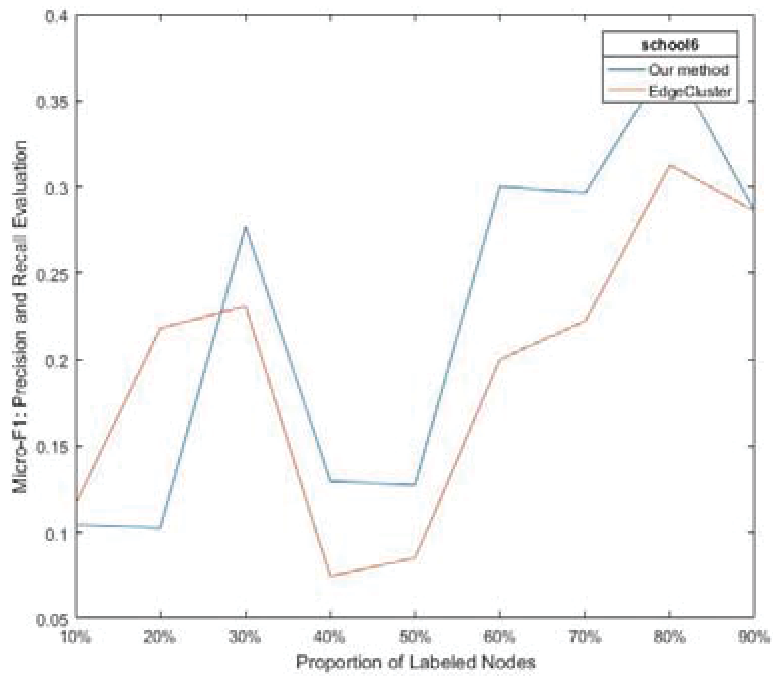 Figure 2: Micro-F1 scores comparison on the Football dataset.
Critical Insight: Why Does This Work?
Most social network algorithms try to find groups within a given structure. This work changes the structure to fit the expected group count. By forcing the rank of the Laplacian, the algorithm effectively "prunes" the noise and "strengthens" the authentic social signals. This is particularly valuable for policy makers or advertisers who need to identify the true influential cores within a sea of superficial social media interactions.
Conclusion & Outlook
This paper proves that structural refinement is just as important as the inference algorithm itself. By simplifying the graph into connected subgraphs at the matrix level, the authors remove the need for expensive post-hoc clustering and improve predictive performance.
Future Directions: While the method is powerful, future work could explore dynamic networks—where social ties appear and disappear in real-time—and how the rank constraint might be updated incrementally without recomputing the entire matrix.