
The Myth of Virality: Why Your Friends Influence You Far Less Than You Think
Distinguishing between Personal Preferences and Social Influence in Online Activity Feeds
This paper presents the Preference-based Matched Estimation (PME) procedure, a statistical method to separate copy-influence (mimicking friends' actions in a feed) from personal preference (homophily) in social networks. By comparing user activity against a "similar stranger" baseline, the researchers tested the method on datasets from Last.fm, Goodreads, Flixster, and Flickr, achieving a new SOTA in observational influence measurement.
TL;DR
Is that new song you "liked" on social media a result of social pressure, or did you just happen to like it because you and your friend have the same taste? This paper introduces the Preference-based Matched Estimation (PME) procedure to answer this. The verdict? Social influence is responsible for less than 1% of actions on platforms like Last.fm and Flickr. Most of what looks like "influence" is actually just two similar people liking the same thing at different times.
The Problem: The "Homophily Trap"
For decades, sociologists and data scientists have struggled to solve a fundamental causal problem: Influence vs. Homophily.
- Influence: User A does something User B sees it and copies it.
- Homophily: User A and B both like Jazz they become friends they both independently listen to a new Jazz album.
If you only look at the correlations (the "locality" of actions), you'll see friends doing the same things and conclude that "influence is everywhere." This work argues that this perspective is fundamentally flawed and treats coincidental similarity as a viral event.
Methodology: The "Similar Stranger" Baseline
The authors propose a clever statistical "hack" to control for personal preference. If we can't conduct a randomized controlled trial (which is often unethical or impossible), we can create a synthetic control group.
The PME Process:
- Preference Proxy: Use a user's past actions to build a preference profile.
- Matching Phase: For every friend a user has, find a "similar stranger" (a non-friend) with the exact same historical taste signature (using Jaccard similarity).
- The Test: Compare the user's "overlap" with their friends' feed vs. their overlap with a simulated feed from these similar strangers.
The logic is elegant: since the user never sees the stranger's feed, any similarity in their actions must be due to personal preference or external factors (like a global marketing campaign). The "gap" between the friend overlap and the stranger overlap is the true measure of influence.
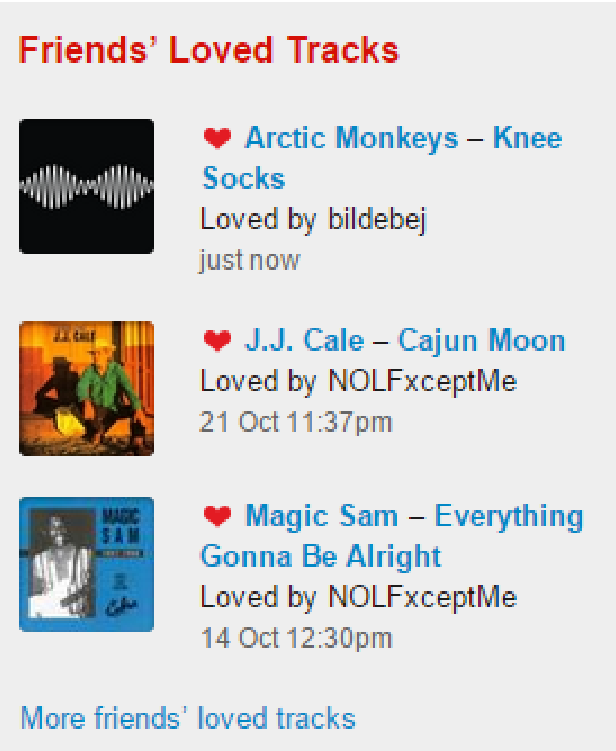 Figure 1: Traditional reverse-chronological activity feed used as the basis for the influence model.
Experiments and Results: A Reality Check
The researchers applied PME to four massive datasets: Last.fm (Music), Goodreads (Books), Flixster (Movies), and Flickr (Photos).
Key Finding 1: Massive Overestimation
Naive estimates (just counting shared actions) suggested that 2-5% of actions were influenced. PME showed the real number was closer to 0.3% to 0.7%.
Key Finding 2: The Domain Matters
- Flickr (High Influence potential): Photos are unique to the platform and "quick" to consume. Here, influence was higher because users couldn't find these photos elsewhere.
- Flixster (Low Influence potential): Movies are "slow" to consume and have massive external marketing. Most people watch movies because of trailers, not because a friend rated them in a feed.
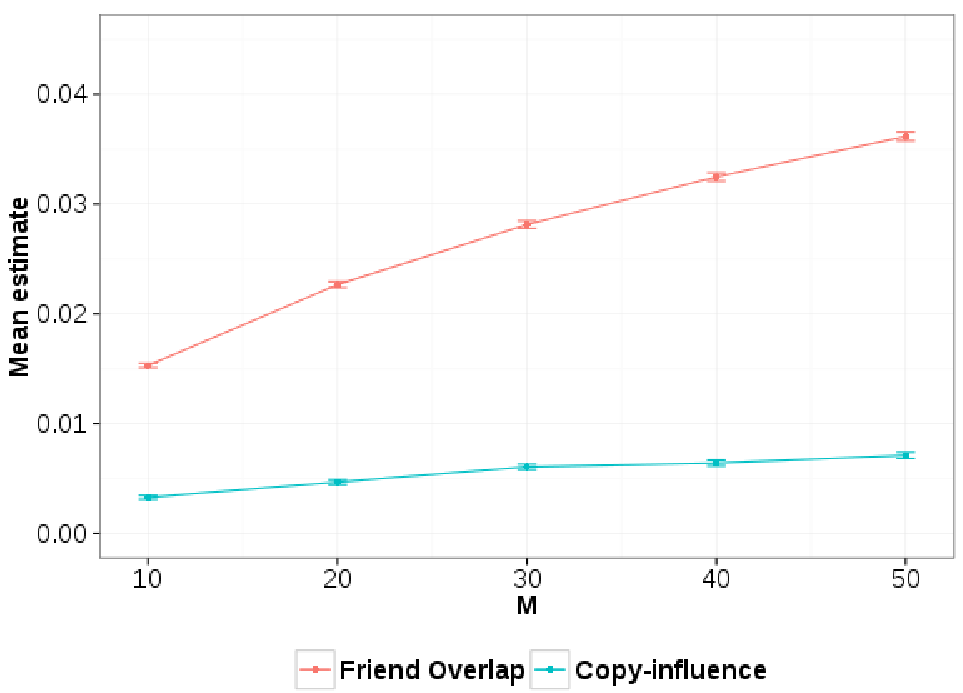 Figure 2: Comparing "Friends-Overlap" (naive) vs. "Copy-Influence" (PME). The gap represents the amount of activity wrongly attributed to social influence.
Critical Insight: Who is actually susceptible?
The paper finds that lower-activity users are most susceptible to influence. Power users, who take hundreds of actions, are driven almost entirely by their own niche tastes. For the average "lurker," a feed might offer content discovery, but for the enthusiast, the feed is mostly "noise" that happens to occasionally overlap with their existing journey.
Conclusion and Practical Takeaways
This work serves as a sobering reminder for product managers and AI researchers:
- Don't over-index on social features: "Friends are doing X" is a weak signal compared to "You have historically liked Y."
- Susceptibility is a feature, not a constant: Influence models should be personalized. Some users are "copycats," but 75% are "islands."
- The Design Matters: The more "focal" and "unique" the item (like Flickr photos), the more the feed actually matters.
Ultimately, the "viral spread" of behaviors is a rare exception, not the rule. Most of our digital lives are lived according to our own internal compasses, not the shifting tides of our social feeds.
Limitations: The study assumes a reverse-chronological feed. In 2024, most feeds are algorithmically ranked (TikTok, Instagram), which arguably creates a "double-loop" of bias where the algorithm itself creates the homophily it then exploits.