
Beyond Blind Trust: Using Graph Algorithms to Refine Social Recommendation
Distinguishing Social Ties in Recommender Systems by Graph-Based Algorithms
This paper introduces a social recommendation framework that distinguishes the varying influence of social ties using graph-based algorithms. By integrating PageRank, HITS, and Heat Diffusion into Probabilistic Matrix Factorization (PMF), the authors achieve State-of-the-Art (SOTA) performance on the Epinions dataset.
TL;DR
Not all friends are created equal, yet most recommender systems treat them that way. This paper proposes a systematic approach to distinguish social influence by ranking friends using PageRank, HITS, and Heat Diffusion. By embedding these global influence scores into Probabilistic Matrix Factorization (PMF), the researchers significantly improved rating prediction accuracy on the Epinions dataset.
Background & Motivation: The Flaw of Equality
The core assumption of social recommendation is that our tastes are influenced by our friends. However, traditional models suffer from two major oversights:
- Binary Simplification: They treat every social connection as a simple 0 or 1, ignoring that an "expert" friend's opinion should carry more weight than a casual acquaintance.
- Local Myopia: Even models that use local similarity (like PCC) fail to account for influence propagation. A friend of a friend who is a known authority in a field still exerts indirect influence that simple local metrics cannot capture.
Methodology: Ranking Influence via Graph Topology
The authors solve this by treating the social network as a directed graph where influence "flows." They employ three classic graph-based paradigms:
1. PageRank & HITS (Centrality-Based)
These algorithms identify "authoritative" nodes. In PageRank, influence is transferred via random walks, while HITS identifies "Hubs" and "Authorities." If your friend is an authority in the global network, their influence on your recommendations is boosted.
2. Heat Diffusion (Flow-Based)
Inspired by thermodynamics, this model simulates heat (influence) flowing from one node to another through "pipes" (social ties). This captures the nuances of how influence dissipates or concentrates across the network over time.
3. Integration with PMF
The crucial step is mapping these graph scores to the PMF objective function. The authors use a power-law distribution to convert the rank () into a trust value (): This ensures that only a small percentage of top-ranked friends dominate the influence, mimicking real-world social dynamics.
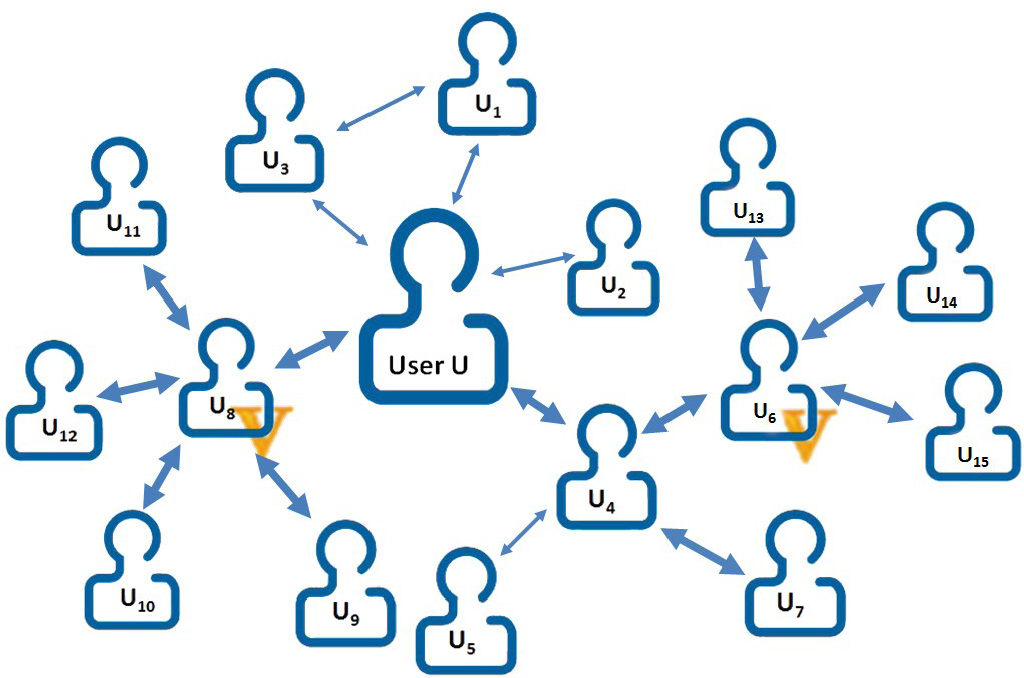 Figure 1: Illustration of how an expert user (V) should exert more influence than others in a social tie network.
Experimental Validation
Using the Epinions dataset, the authors compared their graph-based models against standard PMF and basic social recommendation models.
Key Findings:
- Consistent Improvement: All graph-based variants (PageRank, HITS, HD) outperformed the baselines.
- The Power of PCC-HD: The best results came from "PCC-HD," which combines local Pearson Correlation (PCC) with global Heat Diffusion. This suggests that the ideal trust metric combines how similar we are with how important you are globally.
- Cold-Start Resilience: The graph-based models showed the most significant gains for users with very few ratings (1-10), proving that social structure can effectively compensate for a lack of personal data.
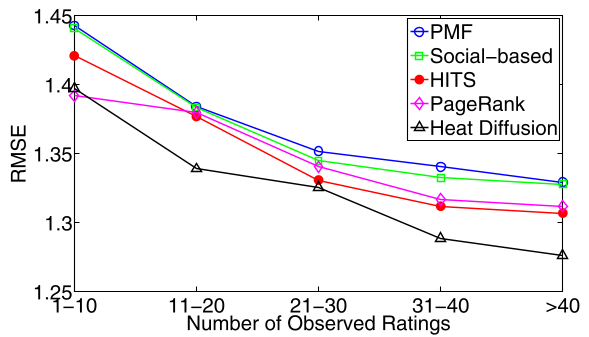 Figure 2: Performance gains are most pronounced for users with low rating counts, highlighting the model's ability to solve the cold-start problem.
Critical Insight & Future Directions
The primary value of this work lies in its move from social presence to social influence. By looking at the global "social graph" rather than just "social neighbors," the model filters out noise from less relevant connections.
Limitations:
- Complexity: Graph-based algorithms like Heat Diffusion are computationally expensive on massive scales.
- Context: The model assumes global influence is static; however, a friend might be influential in "Electronics" but irrelevant in "Fashion."
Future Outlook: Integrating these graph-based rankings with Graph Neural Networks (GNNs) could allow for a more dynamic, feature-rich representation of influence that evolves with user behavior.