
Distributed Access Control: Solving the 172 Trillion Entry Problem in Social Networks
Distributed access control for social networks
The paper proposes a distributed access control model designed specifically for Social Networking Sites (SNS). By shifting management from a central authority to individual users (Stakeholders), it introduces a system of Namespaces, Local Roles (LR), and Object Classes (OC) to handle the massive scalability and privacy demands of millions of users.
TL;DR
Managing privacy on a platform with 800 million users and billions of photos is a technical and social nightmare. This paper proposes moving away from "centralized gatekeepers" to a distributed model where every user manages their own "Namespace." By using local roles and object classes, the researchers demonstrated a way to reduce access control complexity from 28 trillion entries to 3 trillion, all while giving users the fine-grained social control they actually want.
Background: The Socio-Technical Gap
In social networking, an "error" isn't just a technical crash—it’s a social catastrophe. If a system fails to hide a private photo from the wrong person, it results in public outrage and lost trust. Traditional models (like MAC or RBAC) are built for organizations with thousands of employees, not platforms like Facebook. The authors argue that current systems fail because of the socio-technical gap: the distance between what users socially expect (ownership) and what technology provides (rigid, system-wide roles).
The Core Innovation: Namespaces and Local Roles
Instead of one massive matrix mapping every user to every photo, the authors propose a distributed architecture.
1. Stakeholder Namespaces
Every user who posts content (the Stakeholder) owns a private Namespace. Within this space, the owner is the ultimate authority.
2. Local Roles (LR)
Forget generic "Friends" or "Public" tags. In this model, Alice can define "Friday Night Buddies" or "Extended Family" specifically for her domain. These roles don't exist outside her namespace, preventing role explosion at the system level.
3. Object Classes (OC)
Resources are grouped based on privacy clearance. Rather than mapping a user to a specific photo, the system maps a Local Role to an Object Class (e.g., "Best Friends" can view "Private Gallery").
 Figure 1: The architecture demonstrates how Policy Decision Points (PDP) are distributed to the user level.
Security via Distributed Certificates
A major concern in decentralized systems is forgery. How do we know Bob is actually Alice’s "Friend"? The paper solves this with Client-Side Attestation Certificates. When Alice grants Bob a role, a local certificate is stored in her namespace. Because it is local and under her control, it is unforgeable. Access decisions are made by matching the requester's ID against these local roles in real-time.
Efficiency: Numbers That Matter
The technical brilliance of this work lies in its reduction of the "Authorization Matrix."
- Traditional DAC: Subject × Object × Rights = 172 Trillion entries (for Facebook-scale data).
- Proposed Model: Summarized as .
By localizing the relationship check to only the user's "Social Circle," the search space collapses.
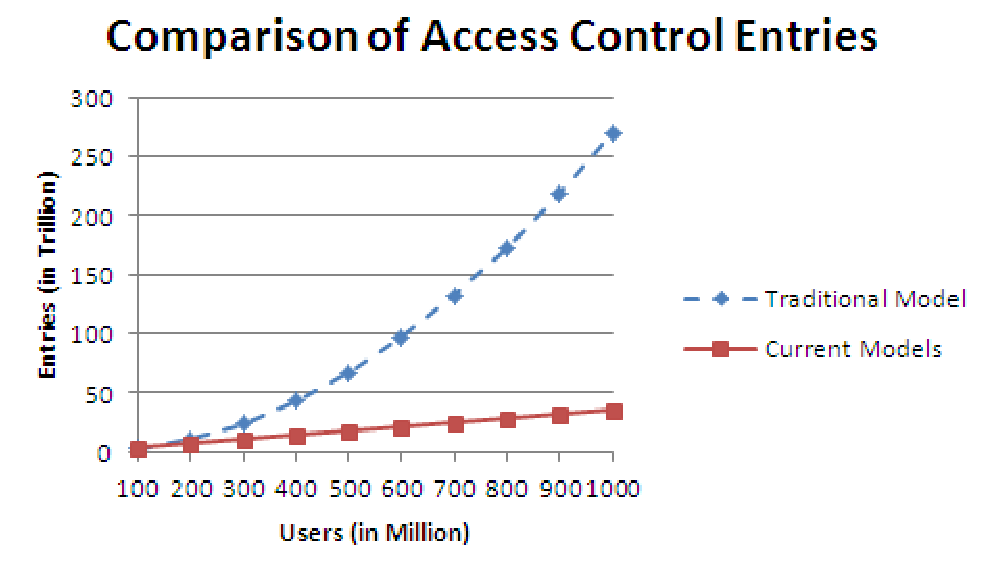 Figure 2: Magnitude comparison show the drastic reduction in access control entries as user numbers grow.
Final Insights
This paper reminds us that as systems scale, centralization is the enemy of both efficiency and privacy. By empowering the "edges" of the network—the individual users—we can create systems that are technically leaner and socially more intuitive.
Limitations: The model assumes users are willing to put in the effort to manage their own roles (the "Usability" challenge). Future work likely needs to focus on how AI or templates can help users manage these "Local Roles" without adding cognitive load.
Takeaway: The future of the social web isn't bigger servers; it's smarter, distributed authority.