
Distributed ACO: Leveraging Crowdsourcing to Solve Continuous Multiobjective Problems
Distributed ACO based on a crowdsourcing model for multiobjective problem
This paper introduces a distributed Ant Colony Optimization (ACO) algorithm tailored for continuous Multiobjective Optimization Problems (MOPs) by integrating a crowdsourcing-inspired decomposition model. The approach, based on MOEA/D principles, successfully approximates the Pareto Front for the KUR test problem by distributing subtasks across a network of collaborative nodes.
TL;DR
This research presents a novel framework that bridges Ant Colony Optimization (ACO) and Crowdsourcing to tackle continuous Multiobjective Optimization Problems (MOPs). By decomposing a complex MOP into simpler single-objective subtasks distributed across a network, the authors achieve a robust approximation of the Pareto Front, specifically optimized for continuous domains.
Background: The Scalability Wall in MOPs
Multiobjective Optimization usually involves internal conflicts—improving one objective often degrades another. Traditionally, Evolutionary Algorithms (MOEAs) have been the go-to solution. However, as we move from discrete tasks (like the Knapsack Problem) to Continuous MOPs, the search space becomes infinite. A single machine often struggles with the computational load required to find a diverse and accurate Pareto Front.
The authors identify a synergy between Decomposition-based algorithms (MOEA/D) and Crowdsourcing models, where a massive task is solved by the "wisdom of the crowd"—or in this case, the collective power of distributed CPUs.
Methodology: Innovation Through Decomposition
The core of the paper lies in three strategic enhancements to the standard ACO process:
1. Discretization and Decomposition
The continuous domain is first discretized using a stride length . Then, the Tchebycheff approach is used to decompose the MOP into scalar optimization subproblems, each defined by a unique weight vector.
2. The PersonalScope Strategy
To prevent ants from wandering uselessly in a "massively wide" domain, the authors introduced PersonalScope. Each ant is restricted to a subset of the domain.
- Top-performing ants keep their scope.
- Underperformers must adapt or inherit scopes from the "elite" ants. This introduces a selection pressure similar to natural evolution, focusing the search on promising regions.
3. Predictive Heuristic Factor
Standard ACO requires a heuristic value () to make probabilistic choices. In continuous MOPs, calculating for a partial solution is difficult. The authors propose a Predictive Method: using the current best-known solution of the colony to "fill in the blanks" of a partial ant path, allowing for an immediate estimation of the objective value.
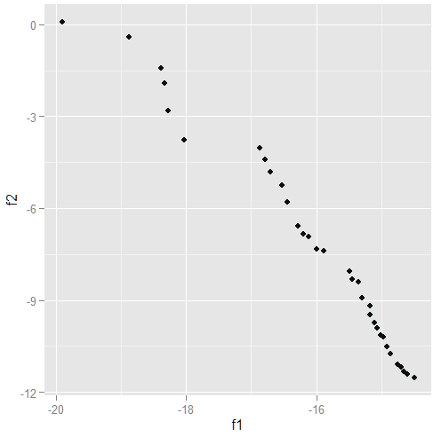 Fig 1: The Process Model showing roles of Crowdsourcer, Task Manager, and the Crowd.
Distributed Infrastructure
The paper simplifies the crowdsourcing model into four roles:
- Crowdsourcer: Defines the MOP.
- Task Manager: Decomposes the task and manages neighbors.
- Crowd: Distributed threads/machines that run the ACO process on specific subproblems.
- Evaluation Engine: Aggregates results to form the final Pareto Front.
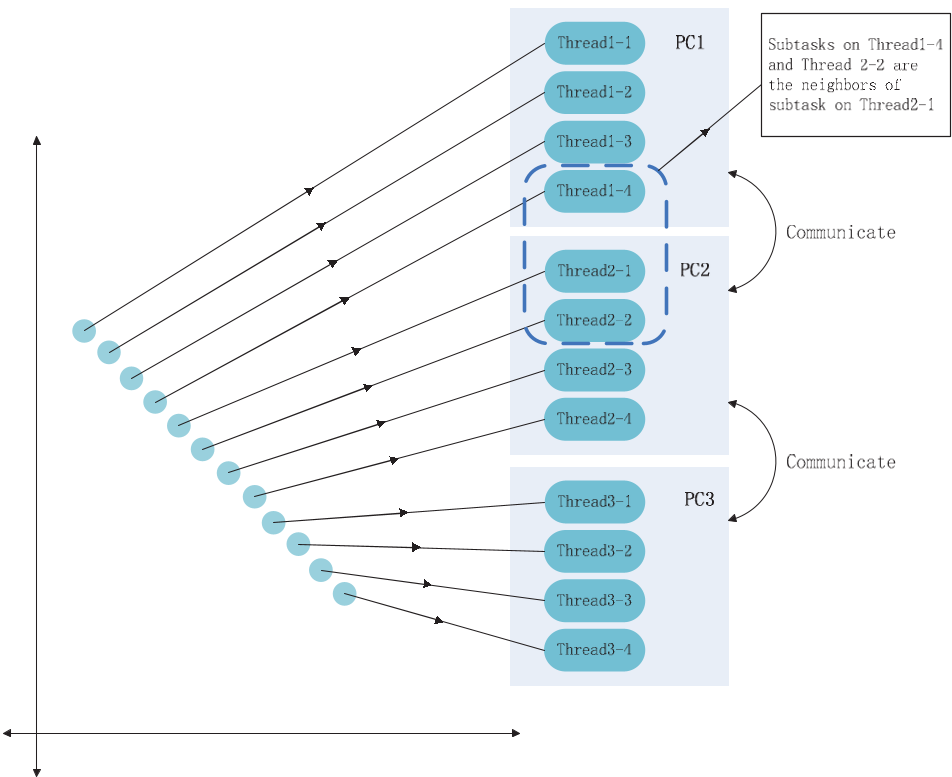 Fig 2: Visualization of how individual threads contribute to the global optimization goal.
Experimental Validation: The KUR Problem
The team tested their approach on the KUR problem, a well-known benchmark for continuous MOPs.
Key Results:
- Hardware: 6 computers (30 subtasks each).
- Total Time: ~321 seconds.
- Outcome: The algorithm successfully converged to a representative Pareto Front.
One interesting finding was the Solution Diminution phenomenon. As iterations progressed, many subproblems converged to solutions shared by their neighbors. While this improved local optimization, it actually reduced the total number of unique non-dominated solutions in the global set (as shown in the figure below).
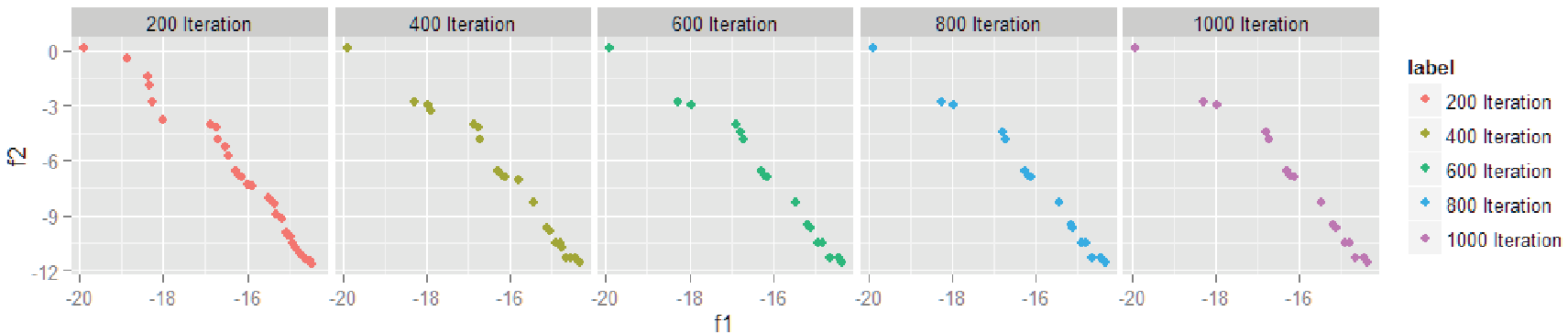 Fig 3: The reduction of unique non-dominated solutions over iterations (200 to 1000).
Critical Insight & Conclusion
The study proves that ACO is not just for the Traveling Salesman Problem; with the right discretization and decomposition, it is a powerhouse for continuous optimization.
Future Outlook: The "diminution" of solutions suggests that in distributed optimization, we should harvest "intermediate" good solutions frequently, rather than just waiting for the final convergence. This "early harvesting" could prevent the loss of diverse Pareto candidates that are globally non-dominated even if they aren't the local optima for a specific sub-task.
Ultimately, this work provides a practical blueprint for deploying swarm intelligence across distributed networks to solve the world's "dilemma-style" decision problems.