
Efficient Distributed Routing through Optimized Virtual Linkage
18016_Distributed Algorithm for Big Data Analytics in Healthcare.
The paper introduces a novel decentralized Peer-to-Peer (P2P) network topology management algorithm designed to optimize routing efficiency in distributed server environments. By utilizing a binary key-based virtual linking strategy and a greedy distance-reduction routing protocol, the method achieves logarithmic hop complexity for resource discovery.
TL;DR
This research presents a decentralized algorithm that transforms how servers in a P2P network identify and link with neighbors. By establishing "virtual links" based on binary key hierarchies, the system reduces the search space for resources from linear complexity to a near-logarithmic scale, ensuring that even in massive clusters, any server can be reached in a handful of hops.
Problem & Motivation: The Scalability Wall
In large-scale distributed systems, the "Search Problem" is the ultimate bottleneck. If Server A needs data from Server Z, how does it find it without asking every other server in between?
- Unstructured Networks: Easy to maintain but require "flooding" requests, which kills bandwidth.
- Structured Networks: Efficient routing but usually require rigid, complex maintenance protocols that break when servers join or leave frequently (churn).
The authors identified that the root cause of inefficiency is the lack of "smart shortcuts." Without a logical way to choose neighbors, a message essentially wanders the network blindly.
Methodology: High-Low Linking Strategy
The proposed solution centers on an elegant iterative sorting and linking process.
1. The Virtual Linkage Logic
As shown in Algorithm 1, each server maintains two lists:
- Llist: Peers with binary keys lower than its own.
- Hlist: Peers with binary keys higher than its own.
Instead of linking to anyone, the algorithm identifies the "extreme" values (Minimum and Maximum) within these lists and creates virtual connections. This mimics the behavior of a Balanced Binary Tree, where a node has links to both close neighbors and distant "hubs."
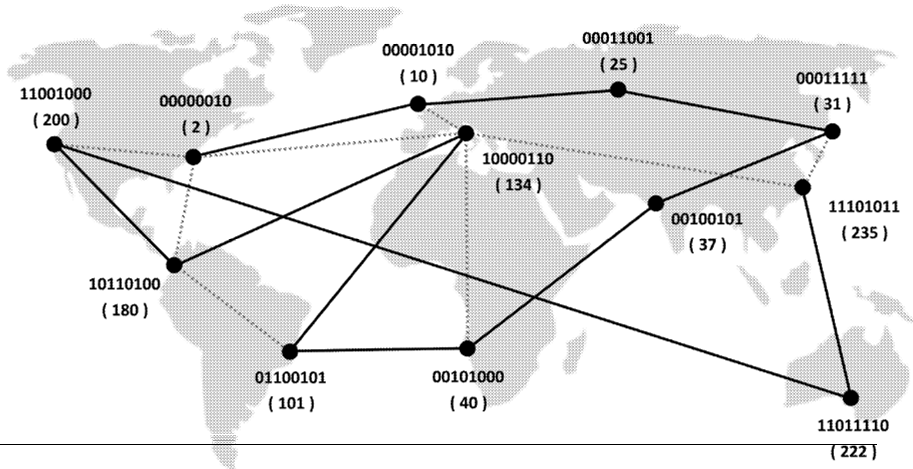
2. Greedy Distance-Reduction Routing
When a request is initiated, the server looks at its neighbors and calculates the binary distance to the target ID. It always forwards the message to the neighbor that minimizes this distance.
Experiments & Results: Navigating the Cluster
The effectiveness of this approach is visualized through routing traces. In a sample experiment, a request originating at Server 101 searching for Server 222 successfully navigated the network in only 3 steps:
| Step | Current Server | Best Neighbor Selected | Distance to Target |
|---|---|---|---|
| 1 | 101 | 180 | 42 |
| 2 | 180 | 200 | 22 |
| 3 | 200 | 222 | 0 (Reached) |
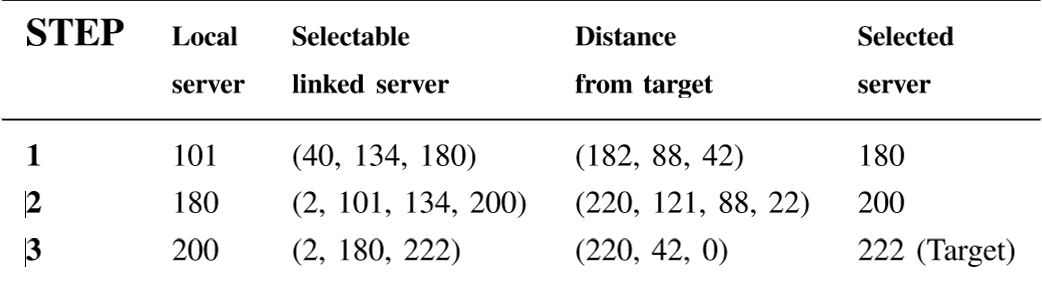
The authors also formulated the relationship between the number of servers and the expected hop count: This formula indicates that as the network grows, the routing overhead increases much slower than the population of the network, proving the system's scalability.
Critical Analysis & Conclusion
Takeaway
The beauty of this method lies in its simplicity. By merely observing the binary ID space and connecting to the "edges" of its local knowledge, a server contributes to a global geometry that is highly navigable.
Limitations
- Binary ID Distribution: If the IDs are not uniformly distributed (e.g., clustered IDs), the "virtual links" might become unbalanced, leading to hotspots.
- Static vs. Dynamic: While the algorithm handles joins/leaves, the overhead of re-calculating the and during high churn needs further quantification.
Future Outlook
This mechanism is a strong candidate for Edge Computing scenarios where devices have limited memory and cannot store a full global routing table. By using this "binary shortcut" logic, edge nodes can maintain connectivity with minimal local state.