
PCC: Decoding Social Hubs through Distributed Spectral Intelligence
A Distributed Algorithm for Identifying Information Hubs in Social Networks
This paper introduces Principal Component Centrality (PCC) and a distributed version using the Kempe-McSherry (KM) algorithm to identify top-k information hubs in social networks. By leveraging friendship graph structures, the method accurately predicts interaction-based hubs without requiring centralized access to private user data, achieving SOTA results on massive Facebook and Twitter datasets.
TL;DR
Researchers have developed a privacy-preserving, distributed algorithm to find the most influential "hubs" in social networks like Facebook and Twitter. By using Principal Component Centrality (PCC) and decentralized spectral decomposition, this method allows third parties (like advertisers) to identify top influencers using only friendship connections—without ever seeing private message logs—achieving up to 50% better accuracy than traditional methods.
Background: The Hub Identification Dilemma
In the digital age, "information hubs" are the gatekeepers of viral trends and brand sentiment. However, identifying these hubs accurately is a privilege usually reserved for platform owners (like Meta or X). Third-party advertisers often have to rely on "friendship graphs" which are static and undirected, whereas the true "influence" happens in "interaction graphs" (who actually talks to whom).
The technical challenge is: How do we infer dynamic influence from static structure without violating user privacy or requiring a central supercomputer?
The Insight: Beyond the Principal Eigenvector
Traditional social metrics like Eigenvector Centrality (EVC) (the foundation of PageRank) have a major flaw: they are "pulled" toward the single largest community in a network. In a multi-polar social network with many distinct cliques, EVC ignores influential people in smaller but highly active communities.
The authors' core insight is that social networks are high-dimensional. Instead of looking at just the first (principal) eigenvector, we should look at the top eigenvectors. This is the logic of Principal Component Centrality (PCC).
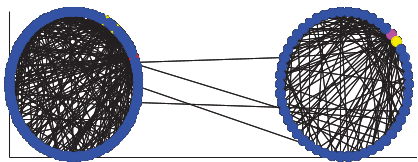 In the figure above, (a) shows how EVC only finds the main cluster. As we increase P (b, c), PCC reveals hubs in smaller, isolated communities.
Methodology: Privacy through Decentralization
To make this practical and private, the researchers utilized the Kempe-McSherry (KM) algorithm.
- Local Computation: Each node (user) only talks to its neighbors.
- Iterative Refinement: Nodes exchange numeric vectors that represent intermediate spectral scores.
- Privacy: These numbers are abstract and cannot be reverse-engineered to reveal who is friends with whom.
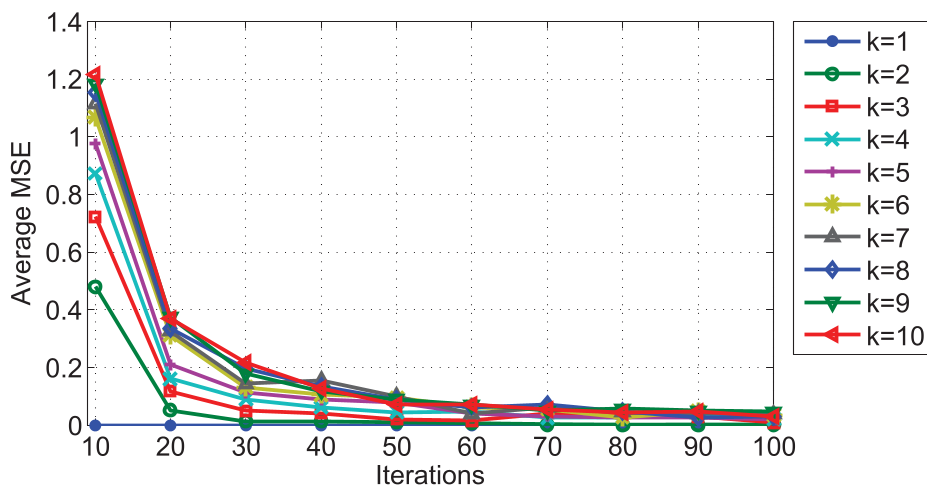 The KM algorithm shows near-perfect convergence (Mean Squared Error) in a limited number of iterations, making it scalable for millions of users.
Experimental Results: Proving the Correlation
The authors tested PCC on three massive datasets:
- Facebook A & B: ~6 Million users, 40M links.
- Twitter: ~2 Million users (using Generalized PCC for directed "follow" links).
Key Performance Metrics:
- Accuracy: Found 50% more "ground truth" hubs (verified by actual interaction data) compared to standard EVC.
- Ranking Precision: The distance between projected ranks and actual interaction ranks (using a custom distance metric ) was minimal, especially for long-term data.
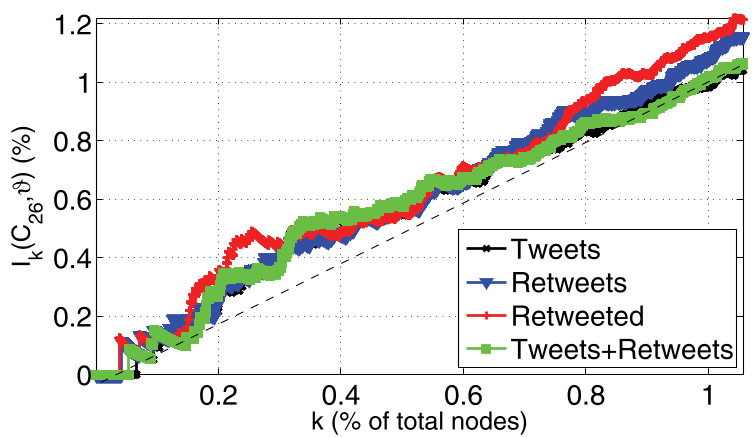 The overlap with real-world activity increases significantly as more eigenvectors (P) are included in the PCC calculation.
Critical Analysis & Future Outlook
Takeaway: This work proves that the "friendship graph" is a surprisingly strong proxy for "real interaction," provided you use the right mathematical lens (PCC). It bridges the gap between graph theory and practical advertising.
Limitations: While highly effective for Facebook's reciprocal friendships, the performance on Twitter (one-way follows) was less dramatic. This suggests that "following" someone is a weaker indicator of information flow than "being friends" with someone.
Future Work: Integrating this decentralized spectral approach with modern Graph Neural Networks (GNNs) could likely push accuracy even further, creating a truly autonomous, privacy-preserving influence-mapping engine.
Conclusion
By moving from 1D centrality to multi-dimensional spectral analysis, the authors have turned local friendship data into global influence intelligence. For advertisers and sociologists, this is a blueprint for non-invasive social discovery.