
Decentralized Trust: Re-imagining TrustWebRank for Distributed Social Networks
A Distributed Algorithm for Personalized Trust Evaluation in Social Networks
This paper introduces a distributed version of the TrustWebRank metric, a personalized trust evaluation algorithm for social networks. By leveraging a local-exchange mechanism and iterative matrix approximation, the method achieves decentralized trust computation, significantly validated on the Epinions.com dataset with over 55,000 nodes.
TL;DR
Scaling trust in a massive social network is a balancing act between Global Centrality (everyone agrees on who is trustworthy) and Local Subjectivity (trust depends on who you ask). This paper presents a distributed implementation of TrustWebRank, moving away from centralized "Master-Nodes" to a peer-to-peer model where trust propagates through local neighbors. Tested on the Epinions dataset, it converges in fewer than 20 iterations for practical accuracy.
The Core Conflict: Centrality vs. Locality
In the early days of web reputation, algorithms like EigenTrust (derived from Google's PageRank) dominated. These systems assign a single "global reputation" to every user. However, as the authors argue, real-world trust is local.
If Alice trusts Bob, and Bob trusts Charlie, Alice might trust Charlie. But Alice's trust in Charlie is unique to her perspective. Centralized models suffer from:
- Flattening: Normalization often hides the actual intensity of trust.
- Global Bias: A single score cannot capture the nuanced trust relationships in diverse social networks.
- Bottlenecks: Calculating an matrix centrally is computationally prohibitive for large networks.
Methodology: Trust as a Distributed Conversation
The authors transform the static TrustWebRank formula into a dynamic, message-passing algorithm.
The Convergence Logic
The algorithm relies on an iterative process where node calculates its trust in node () based on its direct relationship with neighbor and 's reported trust in .
Where:
- : Normalized direct trust experience.
- : A decay factor (ensuring direct experience weighs more than gossip).
- Local Residual (): A threshold used by each node to decide when to stop updating (local convergence).
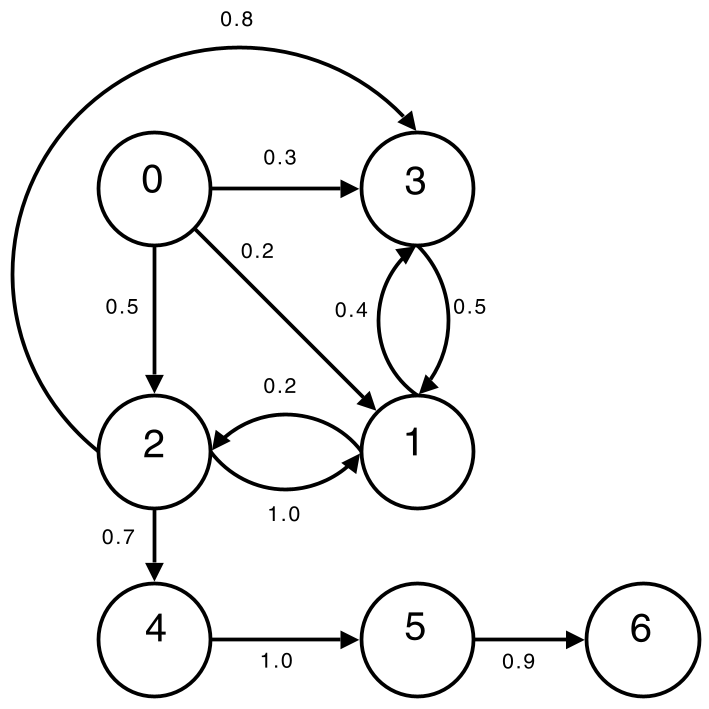 Figure 1: The illustration shows how trust "flows" from direct neighbors to distant nodes through successive iterations.
Experimental Evidence: Reality Check via Epinions
The authors utilized a real-world dataset from Epinions.com, involving 55,105 nodes and 549,133 edges. This is a significant stress test for any distributed algorithm.
1. High-Speed Convergence
One of the most impressive findings is the speed of convergence. While the "mathematical" convergence (error < 0.001) takes about 60 iterations due to the presence of high-degree hubs, a "functional" convergence (error < 0.1) is achieved in under 18 iterations.
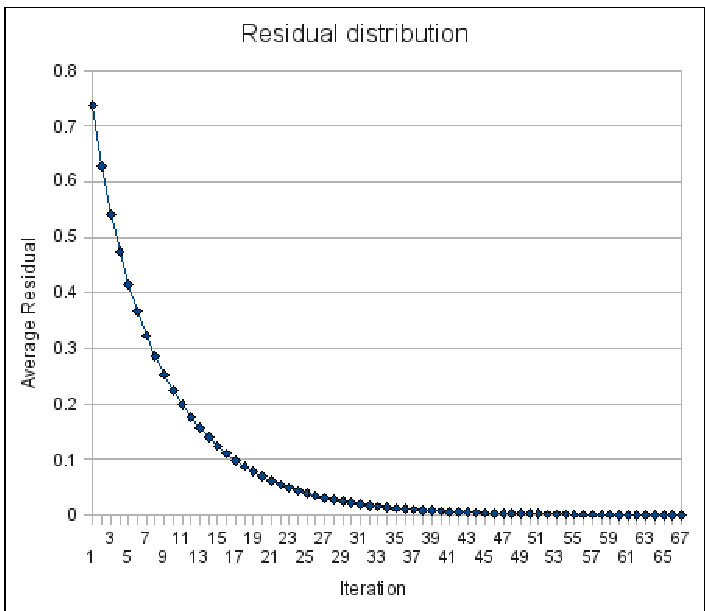 Figure 2: The rapid drop in average residual indicates the algorithm is highly responsive to the network state.
2. The Traffic Challenge
While the algorithm solves the computation bottleneck, it introduces a bandwidth bottleneck. Because Epinions follows a power-law distribution, a tiny fraction of nodes (0.6%)—the "hubs"—end up exchanging over 80% of the total trust values (TVs).
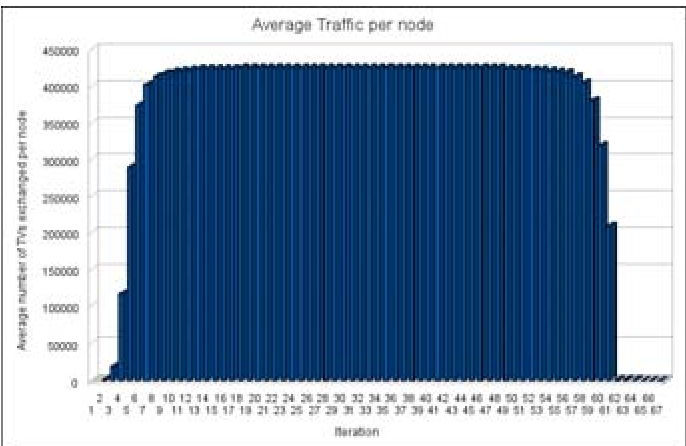 Figure 3: Traffic distribution highlights the uneven load on hub nodes.
Critical Insights & Future Outlook
The transition from a centralized O(N²) problem to a distributed iterative problem is a major win for scalable social systems. However, the study leaves us with a critical takeaway: The "Hub Problem" in Social Graphs.
Key Takeaways:
- Personalized Trust is Scalable: You don't need a global viewpoint to get accurate trust rankings.
- Network Topology Matters: In scale-free networks (like Epinions or Twitter), distributed algorithms must implement "smart pruning" to prevent hub nodes from being overwhelmed by message traffic.
Future Work: The authors suggest pruning "meaningless" messages—those coming from nodes too far away or with trust values near zero. This would likely drastically reduce the traffic load seen in Figure 3 without sacrificing the accuracy of the personalized trust evaluation.