
Scaling the Social Graph: Distributed Client-Server Assignment in OSNs
Distributed Client-Server Assignment for Online Social Network Applications
The paper addresses the "Distributed Client-Server Assignment" problem in Online Social Networks (OSNs), proposing heuristic algorithms to minimize total system load while maintaining load balance. It introduces the Distributed Perturbed Greedy Search (DPGS) and Distributed Simulated Annealing (DSA) to achieve near-optimal user-to-server mapping without global system knowledge.
TL;DR
Online Social Networks (OSNs) like Facebook and Twitter rely on hundreds of servers. If friends are on different servers, the system slows down due to "inter-server chatter." This paper introduces DPGS (Distributed Perturbed Greedy Search), an algorithm that reorganizes users across servers automatically. It slashes total system load and balances server pressure without needing a "central brain" to oversee every user relationship.
The "Locality vs. Balance" Tug-of-War
In a perfect OSN world, all your friends would be on the same server as you. Why? Because when you post an update, the server only has to update local memory—no expensive network requests to other data centers. However, we can't just put everyone on one giant server (it would crash) or spread them randomly (it would create too much network traffic).
The challenge is NP-hard: finding the sweet spot between Locality (keeping communicators together) and Balance (distributing the weight evenly).
Methodology: The DPGS Innovation
The authors propose a clever hybrid approach called Distributed Perturbed Greedy Search (DPGS).
1. Localized Brains, Global Harmony
Unlike previous methods that require a central controller to know the "Global Social Graph," DPGS operates on Summarized Information. Each server only knows:
- Who its own users are.
- Which other servers its users talk to (but not the specific identities of users on those other servers).
- The current "stress level" (load) of other servers.
2. The Two-Phase Attack
DPGS switches between two modes to find the best configuration:
- The Greedy Phase: Overloaded servers look for users who have many friends on a specific "Server B." If moving those users to B reduces the total system load and improves balance, the moves are made immediately.
- The Perturbation Phase: To avoid getting stuck in a "good but not great" configuration (local minima), the algorithm occasionally makes semi-random moves, inspired by Simulated Annealing.
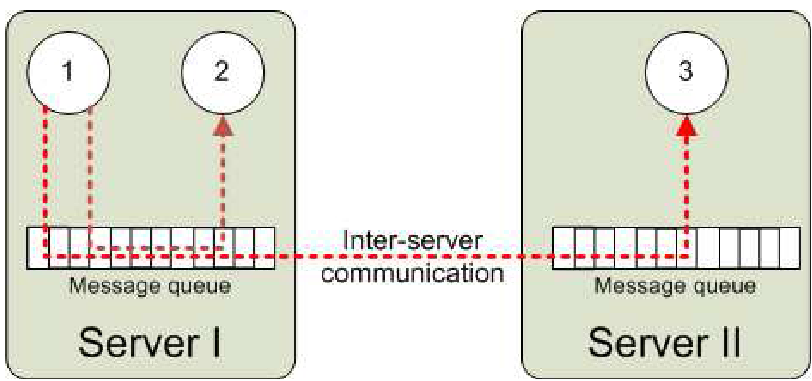 Figure 1: Comparison of different partition strategies. (a) User graph, (b) Balanced but high inter-server load, (d) Optimized locality with handled imbalance.
Performance & Experiments
The researchers tested their algorithms against Metis (a top-tier graph partitioning tool) and Random Partitioning (used by systems like Cassandra).
Key Findings:
- Near-Perfect Optimality: In small-scale tests where the absolute "best" answer was known, DPGS found it or came within 3% of it.
- Adaptability: When user communication patterns changed (e.g., a new viral topic appearing), DPGS recalibrated the server assignments in real-time, whereas traditional hashing algorithms remained static and inefficient.
- Efficiency: DPGS required significantly fewer "user moves" to reach stability than standard Simulated Annealing, making it practical for live production systems.
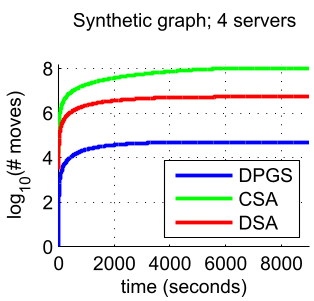 Figure 2: Convergence behavior on Facebook data. Notice how DPGS (solid line) stays low and stable even as network dynamics change.
Critical Insight & Industry Value
The real value of this work lies in its scalability. By proving that local greedy choices (with a tiny bit of random perturbation) can solve a global optimization problem, the authors provide a path for OSNs to grow to billions of users without the "centralized bottleneck" of traditional database managers.
Limitations
The primary cost is the migration overhead. Moving user data between servers consumes bandwidth. While DPGS minimizes the number of moves, the actual size of user profiles (photos, videos) wasn't the primary focus of the mathematical model, which represents an area for future refinement in high-bandwidth multimedia social networks.
Conclusion
As OSNs become more dynamic, the infrastructure must become "socially aware." This paper moves us away from blind hashing toward an intelligent, distributed assignment strategy that understands the value of human connection.