
Social Networks as Multiprocessors: A Memory Consistency Perspective on Collaboration
Distributed collaboration models for social networks
This paper proposes a formal hardware-inspired modeling approach for Social Networks (SN) using memory-consistency perspectives. It defines the "Post-Reply" collaboration model and proves that distributed-replicated and partitioned architectures naturally support this interaction unless "UPDATE" operations are introduced.
TL;DR
Is a social network more like a community of people or a cluster of processors? Jalal Kawash argues for the latter. By treating social interactions (Post, Reply, Query) as memory operations, this paper proves that while simple "append-only" social feeds work perfectly on distributed systems, adding an "Update" button introduces architectural complexities that most designers underestimate.
The "Accidental" Architecture of Virtual Communities
Most virtual communities (VCs) are built as web applications first, with their underlying architectures treated as an afterthought. While sociologists use graph theory to study how we connect, developers are often left guessing how distributed databases or replication lag might distort the "truth" of a conversation.
The author observes a historical parallel: just as processor architects built hardware before fully understanding their impact on software, social network designers are building global platforms without a formal model of Collaboration Consistency.
The Methodology: Porting Hardware Logic to Social Software
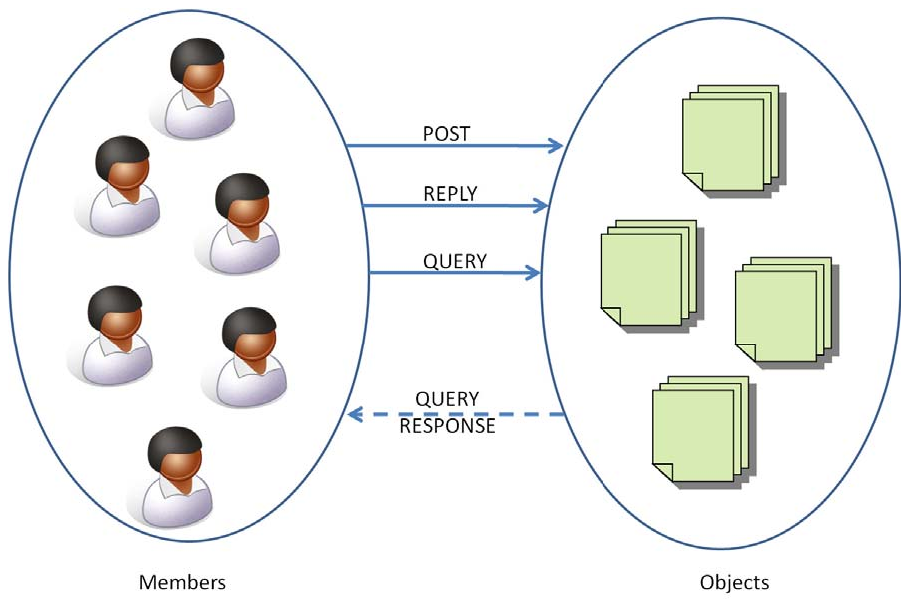
The paper introduces the Post-Reply Collaboration Model. It defines three primary actions that mirror memory operations:
- POST: Creating a unique object (akin to a memory write).
- REPLY: A write that has a causal dependency on a previous object.
- QUERY: An observer action that retrieves a set of objects (akin to a memory read).
Using the Happens-Before Relation, the author establishes a partial order based on three constraints:
- Participation Order: The sequence of actions by a single user.
- Inverse Queries: An object must exist before it is seen.
- Inverse Replies: A post must exist before it can be replied to.
Architectural Proofs: Replication vs. Partitioning
The paper evaluates two common distribution strategies:
- Distributed-Replicated: Every site has a full copy of the data. Updates are broadcasted via bridging protocols.
- Distributed-Partitioned: Data is split across sites (sharding).
The Big Insight: For the basic trio of POST, REPLY, and QUERY, both architectures are "sequentially consistent" by nature. They "passively admit" post-reply collaboration. This means the system doesn't need expensive global locks to make the conversation look sane to every user.
The Breaking Point: The UPDATE Action
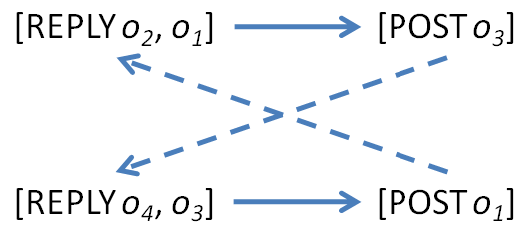
The elegance of the model breaks when the UPDATE action is introduced. In a distributed social network, an update replaces object with .
The author proves that without active synchronization, a distributed system cannot guarantee a "safe" total order for updates. For instance, User A might see an update while User B still sees (and replies to) the stale original post, creating a causal paradox that violates the post-reply-update collaboration model.
Theorem 4.2 formally states that neither replication nor partitioning can support updates correctly without additional "synchronization measures"—the social network equivalent of hardware memory barriers.
Critical Insight & Conclusion
This paper shifts the discourse of Social Network Analysis from "Social Science" to "System Science."
Key Takeaways:
- Architectural Simplicity: The "append-only" nature of early Twitter and chat rooms is why they scaled so easily; they didn't require complex consistency protocols.
- The Cost of Editing: Implementing an "Edit Post" feature in a distributed environment is not just a UI change; it is a fundamental architectural shift that requires moving from passive bridging to active synchronization.
Limitations:
The model is currently limited to three or four operations. Real-world SNs involve complex privacy settings, "Likes," and "Deletes," all of which add more layers to the consistency requirements.
Future Outlook:
As we move toward decentralized social networks (like BlueSky or ActivityPub), understanding these "Memory Consistency" constraints will be vital to ensuring that our global conversations don't succumb to distributed chaos.