
ABT on Androids: Bringing Decentralized AI to the Edge
Distributed Constraint Satisfaction Among Android Devices
This paper presents "ABT on Androids," the first implementation of the Asynchronous Backtracking (ABT) algorithm on mobile devices. The authors successfully port theoretical Distributed Constraint Satisfaction Problem (DisCSP) solvers to a real-world multi-agent hardware platform using Android smartphones.
TL;DR
Researchers at Saga University have successfully migrated the Asynchronous Backtracking (ABT) algorithm from theoretical simulations to a physical multi-agent system using Android devices. By treating each smartphone as an autonomous agent, they've created a decentralized solver for Distributed Constraint Satisfaction Problems (DisCSP), specifically targeting high-stakes scenarios like post-disaster drone coordination where central servers are likely to fail.
Background & Motivation: Moving Beyond Simulations
In the world of Multi-Agent Systems (MAS), the Distributed Constraint Satisfaction Problem (DisCSP) is a foundational model. Whether it's scheduling sensors or coordinating robots, the goal is to find a global solution through local communication.
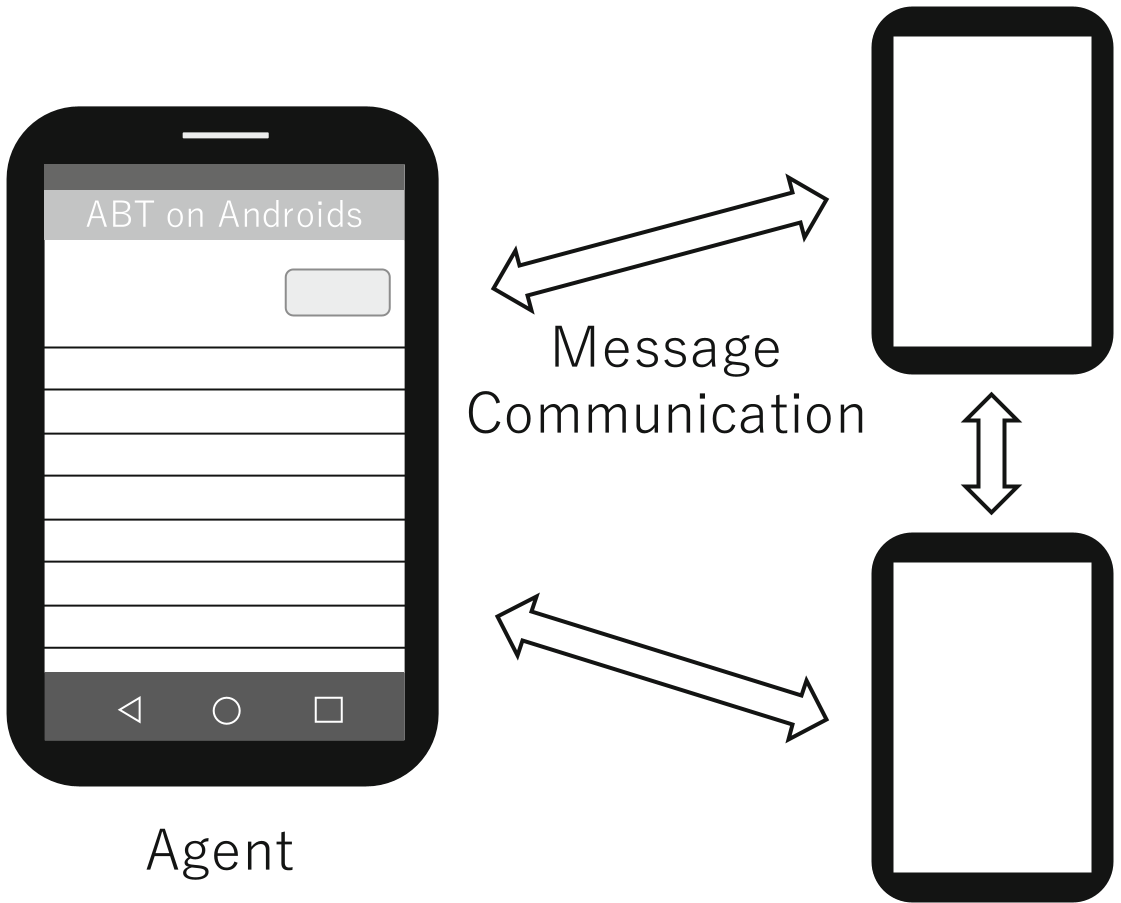
While the theory is mature, the industry suffers from a "centralization trap." Most "distributed" simulations actually run on a single machine. The authors argue that in real-world disasters—like the 2018 Hokkaido earthquake—reliance on a central server is a single point of failure. This work aims to bridge the gap by deploying logic directly onto the hardware that would control autonomous agents (like drones).
Methodology: The "ABT on Androids" Architecture
The core of the system is the Asynchronous Backtracking (ABT) algorithm. Unlike traditional backtracking, ABT doesn't wait for a global state; agents "propose" values to their children in a priority tree and "backtrack" by sending "nogood" messages to their parents when conflicts arise.
The Three-Threaded Design
To prevent the mobile application from freezing during complex computations or network delays, the authors designed a robust concurrent architecture:
- UI Thread: Handles the display and user interaction.
- Communication Thread: Manages TCP/IP sockets over Wi-Fi, preventing
NetworkOnMainThreadException. - ABT Thread: The "brain" of the agent, executing the logic of checking constraints and generating nogoods.
Experimental Validation: The 2-Queens Test
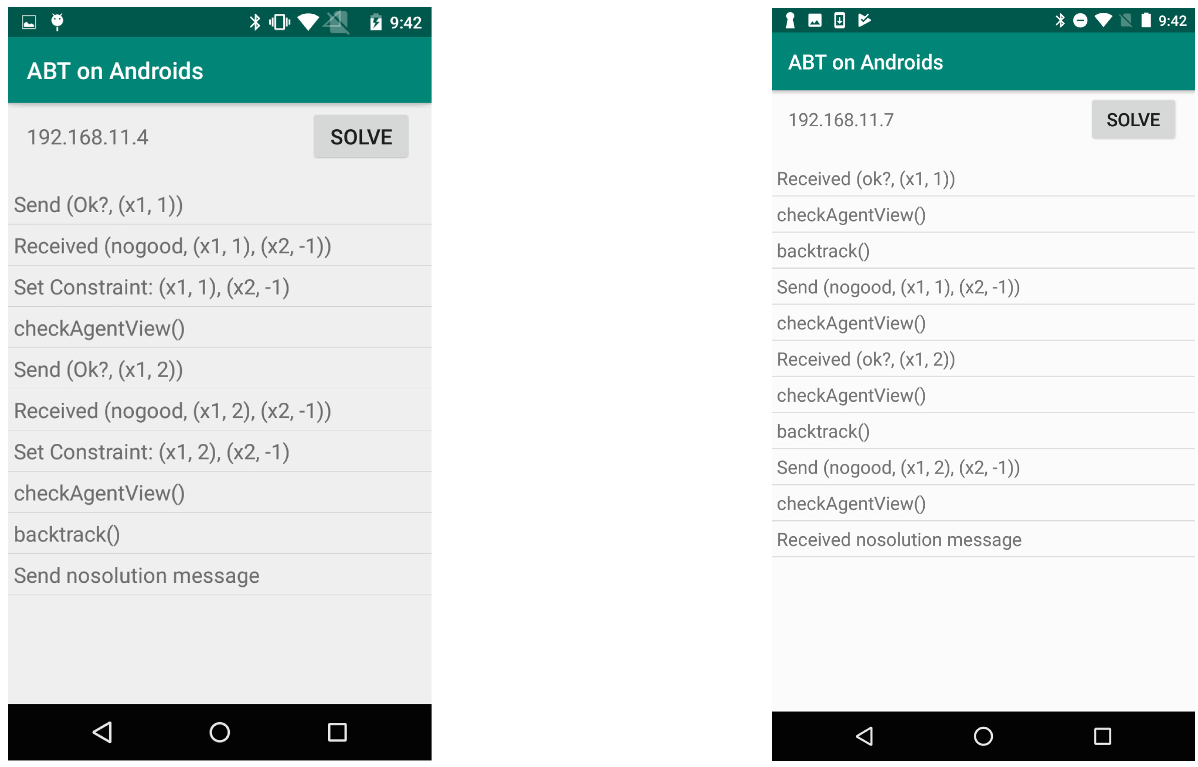
To verify the implementation, the authors used a classic benchmark: the n-queens problem. Specifically, they attempted to solve the 2-queens problem, which is mathematically unsatisfiable.
For a distributed system, proving "no solution" is harder than finding one, as it requires exhaustive search across multiple agents.
The Execution Flow:
- Agent 1 (x1) assigned a value and informed Agent 2 (x2) via an
ok?message. - Agent 2 detected a constraint violation and sent a
nogoodmessage back. - After cycling through all possible domains, Agent 1 generated an empty nogood, signalling the end of the search and successfully proving the problem's unsatisfiability.
Critical Analysis & Future Outlook
This work provides a critical "reality check" for DisCSP researchers. While the 2-queens problem is small, the transition to physical hardware requires handling network latency and device heterogeneity (as seen in the use of both an older JCI device and a newer Nexus 5X).
Future Directions:
- Scaling: Moving from 2 agents to large-scale swarms.
- Physical Integration: The ultimate goal is to embed this ABT solver into drone flight controllers.
- Protocol Efficiency: Exploring Wi-Fi Direct or Bluetooth to remove the need for a shared Wi-Fi router entirely.
Conclusion
"ABT on Androids" demonstrates that the complexity of decentralized constraint reasoning is now within the reach of modern mobile hardware. This is a significant step toward resilient, autonomous multi-agent systems that can operate in the most challenging environments on Earth.