
VDCSP: Orchestrating Virtual Devices via Distributed Constraint Satisfaction
A Distributed Constraint Satisfaction Problem Approach to Virtual Device Composition
This paper introduces the Virtual Device Constraint Satisfaction Protocol (VDCSP), a distributed approach for the dynamic composition of networked appliances in MANETs. It models the selection of heterogeneous services as a distributed Constraint Satisfaction Problem (distCSP) to optimize Quality of Service (QoS) while enabling post-composition adaptation to network performance.
TL;DR
In the era of the Internet of Things (IoT), the ability to combine individual networked appliances into a single "Virtual Device" is crucial. This paper presents VDCSP, a protocol that treats device composition as a Distributed Constraint Satisfaction Problem (distCSP). By moving away from costly broadcast-based advertising and focusing on a negotiation-based "pull" model, VDCSP achieves SOTA-level QoS with a 98% reduction in message overhead.
Background: The MANET Challenge
Mobile Ad Hoc Networks (MANETs) are the ultimate "infrastructure-less" environments. Here, devices must find each other and cooperate without a central server. Traditional methods have two fatal flaws:
- Resource Exhaustion: They "shout" their presence constantly (periodic broadcasting), killing battery life even when no one is listening.
- Static Assumptions: They assume once a virtual device is formed, the network stays the same. In reality, bandwidth and jitter fluctuate wildly.
Problem & Motivation: Beyond "Best Effort"
Most existing service discovery protocols focus on "finding any match." For a high-quality user experience, we need the best possible match that respects:
- Task Requirements: Minimum services needed.
- User Preferences: Desired Quality of Service (QoS).
- Network Constraints: The physical limits of the current wireless link.
The authors recognize that nodes are independent agents. They might have Private Policies (e.g., billing models, security levels) they don't want to broadcast to the entire network. This makes a distributed, negotiation-based approach like distCSP the ideal mathematical framework.
Methodology: Solving the distCSP
The core of the paper is the Virtual Device Constraint Satisfaction Algorithm (VDCSA). It operates in stages:
- Candidate Formation: Instead of constant broadcasting, a device only sends a request when a task is activated.
- QoS Ranking: Every candidate node calculates its own capability score based on a similarity function between the user's needs and its actual hardware/software.
- Asynchronous Backtracking: Nodes negotiate. Higher-priority nodes pick their best services; lower-priority nodes check for conflicts. If a conflict occurs, they "backtrack" by sending a
nogoodmessage to the higher-priority node, forcing it to try its second-best option.
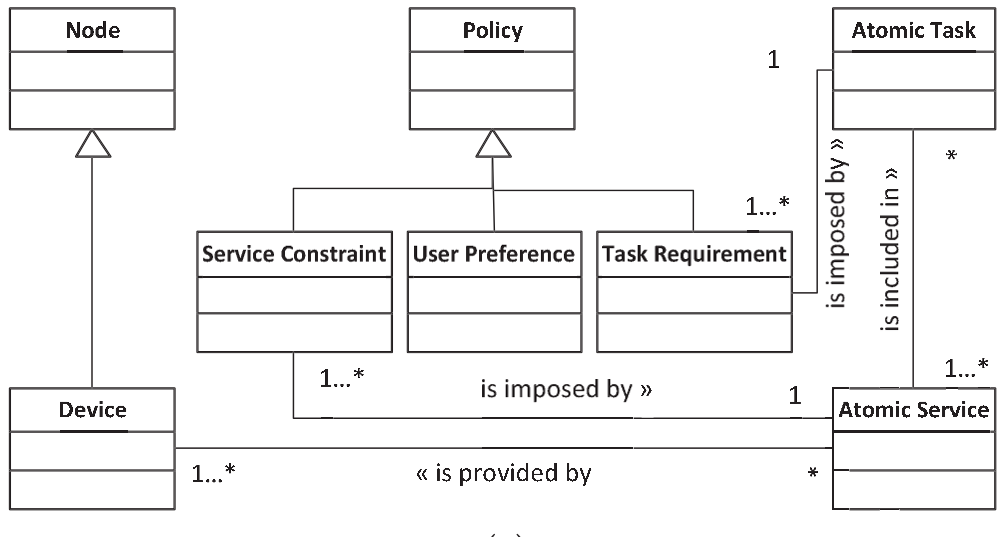 Figure 1: The abstract model represents the conversion of a service matrix into a committed composition.
The math behind the QoS model is particularly robust, utilizing a similarity function (Sim) that normalizes outcomes between 0 and 1, ensuring that the "Distance" between a user's request and a device's capability is precisely quantified.
Experiments & Results: Efficiency Gains
The authors compared VDCSP against the DSC (Distributed Service Composition) protocol across varying service densities and composite lengths.
1. Superior QoS
VDCSP consistently hits a QoS level above 99% because its constraint engine specifically hunts for the "optimal" set of services, whereas the baseline DSC merely finds "available" ones.
2. Drastic Overhead Reduction
The most striking result is the cost. Because VDCSP only acts on demand (Pull method):
- Messages: Used 62,750 fewer messages on average than DSC.
- Time: Reduced composition time by roughly 74%.
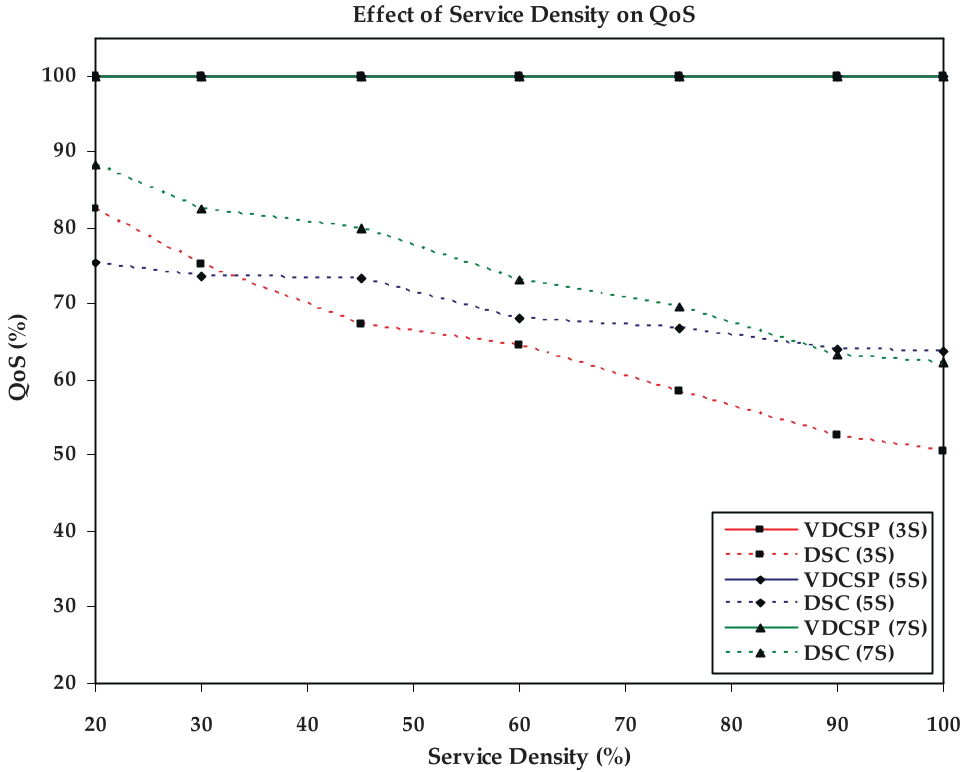 Figure 2: QoS Comparison—VDCSP maintains high quality even as the complexity of the task (number of services) increases.
3. The Mobility Trade-off
While VDCSP wins on efficiency, it faces a challenge with High Mobility. If nodes move out of range during the negotiation process, the "Pull" model lacks the cached data that a "Push" model provides. This indicates a need for hybrid approaches in extremely volatile environments.
Critical Analysis & Conclusion
Takeaway
VDCSP proves that modeling device composition as a distributed CSP is not just academically elegant—it's practically superior for resource-constrained MANETs. It solves the performance-privacy trade-off by allowing agents to negotiate via summarized messages rather than raw data dumps.
Limitations
The protocol's performance drops as the network area scales beyond a single hop. In its current form, it's better suited for "Personal Area Networks" or immediate surroundings than large-scale urban mesh networks.
Future Outlook
The authors point towards a Hybrid Push/Pull technique. By broadcasting only when a service changes (rather than periodically), future iterations could Combine the resilience of DSC with the extreme efficiency of VDCSP. This work lays the foundation for "Ghost Devices"—powerful virtual systems that assemble and dissolve instantly as users move through smart environments.