
Distributed Ego-Network Coverage: Solving the Availability Gap in F2F Social Networks
Distributed Coverage of Ego Networks in F2F Online Social Networks
The paper introduces a novel Friend-to-Friend (F2F) Distributed Online Social Network (DOSN) architecture aimed at solving data availability. It utilizes the concept of ego-network coverage and a specialized "Neighbour Dominating Set" (NDS) algorithm to ensure that user profiles are always accessible via mutual friends, achieving approximately 90% availability on real-world datasets.
TL;DR
This research tackles the "Online/Offline" dilemma in Distributed Online Social Networks (DOSNs). By treating a user's social circle as an Ego-Network and applying a graph-theoretic Neighbour Dominating Set approach, the authors enable offline users to "delegate" their data to a minimal set of trusted friends. This ensures that any online friend can still retrieve the data through a mutual "Social Storage" node, maintaining 90% availability with minimal network traffic.
The Churn Problem in Decentralized Social Webs
In a centralized OSN (like Facebook), your data lives on a server 24/7. In a Distributed OSN, your data lives on your device. When you log off, your data disappears from the network.
Current decentralized alternatives often use Distributed Hash Tables (DHTs) or random replication. The drawback? You end up storing your private profile on the devices of total strangers. This creates a friction between Privacy (I only want friends to have my data) and Availability (I want my data reachable even when I am asleep).
The Insight: Social Connectivity as a Bridge
The authors propose that we don't need everyone to hold a copy of a profile. We only need a strategically chosen subset of mutual friends to act as Social Storage (SS).
The core methodology relies on Ego-Network Coverage. If User A goes offline, they select specific friends (B and C) to hold their profile. These "Social Storages" are chosen such that every other friend of A is either a Social Storage themselves or is directly connected to one.
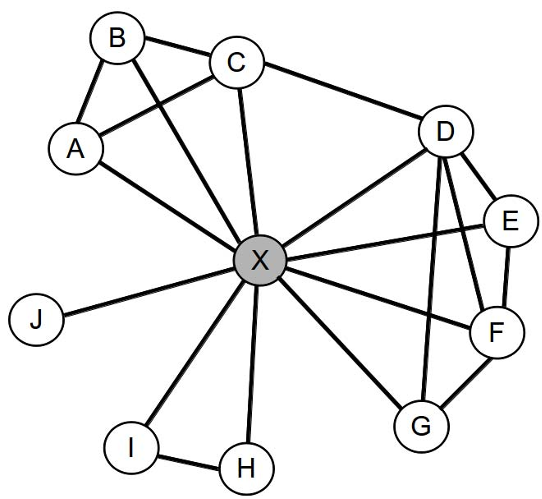 Fig 1: Selection of a Local Point of Storage (LPS) based on high local degree and session stability.
Methodology: The Neighbour Dominating Set (NDS)
The paper formalizes the replica selection as an NDS problem. In graph theory, an NDS ensures that for every edge in the ego network, at least one endpoint or a common neighbor is in the storage set.
Two types of storage are defined:
- Local Point of Storage (LPS): A stable "backup" friend chosen by a Social Score (Common Friends Average Session Length).
- Social Storage (SS): Dynamic nodes elected via a greedy "Span" algorithm to cover the remaining gaps in the network.
The Disconnection Workflow
When a user prepares to log off:
- It calculates the "Span" of its online friends (how many edges they cover).
- It elects the highest-span nodes as SS.
- It pushes the profile to these nodes.
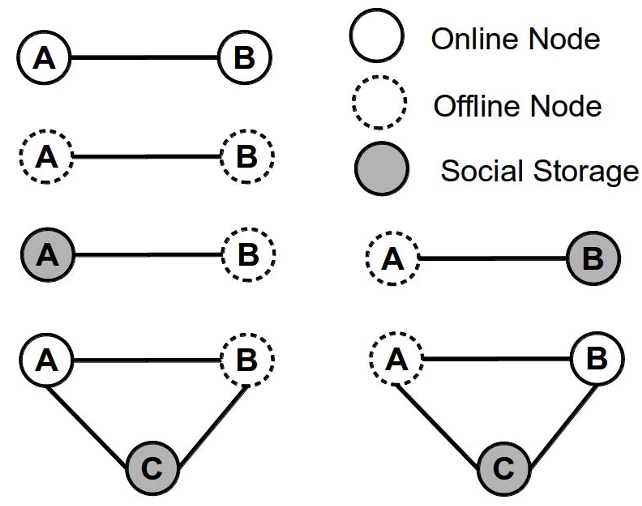 Fig 2: Example of Ego A going offline and electing Social Storages to satisfy the coverage of missing links.
Experimental Validation
The authors didn't just theorize; they built a Facebook application to crawl real social graphs and user "Online/Offline" patterns (sampled every 8 minutes).
Key Results:
- Availability: Achieved up to 90% availability during peak hours and stayed above 70% even during "sleep" hours (nighttime churn).
- Efficiency: The number of Social Storages required was roughly 10% of the total online user population.
- Scalability: The message overhead for electing new storages remained proportional to the number of active users, preventing network congestion.
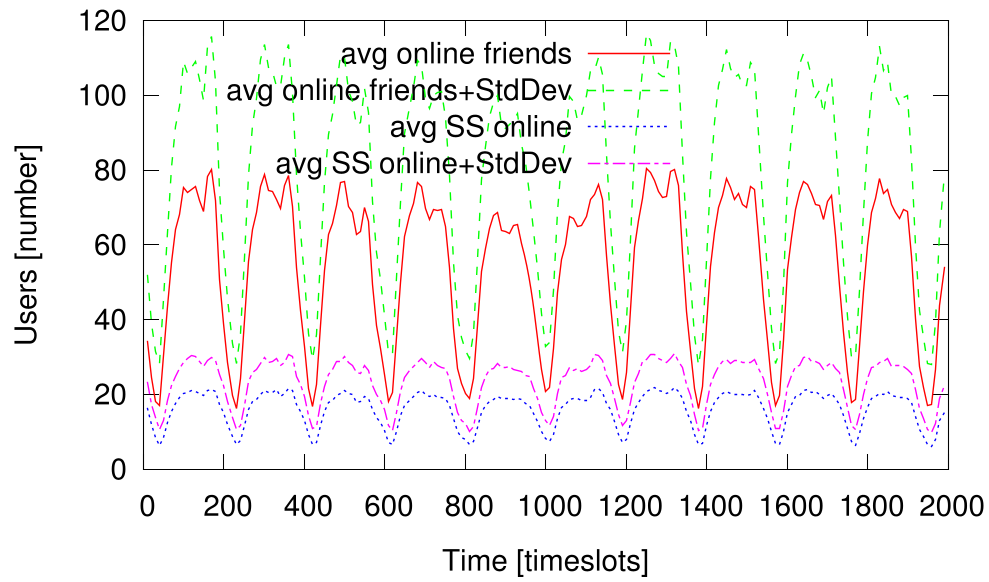 Fig 3: The cyclic nature of online users vs. the required Social Storage nodes.
Critical Insight & Future Outlook
This work proves that social structure is a resource. By shifting from "Random P2P" to "F2F Ego-Networks," we can achieve enterprise-level availability without sacrificing the trust-based nature of social relationships.
However, the paper identifies a potential "hotspot" problem: popular users might be elected as SS for dozens of friends simultaneously. Future iterations will need Social Load Balancing to ensure that being a "good friend" doesn't drain your phone's battery or bandwidth.
Conclusion
By mapping the data availability problem onto the NDS graph problem, this research provides a mathematically grounded path for truly private, decentralized social media that actually works under real-world churn conditions.