
D2ISCO: Evolution of Recommender Systems via Distributed Deliberation and Fuzzy Logic
Distributed Deliberative Recommender Systems
The paper introduces D2ISCO, a distributed Case-Based Reasoning (CBR) framework for recommender systems. It leverages a fuzzy-logic-based argumentation protocol and social network topologies to coordinate multiple agents, achieving SOTA-level accuracy in individual and group recommendation tasks.
TL;DR
Recommender systems are evolving from simple algorithms into collaborative "committees." This paper presents D2ISCO, a framework that treats agents as social entities. By combining Fuzzy Logic with the AMAL argumentation protocol, it allows a network of agents to debate recommendations based on trust and user personality, leading to significantly higher accuracy in both individual and group settings.
Problem & Motivation: The Limits of Loneliness
Most modern recommender systems are "lonely"—they function as a single agent querying a single massive database. This creates three major bottlenecks:
- Lack of Diversity: Centralized systems miss out on the "ensemble effect," where uncorrelated data sources improve accuracy.
- Rigidity: Existing distributed CBR protocols (like AMAL) use strict Description Logics, making them incompatible with the "fuzzy" and numerical nature of real-world user ratings (e.g., scoring a song 3.5/5).
- Social Blindness: They ignore that human decisions are often hierarchical and social, influenced by who we trust and our personality type.
Methodology - The Core: Arguments, Counterexamples, and Fuzzy Logic
The authors re-engineered the AMAL deliberation process. In D2ISCO, agents don't just provide list items; they participate in joint deliberation rounds.
The Deliberation Cycle
- Proposal: An agent suggests a solution based on its local case base.
- Counterargument: Other agents can rebut with a "counterexample" (a similar item with a low rating).
- Defense: The original agent can defend its choice using a similar item with a high rating.
1. The Fuzzy Decision System
Instead of binary logic, D2ISCO uses a Fuzzy Reasoner to calculate:
- Case Evaluation: How much should we trust a specific recommendation based on local goodness and query similarity?
- Acceptance Thresholds: Using fuzzy rules to decide if a counterexample is strong enough to discard a recommendation.
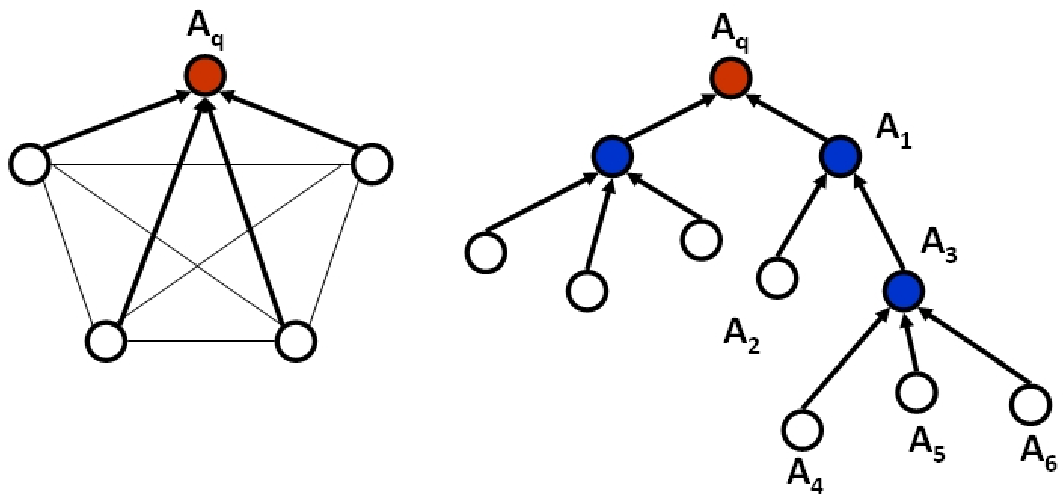 Figure 1: Comparison between AMAL's N-to-N topology (left) and D2ISCO's hierarchical, social-link-based topology (right).
2. Social Topology & Trust
Unlike previous models that link every agent to every other agent (unscalable), D2ISCO mirrors social networks. Trust is modeled based on the distance between nodes and historical accuracy, making the "voices" of like-minded friends louder in the deliberation process.
Experiments & Results: Proving the "Committee" Effect
The researchers tested D2ISCO in two domains: Music (Individual) and Movies (Group).
Performance Boost
The "Fuzzy" improvement over the standard AMAL protocol was significant. By minimizing the difference between the system's predicted rating and the user's actual preference, the fuzzy approach achieved a much higher Performance Score.
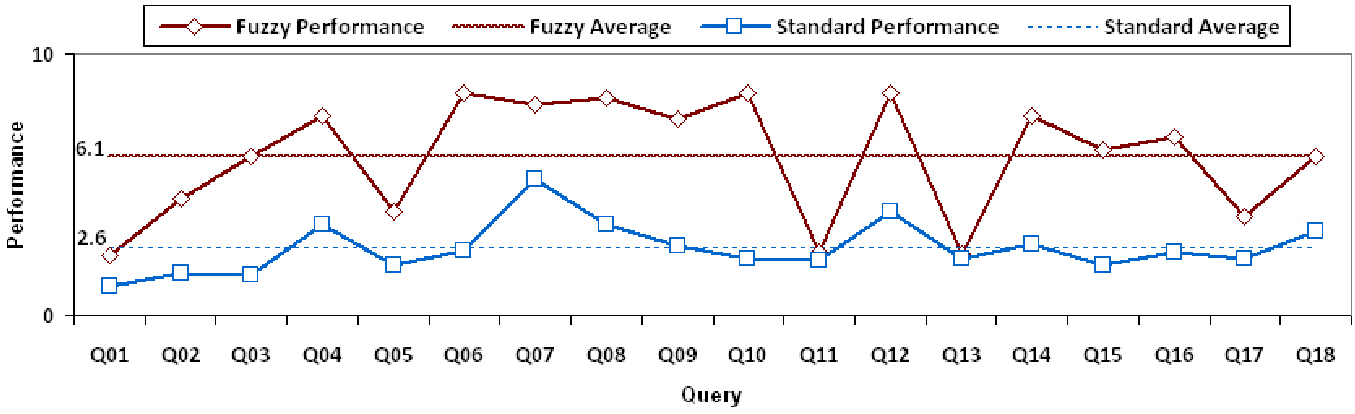 Figure 2: Performance comparison—the Fuzzy approach (green line) consistently tracks closer to real user preferences than the standard protocol.
Group Personality Matters
For group movie nights, D2ISCO incorporates the Thomas-Kilmann Conflict Mode Instrument (TKI). It weights the opinions of "Competing" personalities higher than "Accommodating" ones, mimicking real-world group dynamics where some members are more influential in reaching a consensus.
Critical Analysis & Conclusion
Takeaway
D2ISCO proves that deliberation works. By allowing agents to argue using fuzzy logic, we can bridge the gap between abstract symbolic reasoning and numerical user data.
Limitations & Future Work
- Scalability: While hierarchical, the current model was tested with 50 nodes. Real-world networks with millions of nodes would require even more efficient query propagation.
- Cold Start: The system relies heavily on existing ratings; a new agent with an empty case base has little "argumentative power."
- Outlook: The authors are now working on reusable templates for jcolibri 2, which will allow the CBR community to deploy these distributed, deliberative agents across diverse domains like healthcare or e-commerce.
Final Thought: If we want AI to recommend like humans, we must allow it to argue like humans.