
ETT: Solving the DDoS Traceback Puzzle in Cloud-Assisted Healthcare Networks
Distributed Denial of Service Attack Source Detection Using Efficient Traceback Technique (ETT) in Cloud-Assisted Healthcare Environment
This paper introduces the Efficient Traceback Technique (ETT), a novel source identification mechanism for DDoS attacks in cloud-assisted Wireless Body Area Networks (WBANs). By utilizing a Dynamic Probability Packet Marking (DPPM) approach integrated into the MAC header, ETT achieves faster attack path reconstruction with significantly lower computational overhead than traditional methods.
TL;DR
Securing Wireless Body Area Networks (WBANs) is a matter of patient safety, yet DDoS attacks frequently exhaust their tiny batteries. This paper presents ETT (Efficient Traceback Technique), a lightweight mechanism that identifies the source of an attack by dynamically marking packets at the MAC layer. It eliminates the "uncertainty" of spoofed attacks and reconstructs paths much faster than previous SOTA methods.
Context: Why Standard Traceback Fails WBANs
In a typical cloud-assisted healthcare setup, wearable sensors collect vital signs and transmit them through aggregate nodes (hubs) to the cloud. When a DDoS attack occurs, we don't just need to stop it; we need to trace it to the source to block the malicious entry point.
Existing solutions like Probabilistic Packet Marking (PPM) were built for the "big" internet. In those systems, routers mark packets with a fixed probability (e.g., 5%). However, in a multi-hop WBAN:
- High Overhead: Resource-thin sensors can't handle complex logging.
- Unfairness: Nodes near the "victim" overwrite the marks of nodes near the "attacker," making it nearly impossible to find the true origin without collecting millions of packets.
- Spoofing: Attackers can forge "marks" within the packet to redirect suspicion.
The Methodology: Dynamic Probability at the MAC Layer
The authors' core insight is the transition from Fixed to Dynamic probability. Instead of every node marking at a 5% rate, ETT uses a distance-based formula: where is the number of hops from the source.
1. The MAC Header Innovation
Because WBANs often bypass the full TCP/IP stack to save energy, ETT embeds its "DPPM Label" directly into the MAC Protocol Data Unit (MPDU). This 12-byte field tracks the source, aggregate nodes, and traveled distance.
 Figure 1: The Cloud-Assisted Healthcare Architecture featuring the reconstructed yellow attack path.
2. Achieving Uniform Residual Probability
By using the probability, the "Residual Probability" (the chance that a mark survives until it reaches the victim) becomes uniform (). This ensures that the victim receives information about the node near the attacker just as often as information about the node right next to it.
Performance Benchmarks
The authors evaluated ETT using NS-2, comparing it against Fishbone Traceback (FBT).
1. Convergence Time (Speed to Identification)
ETT's convergence time is linear (), meaning if there are 20 nodes, you roughly need only 20 packets to find the source. In contrast, fixed-probability schemes (FBT) show exponential growth, requiring thousands of packets as the path gets longer.
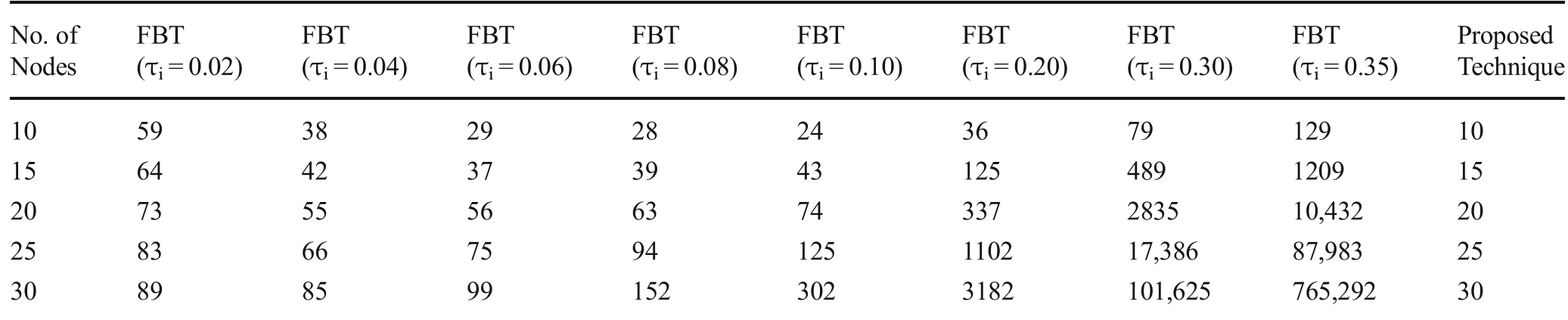 Table 1: Notice how ETT (Proposed) remains significantly lower than FBT across all path lengths.
2. Computational Overhead
By assigning variable probabilities, the total overhead on the network follows a Harmonic Number progression (), which is mathematically much smaller than the linear accumulation of fixed-marking schemes (). This directly translates to longer battery life for patient sensors.
Critical Insight & Conclusion
The ETT approach effectively solves the Uncertainty Factor (). In standard PPM, attackers can fake labels. Because ETT ensures that every packet is marked at least once through its dynamic probability, "spoofed" labels are almost always overwritten by legitimate node IDs before they reach the victim, reducing uncertainty to zero.
Limitations: The scheme currently relies on specific WBAN MAC headers. As the industry moves toward IPv6 (6LoWPAN) for medical devices, the next evolution of ETT will need to map these dynamic labels into the IPv6 Extension Headers without fragmenting the small packets.
Final Takeaway: ETT proves that in WBAN security, "Fairness" in packet marking isn't just a protocol preference—it's the key to achieving fast, low-energy forensics in life-critical environments.