
DCMSC: Reducing EV Charging Costs through Distributed Social Altruism
14878_Distributed Electric Vehicles Charging Management With Social Contribution Concept.
This paper introduces a distributed charging management framework for electric vehicles (EVs) based on a Generalized Nash Equilibrium (GNE) game. It uniquely integrates a "social contribution" concept where EVs with flexible schedules shift their charging to mitigate system overloads and reduce total costs.
TL;DR
As electric vehicle (EV) adoption surges, charging stations face critical "overload" periods. This paper presents a distributed management system where EVs aren't just selfish agents; they utilize a Social Contribution concept. By shifting their charging schedules to help "in-need" neighbors during peak loads, contributed EVs reduce the overall system cost without increasing their own expenses.
Motivation: Beyond Selfish Agents
Most current EV charging research falls into two camps: Centralized (efficient but privacy-invasive and computationally heavy) and Distributed Noncooperative (scalable but often suboptimal during overloads).
The authors identify a missed opportunity: Flexibility. Some EVs stay parked for long durations with low energy needs. If these "flexible" EVs could be motivated to "step aside" during power bottlenecks, they could allow "inflexible" EVs (those leaving soon with empty batteries) to charge during cheaper windows, avoiding expensive peak-load penalties.
Methodology: The GNE Game and Social Shift
The problem is framed as a Generalized Nash Equilibrium (GNE) game. Unlike a standard Nash game, the players' strategy sets are coupled by a shared constraint: the Charging Station's total power capacity.
The Three-Task Architecture
The proposed DCMSC (Distributed Charging Management with Social Contribution) algorithm operates through three iterative tasks:
- Optimization: Each EV calculates its local cost-minimizing schedule.
- Communication: Local controllers use a Consensus Network to share public signals () to ensure the total power doesn't exceed the station's limit (Overload Control).
- Contribution: This is the "secret sauce." If an EV finds it can meet its goals in a different time slot with the same price, it lowers its local power limit during overload periods, effectively donating its "quota" to others.
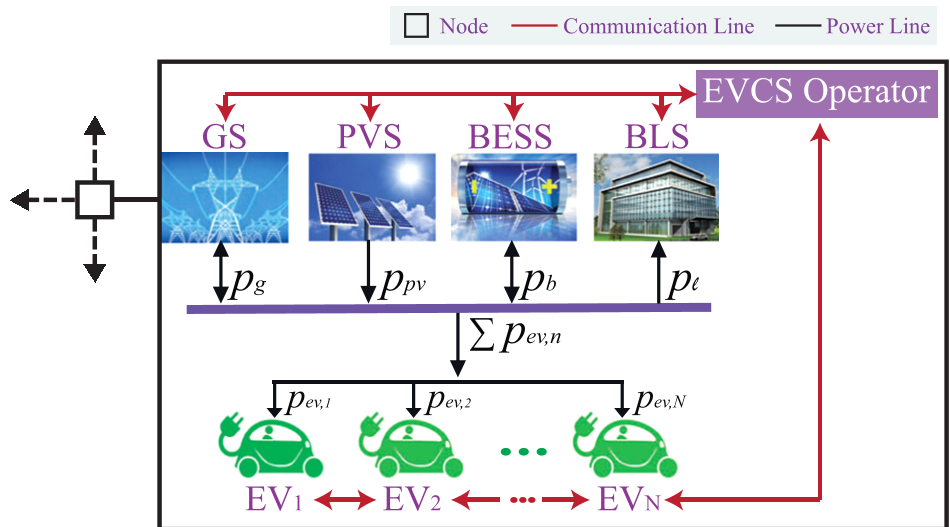 Fig 1. The EV Charging Station (EVCS) framework integrating PV, Battery Storage, and Grid interaction.
Simulation and Experimental Results
The authors compared three methods:
- Method-1: Selfish optimization (causes overloads).
- Method-2: Standard Overload Control (prevents overloads but costs more).
- Method-3 (Proposed): Overload Control + Social Contribution.
Performance Gains
In a 50-EV scenario, Method-3 reduced the total cost by 6.22% compared to Method-2. As the number of EVs scaled to 1,500, the savings rate clinical increased to 7.64%, proving the algorithm's scalability.
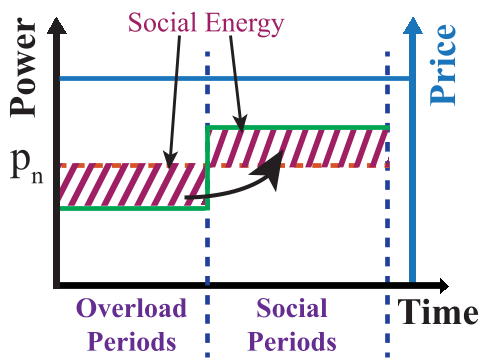 Fig 2. Comparison of charging profiles. Note how Method-3 shifts demand more effectively than Method-2 to avoid high-cost overlap.
Hardware Validation
The researchers didn't stop at math. They built a 1:200 downscaled testbed using NI myRIO controllers and dc-dc converters. The experimental data (Fig 8 in the paper) showed that real-time hardware execution matched the theoretical simulations almost perfectly, confirming the method's practical viability.
Critical Insight: Why it Works
The "magic" happens because the social contribution is cost-neutral for the contributor but value-additive for the recipient. By leveraging periods of identical electricity prices, the system reshuffles the "bottleneck energy" from high-utility agents to low-utility agents. It effectively turns a rigid physical constraint into a flexible social agreement handled by distributed code.
Conclusion & Future Outlook
This work demonstrates that "Sociality" can be an engineering parameter. By designing algorithms that account for an agent's ability to help the collective—without self-sacrifice—we can build much more resilient and efficient smart grids. Future research could investigate how to design specific financial incentives (like charging discounts) to further encourage this social behavior in real-world markets.
Summary Table: Cost Reduction Benchmarks
| Penetration (No. of EVs) | 50 | 500 | 1500 |
|---|---|---|---|
| Cost Reduction (%) | 6.22% | 6.81% | 7.64% |