
Distributed Alpha-Centrality: Empowering Influencers in Decentralized Consensus
Distributed Estimation of Node Centrality with Application to Agreement Problems in Social Networks
This paper presents a novel distributed framework for computing node alpha-centrality and achieving influence-weighted consensus in social networks. It introduces a local iteration protocol for agents to estimate their global importance and a parallel consensus algorithm that converges to a weighted average determined by these centrality indices.
TL;DR
In the digital age, not all voices are equal. This paper introduces a decentralized method for nodes in a network to calculate their own "Alpha-Centrality"—a measure of global influence—using only local talk. More importantly, it features an ingenious consensus algorithm that allows a network to reach an agreement where the final decision is weighted more heavily by the "experts" or "influencers" identified during the process.
Background: The Power Law of Information
In social networks, "centrality" identifies the heavy hitters—the brokers and bridges that hold communities together. While we have known how to calculate these values centrally for decades, doing so in a distributed fashion (where no single node sees the whole graph) is a significant challenge. Most consensus algorithms (like Average Consensus) treat every node's initial opinion with equal weight. This paper argues that for social applications, we need an Influence-Based Consensus.
Problem & Motivation: Beyond Simple Averages
Why is this difficult?
- Asymmetry: Real-world relationships aren't always mutual (think Twitter followers).
- Scale: You can't wait for a central server to map billions of connections.
- Dynamics: Consensus and centrality estimation usually happen sequentially, which is slow. The authors wanted to do both simultaneously.
Methodology: The Cascading Architecture
The paper proposes two layers of logic running in parallel:
1. The Centrality Estimator
Each agent maintains an estimate . Instead of sharing the whole estimate, nodes share the increment (). The update rule is: The parameter acts as a "forgetting factor" for distance—small looks at local neighbors, while larger considers global structure.
2. The Influence-Weighted Consensus
This is where the magic happens. Standard consensus reaches . The authors wanted the network to reach: They achieve this by using the centrality estimates to inject an "exogenous input" into the classical consensus loop. As a node learns it is more central, it subtly pushes its "opinion" harder into the network.
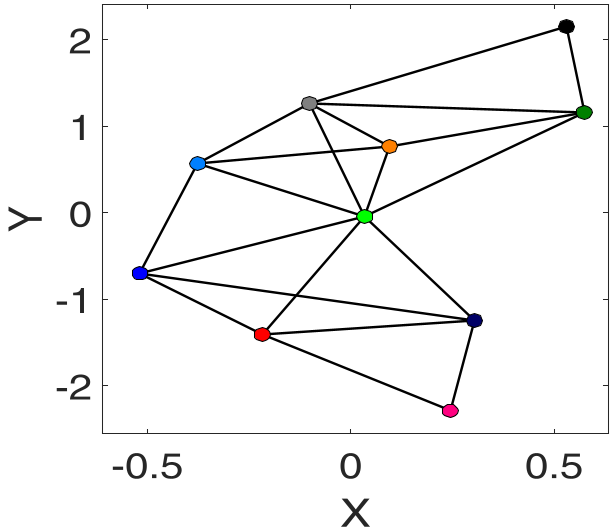 Figure 1: The tested network topology where the green node displays higher centrality.
Experiments & Results
The authors validated their theory through simulations. Key findings include:
- Convergence Speed: The centrality estimation error follows a geometric decay, bounded by the spectral radius of the influence matrix.
- Weighted Equilibrium: In the consensus phase, the network ignored the simple mean and converged precisely to the weighted average dictated by the alpha-centrality.
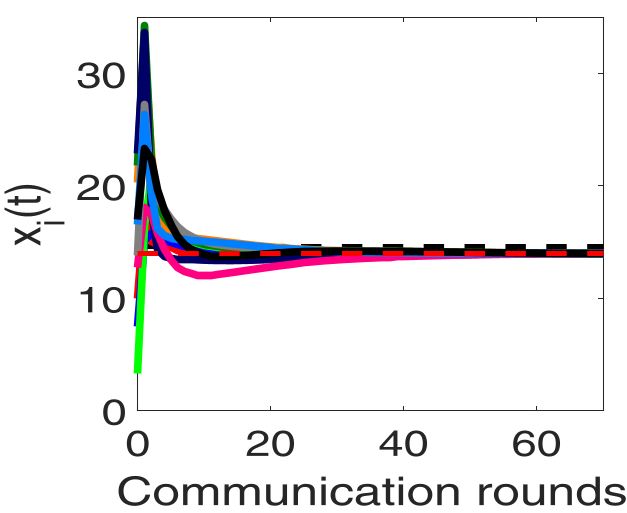 Figure 2: Evolution of the consensus. Notice the gap between the simple average (black dashed) and the influence-weighted result (red dashed).
Critical Analysis & Conclusion
Takeaway
This work bridges the gap between graph theory and social group dynamics. It proves that a network can "self-organize" to identify its leaders and then let those leaders guide the collective agreement—all without any node knowing the full map.
Limitations
- Fixed Topology: The paper assumes the graph (and influence weights) doesn't change during the process. In real social networks, influences shift constantly.
- Bandwidth: Each agent must trade three scalar values per round, which is slightly higher than the standard one-scalar consensus.
Future Outlook
This approach could potentially be applied to Sybil attacks in blockchain (weighting nodes by trust/centrality) or decentralized sensor networks where high-precision sensors are given more "weight" than noisy ones automatically.