
Social Learning vs. Fusion Evolution: When is Transparency Futile in Team Voting?
Distributed Hypothesis Testing With Social Learning and Symmetric Fusion
This paper investigates the utility of social learning in a distributed hypothesis testing framework where agents with a common goal make sequential decisions. Using an L-out-of-N symmetric fusion rule, the study identifies conditions under which observing previous votes is either beneficial or entirely futile for minimizing Bayes risk.
TL;DR
Does knowing how your colleagues voted help you make a better decision for the team? This paper analytically proves a counter-intuitive result: if everyone is equally competent, "Social Learning" (observing others' votes) is completely useless in a standard voting system. However, if the team has varying levels of expertise, the order of voting becomes a "secret weapon" for maximizing accuracy.
Background: The Tension Between Belief and Impact
In common social scenarios, we update our beliefs based on what others do—a process called Social Learning. If two doctors recommend surgery, the third doctor is naturally biased toward surgery. In decentralized detection, this is typically seen as a way to improve individual accuracy.
However, this paper places these agents in a Team Decision context with a fixed L-out-of-N fusion rule (like a majority vote). Here, an agent’s goal isn't just to be "personally right," but to minimize the total team error (Bayes Risk).
The Core Insight: The Cancellation Effect
The authors identify two competing forces at play when agents vote sequentially:
- Belief Update: Seeing previous "0" votes makes an agent believe the true state is more likely to be "0." This encourages them to follow the crowd (herding).
- Fusion Rule Evolution: If many people have already voted "0," a "0" vote from the current agent might be redundant or "waste" the vote, whereas a "1" might be the only way to counteract a potential team error.
In the case of conditionally i.i.d. signals, the authors provide a mathematical proof (using induction) that these two forces cancel out perfectly.
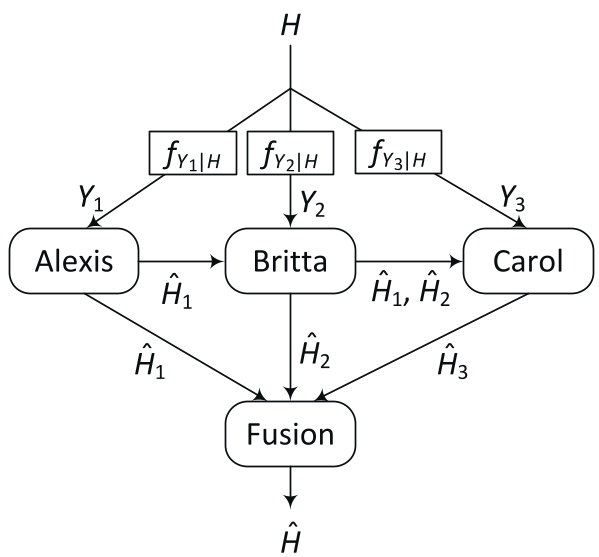 Figure 1: The sequential model where later agents observe the decisions (public signals) of earlier ones.
Methodology: The Math of Symmetry
The study focuses on the Bayes Risk (), which balances the costs of False Alarms and Missed Detections.
- Secret Voting: Agents decide simultaneously based only on their private signal .
- Public Voting: Agents decide based on AND the bits .
For i.i.d. agents, the optimal threshold remains identical regardless of the public signals. The paper shows that even with Partial Public Voting (only seeing your neighbor's vote), there is no performance gain over keeping ballots completely secret.
Heterogeneous Agents: When Expertise Matters
The game changes when agents have different Signal-to-Noise Ratios (SNRs).
- Unanimity Rules (AND/OR): Social learning is still futile. Because your vote only matters if everyone else matches a specific pattern, you must act as if that pattern is already true, effectively ignoring the actual public signal.
- Majority Rules: Social learning strictly improves performance.
The Ordering Effect
If you have an Expert (High SNR), a Median agent, and a Novice (Low SNR), who should speak first?
- In a 3-agent Majority check, the team achieves the lowest error when the Median agent acts first.
- In a 4-agent (2-out-of-4) rule, having the second-best agent act first is optimal.
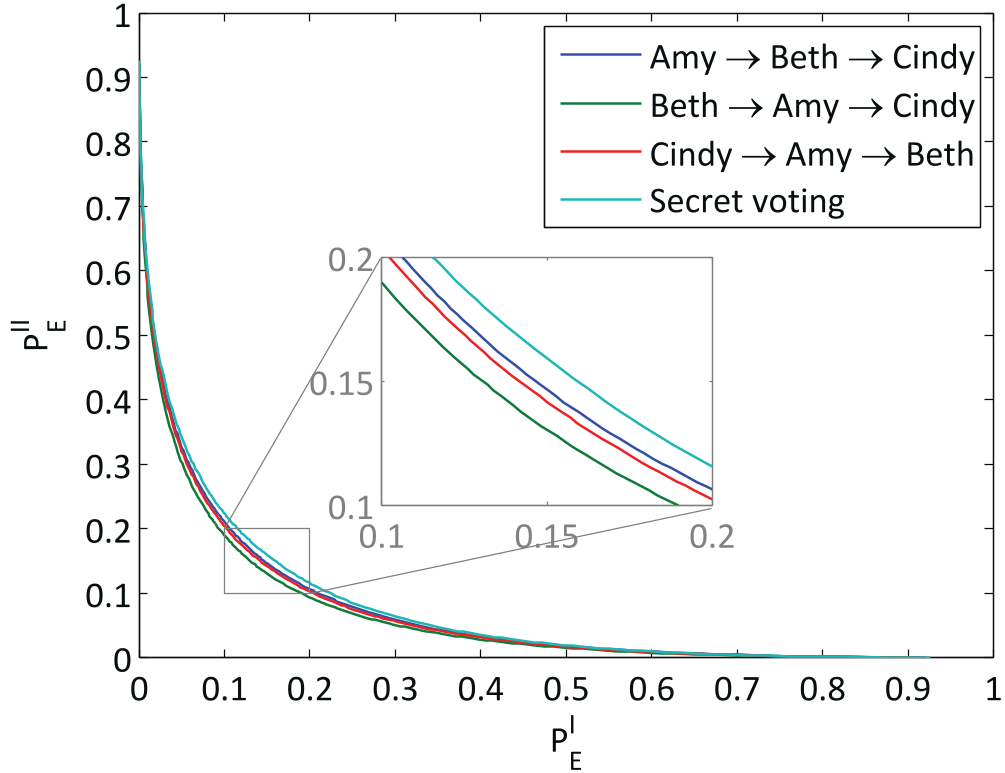 Figure 2: Reversed ROC curves showing that public voting (social learning) outperforms secret voting when agent SNRs differ.
Critical Analysis & Conclusion
Takeaway
The study provides a rigorous foundation for understanding why "transparent" voting isn't always better. In homogeneous systems (like sensor networks with identical hardware), the overhead of sharing intermediate states is a waste of resources.
Limitations
- Fixed Fusion Rules: In many modern AI systems, we use weighted fusion (like the Chair-Varshney rule). This paper assumes every vote has equal weight, which is common in human democracy but less so in optimized machine ensembles.
- Rationality Assumption: Human agents often suffer from "Cognitive Overload" or "Conformity Bias," where the belief update overwhelms the logic of fusion evolution.
Future Outlook
This work hints at a "Systematic Ordering Rule" for large-scale decentralized systems. If we can determine the optimal sequence for agents with varying reliability, we can significantly boost the robustness of distributed AI without changing the underlying models—only the order in which they "speak."