
Decentralized Influence: Scaling Node Detection in Mobile Social Networks
Distributed Influential Node Detection Protocol for Mobile Social Networks
The paper introduces a fully distributed protocol for detecting influential nodes in Mobile Social Networks (MSNs) using a combination of Random Walks and DB-Scan clustering. By replacing centralized graph processing with local walk counters, the method effectively identifies high-centrality users to optimize information dissemination.
TL;DR
Detection of influential nodes in Mobile Social Networks (MSNs) has long been a bottleneck due to the reliance on centralized, power-hungry algorithms. This paper proposes a fully distributed protocol that leverages Random Walks and DB-Scan clustering to identify "super-spreaders" locally. The result? A system that achieves 98% accuracy without ever needing a global view of the network.
Problem & Motivation: The Centralization Trap
In the realm of Mobile Ad-hoc Networks (MANETs), traditional influence detection targets nodes with high "centrality." However, calculating centrality usually requires a complete social-contact graph—a luxury that mobile environments cannot afford.
The authors identify two critical pain points:
- Resource Exhaustion: Centralized computing creates data traffic bottlenecks and drains smartphone batteries.
- Network Dynamism: Mobile users move constantly. By the time a central server builds a graph, the topology has already changed.
The research insight here is simple but powerful: If we let small "test messages" wander randomly through the network, they will naturally "bump into" influential nodes more often. This is an application of the friendship paradox in a mobile context.
Methodology: Random Walks and Local Clusters
The proposed protocol operates in the background of each smartphone through four main phases:
1. The Random Walk Mechanism
Each node periodically initiates a test message with a pre-configured Time-To-Live (TTL). As these messages hop from neighbor to neighbor, each recipient increments a local counter.
- Physical Intuition: Highly connected nodes (influentials) act as hubs. Statistically, a random walker is significantly more likely to visit a hub than a peripheral node.
2. Distributed Clustering via DB-Scan
To manage the scale, the network is partitioned using DB-Scan (Density-Based Spatial Clustering of Applications with Noise). This allows the protocol to identify dense groups of users while filtering out "noise" (isolated users).
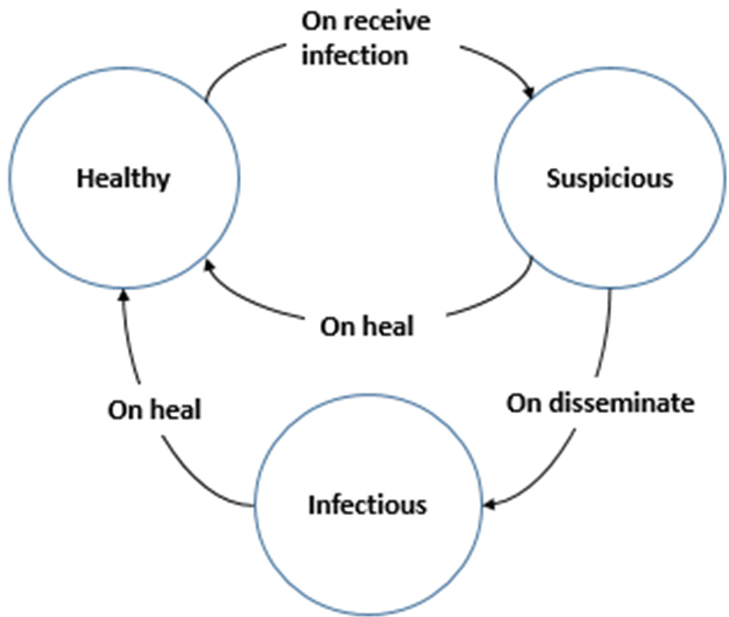 Figure 1: The logical transition of a node from susceptible to influential within the local cluster.
3. The Election Mechanism
After a fixed time interval , nodes within the same cluster share their counters. The top- nodes with the highest counts are "elected" as influential nodes for that specific partition.
Experiments & Results: Accuracy vs. Mobility
The authors simulated a 1000m² area (like a university campus) with 300 nodes. They focused on three metrics: Accuracy, Sensitivity, and Error Rate.
1. The Mobility Trade-off
The study found that as node velocity increases, detection accuracy drops.
- Why? High mobility causes clusters to dissolve and reform too quickly for the random walk counters to stabilize.
2. The Impact of Walk Length (L)
Increasing the walk length improves sensitivity. A longer walk means a message explores more of the cluster, providing a better "sampling" of node importance.
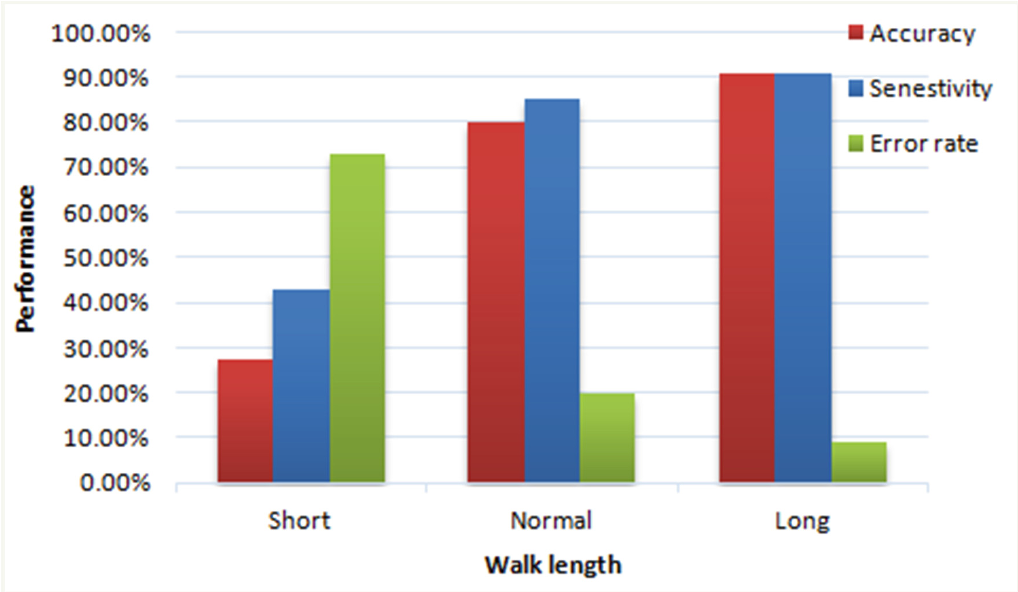 Figure 2: Sensitivity increases as the walk length grows, validating the random walk theory.
3. Convergence Speed
One of the most impressive results is the protocol's convergence. Within just 45 seconds, the system reaches a stable state with nearly 98% accuracy.
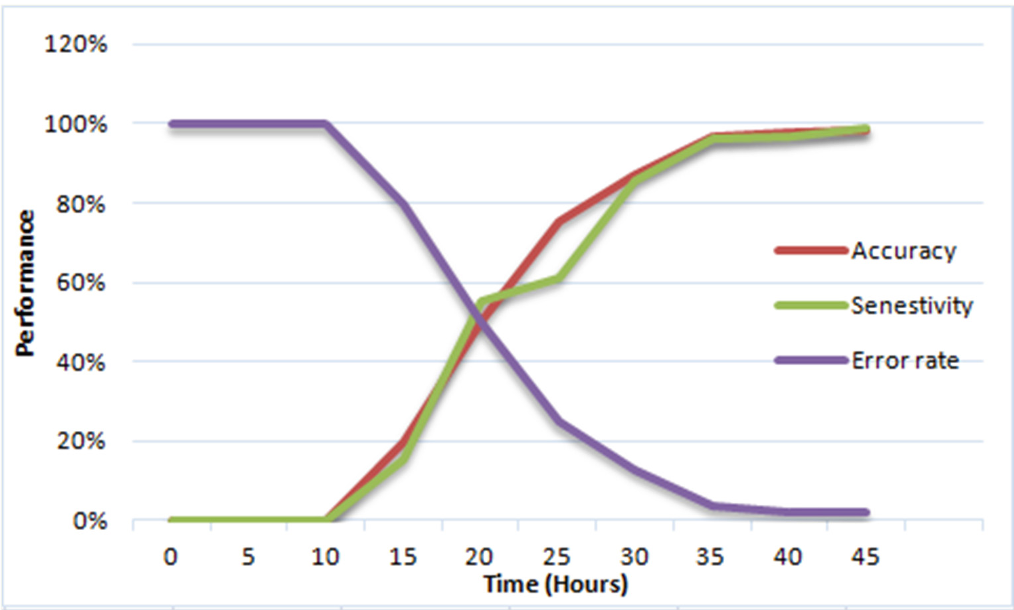 Figure 3: Short-term operation results showing rapid accuracy gains.
Critical Analysis & Conclusion
This work demonstrates that the Distributed Influential Node Detection Protocol is a viable alternative to centralized SOTA methods. By using localized "epidemic" modeling, the protocol bypasses the need for costly graph construction.
Takeaways:
- Scaling MSNs: The approach is inherently scalable because all calculations are local to the cluster.
- Limitations: The protocol struggles in extremely high-mobility scenarios where the "mixing time" of the network exceeds the TTL of the walkers.
- Future Work: Integrating mobility prediction (e.g., using Kalman filters or RNNs) could potentially mitigate the accuracy loss in high-velocity scenarios.
For developers of decentralized social apps or emergency communication mesh-nets, this protocol offers a blueprint for efficient, low-power information propagation.