
LEARNAE: Breaking the AI Monopoly with Decentralized Ledgers
Using distributed ledger technology to democratize neural network training
This paper introduces LEARNAE, a fully decentralized framework for training Deep Neural Networks (DNN) using Distributed Ledger Technology (DLT). By integrating IPFS for model diffusion and IOTA for IoT data streaming, the system achieves democratized AI training without central parameter servers or high-end infrastructure.
TL;DR
LEARNAE is a research initiative that shifts Neural Network training from high-performance corporate clusters to a "democratized" P2P network. By combining IPFS for storage and IOTA for IoT data, it allows individual researchers to collaborate on model training without trusting a central authority or sharing sensitive raw data.
Background: The Centralization Trap
Currently, Deep Learning thrives on "Big Data," but this data is locked behind the silos of tech giants. Individual practitioners face three major hurdles:
- Infrastructure Costs: High-end GPUs are expensive.
- Privacy Concerns: Traditional "leased" processing involves uploading data to remote servers.
- Centralized Vulnerability: Methods relying on Parameter Servers have single points of failure (bottlenecks).
LEARNAE addresses these by positioning itself as a purely decentralized, asynchronous, and heterogeneous ecosystem.
Methodology: A Multi-Ledger Approach
The core of LEARNAE lies in its "Fat Node" and "Thin Node" architecture, which uses two distinct DLT technologies:
1. Model Diffusion via IPFS
Instead of a central server, LEARNAE utilizes IPFS (Interplanetary File System). Models and "dataslices" are content-addressed (via hashes). When a peer trains a model, it broadcasts the hash. Other peers fetch these chunks via gossip protocols. This ensures that even if several nodes go offline, the model data persists across the remaining swarm.
2. IoT Integration via IOTA Tangle
To bring low-energy sensors (the "Thin Nodes") into the fold, the authors use IOTA’s Masked Authenticated Messages (MAM). Sensors stream data into the Tangle's Directed Acyclic Graph (DAG). Powerful "Fat Nodes" then listen to these streams, buffer the data, and convert it into training-ready slices.
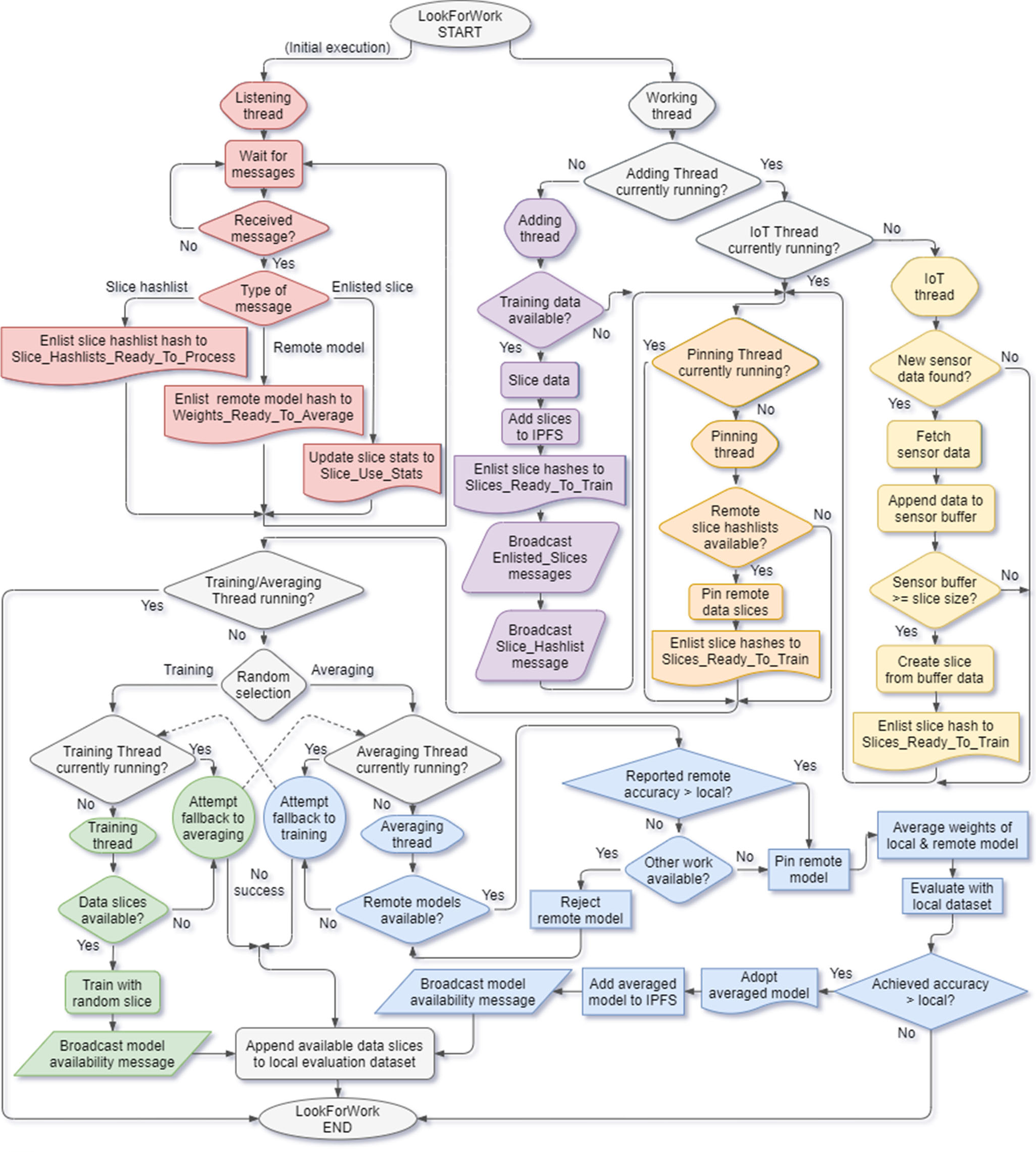 Figure 1: The principal parts of a Full Node’s workflow, showing the interaction between local training and P2P weight averaging.
Resilience: Training in the Face of Chaos
A standout feature of this research is the Fault Tolerance study. The authors simulated network disruptions with "Offline Probabilities" ranging from 0% to 80%.
- Weight Averaging: Instead of sharing data, nodes share model weights. When a peer finds a neighbor with a more accurate model, it performs a local average. This introduces stochasticity, which ironically helps the model generalize better.
- Performance Stability: Even when nodes were offline 60% of the time, the distributed accuracy remained significantly higher than standalone training.
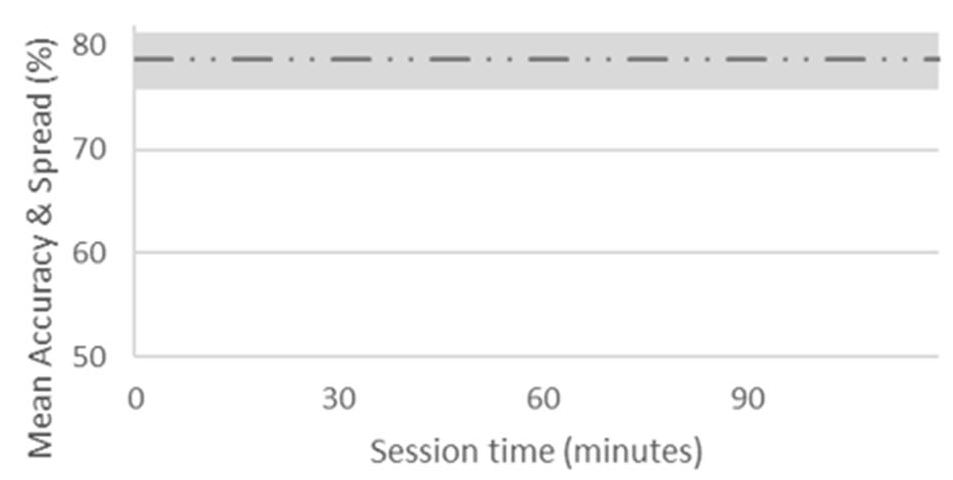 Figure 2: Mean Accuracy and Spread across different Offline Probabilities. The system maintains convergence even under extreme network instability.
Critical Insight: Why This Matters
The most profound takeaway is the Data Sovereignty. In "Privacy Mode," raw data never leaves the local device. Only the mathematical knowledge (weights) is shared.
The experiment on the HEPMASS dataset (exotic particle detection) showed that 20 commodity-grade workstations could collectively outperform their individual efforts by 1.12% in accuracy, effectively "pooling" their intelligence without a central overseer.
Conclusion & Future Outlook
LEARNAE demonstrates that DLT is not just for cryptocurrencies; it is a robust infrastructure for distributed intelligence. While the current implementation focuses on 20 nodes, the modular nature of IPFS and IOTA suggests this could scale to thousands.
However, challenges remain:
- Incentivization: Why would a node contribute its GPU power if it doesn't need the final model? (Future work aims to address this via tokenomics).
- Adversarial Nodes: How does the network handle "poisoned" weights?
As we move toward a world of 50 billion IoT devices, decentralized frameworks like LEARNAE will be essential to prevent a few corporations from owning the "global brain."
Keywords: Decentralized AI, DLT, IPFS, IOTA, Peer-to-Peer Learning.