
CBRA: Enhancing Link Prediction with Clustering and MapReduce
A Distributed Link Prediction Algorithm Based on Clustering in Dynamic Social Networks
The paper introduces CBRA (Clustering-Based RA index), a distributed link prediction algorithm designed for large-scale dynamic social networks. It integrates community clustering information with the Resource Allocation (RA) index and uses a MapReduce framework on Hadoop to achieve superior prediction accuracy and scalability.
TL;DR
Link prediction—the art of guessing future or hidden connections in a network—is often hampered by sparse data and massive scale. This paper introduces CBRA (Clustering-Based Resource Allocation), an algorithm that leverages community clustering to boost accuracy and adopts the MapReduce framework to handle the computational heat of big data.
Motivation: The Missing Link in Prediction
In the realm of social network analysis, most classical algorithms (like Common Neighbors or Adamic-Adar) focus on "local topology." They look at immediate neighbors but fail to see the "forest for the trees"—ignoring the fact that nodes belong to intensive communities (clusters).
The authors argue that:
- Clustering matters: Two nodes in the same tight-knit community are much more likely to connect than two nodes with the same number of "random" shared neighbors.
- Scalability is a bottleneck: Traditional algorithms die on a single machine when the network grows to millions of nodes.
Methodology: The CBRA Architecture
The proposed CBRA index evolves from the standard Resource Allocation (RA) index. While the RA index treats all common neighbors () as resource transmitters, CBRA focuses on neighbors that reside within the BestCluster, as identified by the ROCK clustering algorithm.
1. Mathematical Intuition
The similarity score () is calculated as: Where represents common neighbors belonging specifically to the identified cluster. This filters out the "noise" of coincidental connections and prioritizes "meaningful" community-driven links.
2. Distributed Execution (MapReduce)
To handle large-scale data, the process is serialized into a Hadoop workflow:
- Map Phase: Receives the adjacency matrix, emitting node pairs and their shared neighbors.
- Reduce Phase: Aggregates these pairs and calculates the CBRA similarity score in parallel across the cluster nodes.
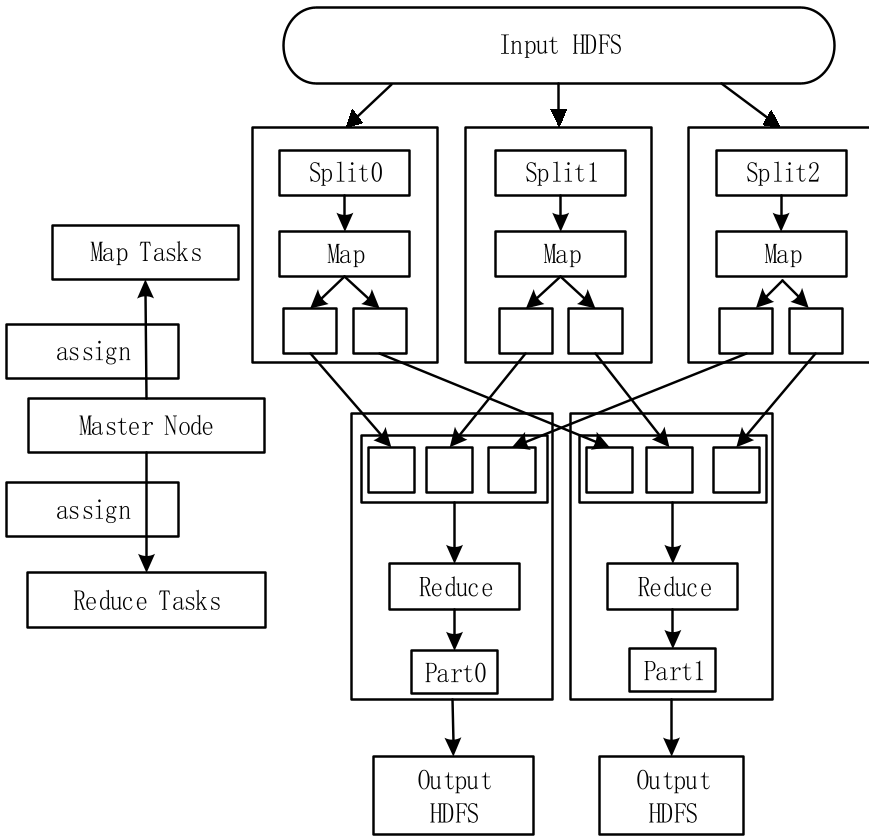 Fig 1: The execution flow of the distributed link prediction job.
Experiments and Results
The authors tested CBRA against five real-world datasets: USAir (Airports), PB (Political Blogs), Yeast (Proteins), Power (Grid), and Router (Internet).
Performance Highlights:
- High Accuracy: In the USAir dataset, CBRA achieved an AUC of 0.9811, outperforming the standard CN (0.9542) and RA (0.9722).
- Scalability: As shown in Fig. 4, the running time drops dramatically as more Map/Reduce tasks are added. The transition from a single-machine simulation to a distributed 10-node cluster proves the method is ready for "Big Data."
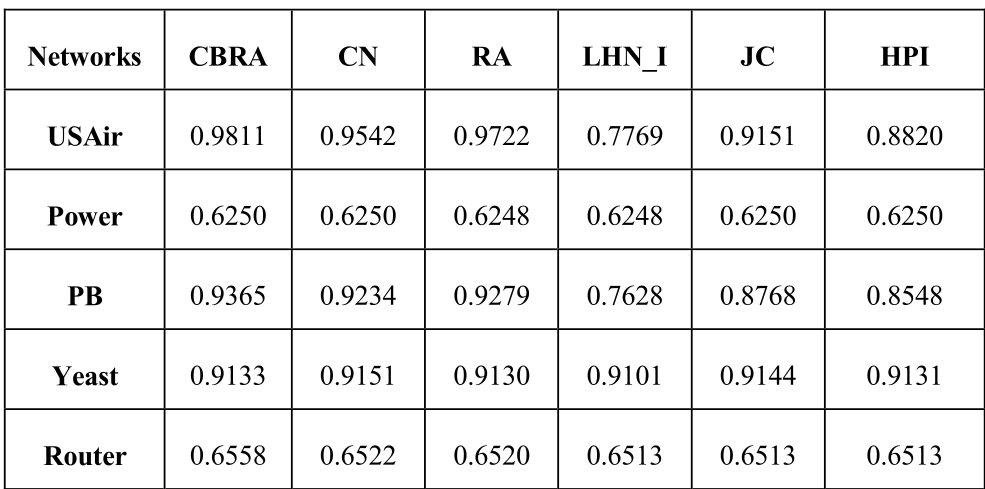 Table 1: CBRA consistently achieves higher AUC across various network types.
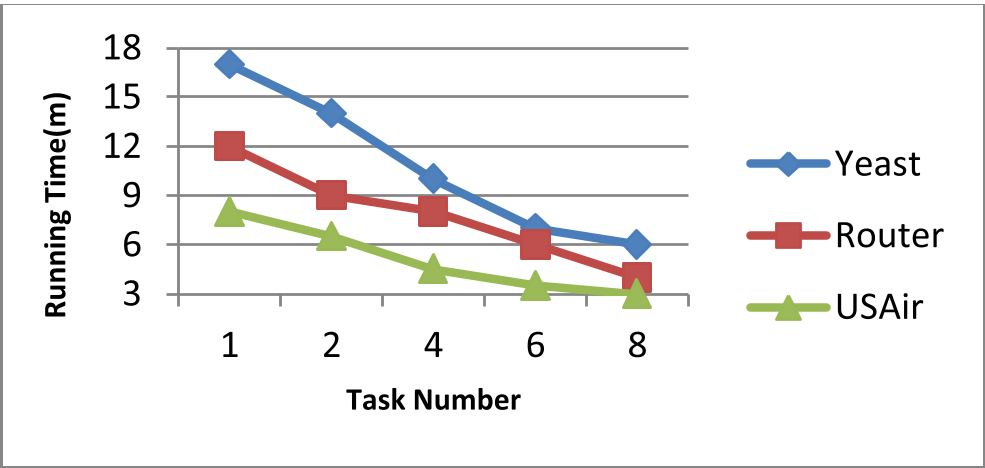 Fig 2: Drastic reduction in running time as task parallelism increases.
Critical Analysis & Conclusion
CBRA successfully bridges the gap between local structural features and global community insights. By using MapReduce, it bypasses the I/O and memory bottlenecks that plague traditional link prediction.
Limitations & Future Outlook:
- Weight & Direction: The current model focuses on undirected, unweighted graphs. Real-world social networks (like Twitter or LinkedIn) often have "follow" directions and "frequency of interaction" weights.
- Next Steps: Future research aims to adapt CBRA for directed weighted networks and explore multi-stage clustering to further optimize the time complexity for billions of nodes.
Takeaway: If you are dealing with sparse networks, don't just look at the neighbors—look at the community.