Beyond FLOPs: Why Predicting Distributed Matrix Multiplication Latency is a Multi-Dimensional Challenge
Distributed Matrix Multiplication Performance Estimator for Machine Learning Jobs in Cloud Computing
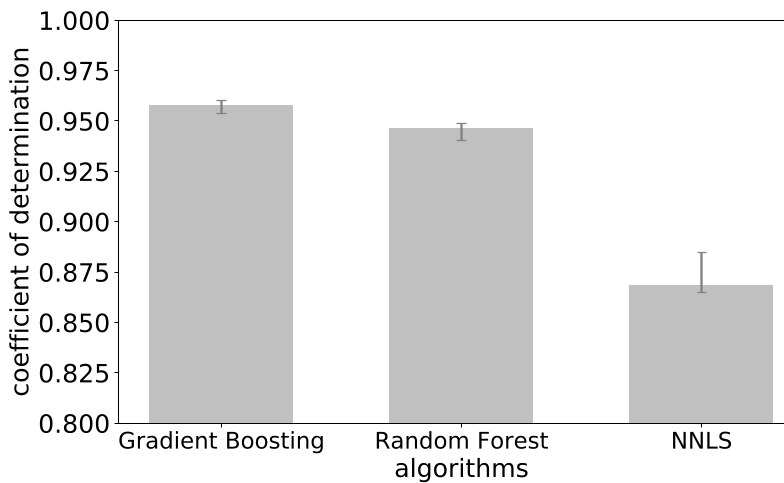
This paper introduces a specialized Matrix Multiplication Performance Estimator for Cloud Computing to predict the execution latency of distributed matrix multiplication tasks. By utilizing a Gradient Boosting (GB) regressor optimized via Bayesian inference, the method achieves State-of-the-Art (SOTA) prediction accuracy on Apache Spark clusters, significantly outperforming general-purpose cloud performance predictors.
TL;DR
While matrix multiplication is the heartbeat of Machine Learning, its performance in a distributed cloud environment is notoriously difficult to predict. This paper presents a specialized estimator that uses Gradient Boosting and Bayesian Optimization to account for the hidden costs of Network Shuffle and I/O. The result? A 63% improvement in prediction accuracy over previous industry standards like Ernest, and a fascinating revelation that more expensive GPU instances aren't always faster for distributed matrix joins.
The "Shape" of the Problem: Why Sampling Fails
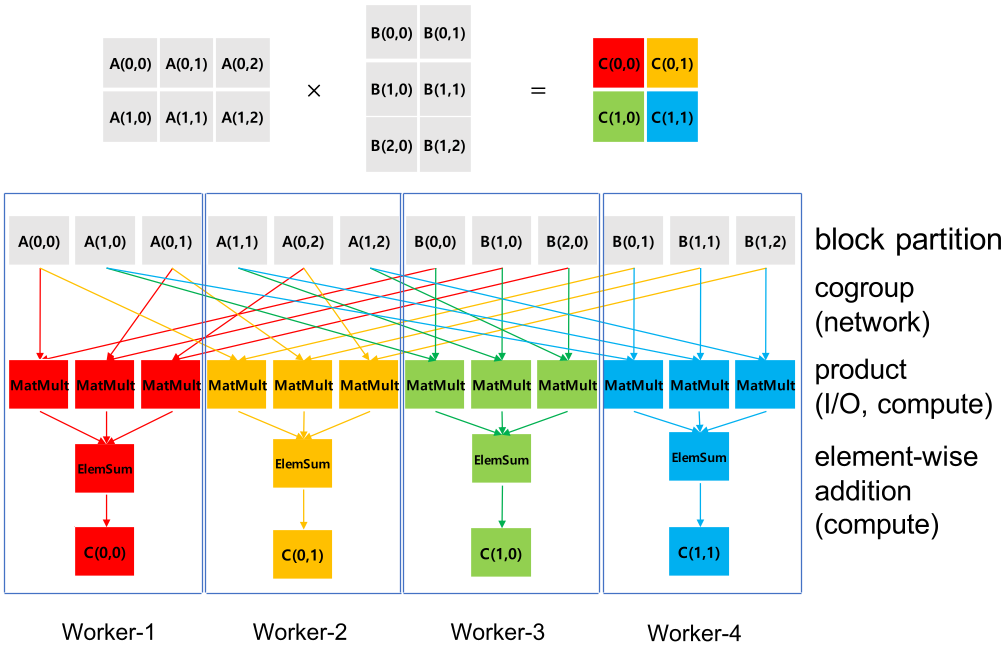
Most cloud performance predictors operate on a simple "scale-down" logic: if 10% of the data takes seconds, the full dataset will take roughly . However, in a distributed system like Apache Spark, matrix multiplication (C = A × B) is more than just raw math. It involves:
- Shuffle Overhead: Moving blocks across the network to the correct worker nodes.
- I/O Latency: Reading fetched blocks from local disk/buffer.
- Compute: The actual OpenBLAS/NVBLAS execution.
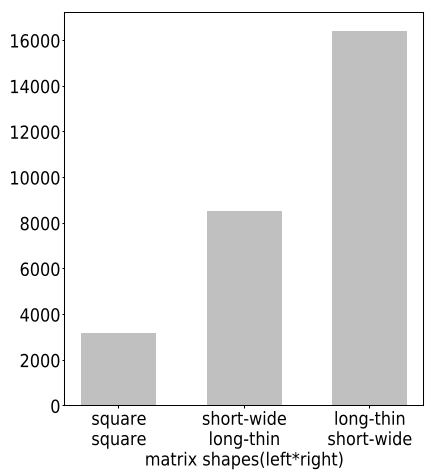
As shown in the authors' research, two multiplications with the exact same number of operations can have wildly different latencies depending on whether the matrices are square, "long-thin," or "short-wide."
The Methodology: Feature Engineering for Distributed Systems
To capture these nuances, the authors moved beyond "dataset size" as a single feature. Instead, they extracted 8 specialized features derived from the block dimensions ():
- : Representing the Output Matrix size (determines final write overhead).
- : Representing the total data involved in the Shuffle and I/O stages.
- : The traditional FLOP count.
The Engine: Gradient Boosting (GB)
The choice of a Gradient Boosting regressor is intentional. Unlike linear models, GB can capture non-linear interactions—for instance, the fact that Shuffle overhead might only become the bottleneck once the matrix width passes a certain network bandwidth threshold.
Experimental Insights: GPUs Aren't Always the Answer
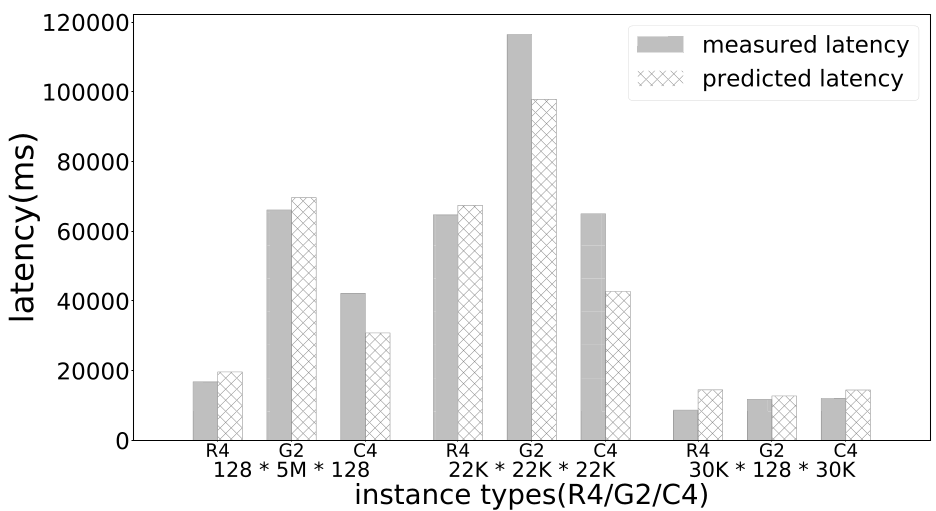
One of the most striking findings in the paper is the comparison between Amazon EC2 instance types.
- R4 (Memory Optimized) vs. G2 (GPU Optimized).
- In the case of a matrix multiplication, the G2 instance was 3x slower than the R4 instance.
- The Insight: In distributed matrix multiplication, the overhead of moving data into the GPU's memory and the network communication often outweighs the raw speed of the GPU core itself.
Critical Analysis & Takeaways
The strength of this work lies in its Inductive Bias. By baking the physics of distributed computing (Shuffle + I/O + Compute) into the feature set, the model achieves an without needing massive amounts of training data.
Limitations:
- Clustering Overhead: The model currently assumes a static number of worker nodes (4 in the study). In highly elastic cloud environments, "Cluster Size" should be an additional input feature.
- Hardware Specifics: While it works across C4, G2, and R4, it requires profiling for each new hardware generation to capture different I/O and Network throughputs.
Future Outlook: This research highlights a shift in Cloud ML. We are moving away from brute-force "provisioning the biggest VM" toward Shape-Aware Orchestration, where the system predicts the best instance type based on the specific geometry of the tensors being processed.