
Efficient Privacy-Preserving Friend Discovery: A Distributed Multi-Authority ABE Approach
Distributed Multi-authority Attribute-based Encryption Scheme for Friend Discovery in Mobile Social Networks
The paper proposes a distributed multi-authority Ciphertext-Policy Attribute-Based Encryption (CP-ABE) scheme tailored for friend discovery in Mobile Social Networks (MSNs). By leveraging cloud-assisted profile matching and a piecewise multi-authority framework, it achieves fine-grained access control and privacy preservation while significantly reducing the computational burden on mobile devices.
TL;DR
In the world of Mobile Social Networks (MSNs), the paradox of "finding friends without revealing secrets" is a major hurdle. This paper introduces a Distributed Multi-authority CP-ABE scheme that enables fine-grained social matching on mobile devices. By offloading heavy lifting to the cloud and splitting trust among multiple authorities, the researchers achieved significant performance gains: constant overhead for the user regardless of network size.
Problem & Motivation: The Heavy Cost of Trust
The basic premise of MSNs is profile matching: finding common ground in hobbies, education, or location. However, existing solutions face a triple threat:
- Computational Bottleneck: High-cost primitives like Homomorphic Encryption or Group Signatures drain mobile batteries.
- Centralization Risk: Relying on a single Trusted Third Party (TTP) means a single hack can leak everyone's personal data.
- Lack of Granularity: Many schemes are "all or nothing"—either you share everything or nothing at all.
The authors' insight was to move away from interaction-heavy signatures and instead treat "friendship eligibility" as an access control problem using Ciphertext-Policy Attribute-Based Encryption (CP-ABE).
Methodology: Decentralizing the Logic
The proposed system architecture splits the ecosystem into four roles:
- Initiator: Encrypts their profile under an access policy.
- Responders: Users who want to match.
- Cloud Server: The "blind" matchmaker that stores profiles but cannot decrypt them.
- Distributed Authorities (CAs & AAs): Multiple entities that collectively manage user keys, preventing collusion.
The Core Mechanism: Architecture Overview
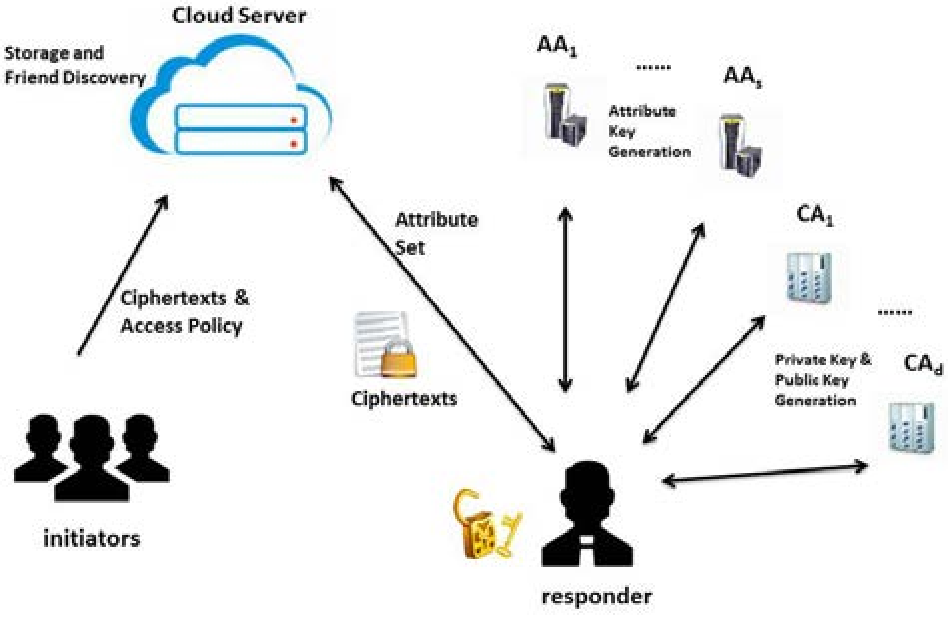
The scheme uses a piecewise generation of keys. A user gets their identity keys from a Central Authority (CA) and their attribute keys from specific Attribute Authorities (AA). The mathematical foundation relies on bilinear pairings in a group of composite order , ensuring that even if an authority is "curious," they can't reconstruct the full secret without colluding with all other entities.
Access Policy Implementation
The initiator sets a policy (e.g., "Must be a CSU Student AND Hobbies = Coding"). This is mapped via a Linear Secret Sharing Scheme (LSSS) matrix. The Cloud Server performs the matching process on the ciphertext. If and only if the responder's attributes satisfy the matrix, they can proceed to decrypt the initiator's identity.
Experiments & Results: Performance at Scale
The true value of this work is revealed when comparing it to traditional group-signature-based methods. In those models, the more potential friends there are, the harder your phone has to work.
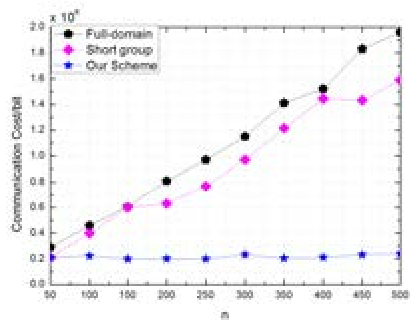 (a) Impact on Initiator | (b) Impact on Responder
Key Findings:
- Scalability: While competing methods [19, 20] show a linear spike in time as the number of responders reaches 500, the proposed scheme's cost remains flat (constant) at roughly 20-30ms.
- Lightweight Communication: By using the cloud as a central repository for encrypted profiles, the initiator doesn't need to broadcast individual signatures to every responder, keeping the data traffic minimal.
Critical Analysis & Conclusion
Takeaway
This paper effectively transforms the friend discovery problem from a "matching" problem into an "access control" problem. By distributing the authority, it mitigates the biggest security weakness of traditional cloud systems: the "god-mode" power of a single server.
Limitations & Future Work
While the distributed model adds security, the paper assumes that authorities do not collude—a significant assumption in real-world geopolitics. Additionally, the current scheme lacks dynamic revocation. If a user loses a certain attribute (e.g., they graduate and are no longer a "student"), the process of updating their keys across multiple authorities remains a complex challenge. The authors plan to address ciphertext updating and revocation in future iterations.
This work stands as a strong foundation for practical, privacy-first mobile social interaction, proving that robust security doesn't have to come at the cost of mobile performance.