
DMJSM: Overcoming Modern Anti-Crawling Barriers via Distributed Multi-Tasking Scheduling
A distributed multi-tasking job scheduling mechanism for web crawlers
The paper introduces DMJSM (Distributed Multi-Tasking Job Scheduling Mechanism), a cloud-based web crawler architecture designed to collect massive social network data while avoiding anti-crawling blocks. It achieves state-of-the-art performance by implementing a dynamic, depth-first distributed scheduling loop.
TL;DR
To combat the rigorous anti-crawling mechanisms of social networking sites, researchers have developed DMJSM (Distributed Multi-Tasking Job Scheduling Mechanism). Unlike traditional crawlers that become idle when blocked or finished with one task, DMJSM uses a dynamic job pool and a distributed depth-first cycle to keep hundreds of crawlers at full workload. The result? A 14.4% throughput increase over industry-standard Nutch and a robust 98.3% data precision.
Background: The Social Data Bottleneck
As social media becomes the primary venue for consumer feedback, enterprises face a paradox: the data is more valuable than ever, yet harder to extract. Social sites implement sophisticated blocking to protect server resources, leading to a "centralized bottleneck" where a cluster of crawlers often sits idle while waiting for timeouts or navigating complex page hierarchies.
The Problem & Motivation
The authors identified two fatal flaws in existing centralized distributed architectures:
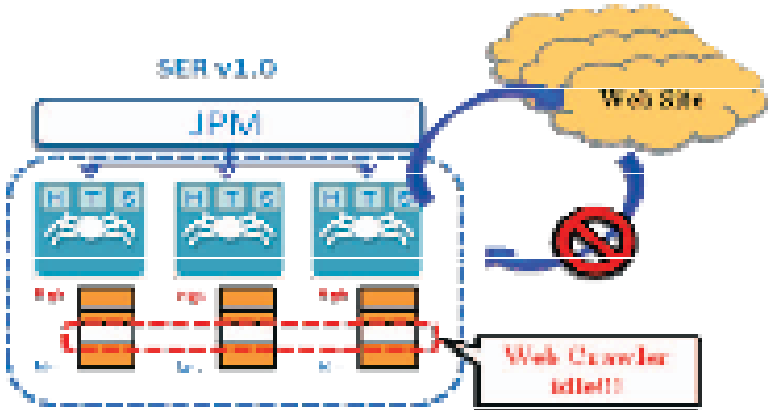
- Uniform Blocking: When several crawlers hit a site from the same logic level, the site’s defense mechanism triggers, idling the entire fleet.
- Breadth-First Waste: Centralized managers often wait for all "Level 1" pages to finish before starting "Level 2," leading to massive resource under-utilization if some pages are deeper than others.
Methodology: The DMJSM Engine
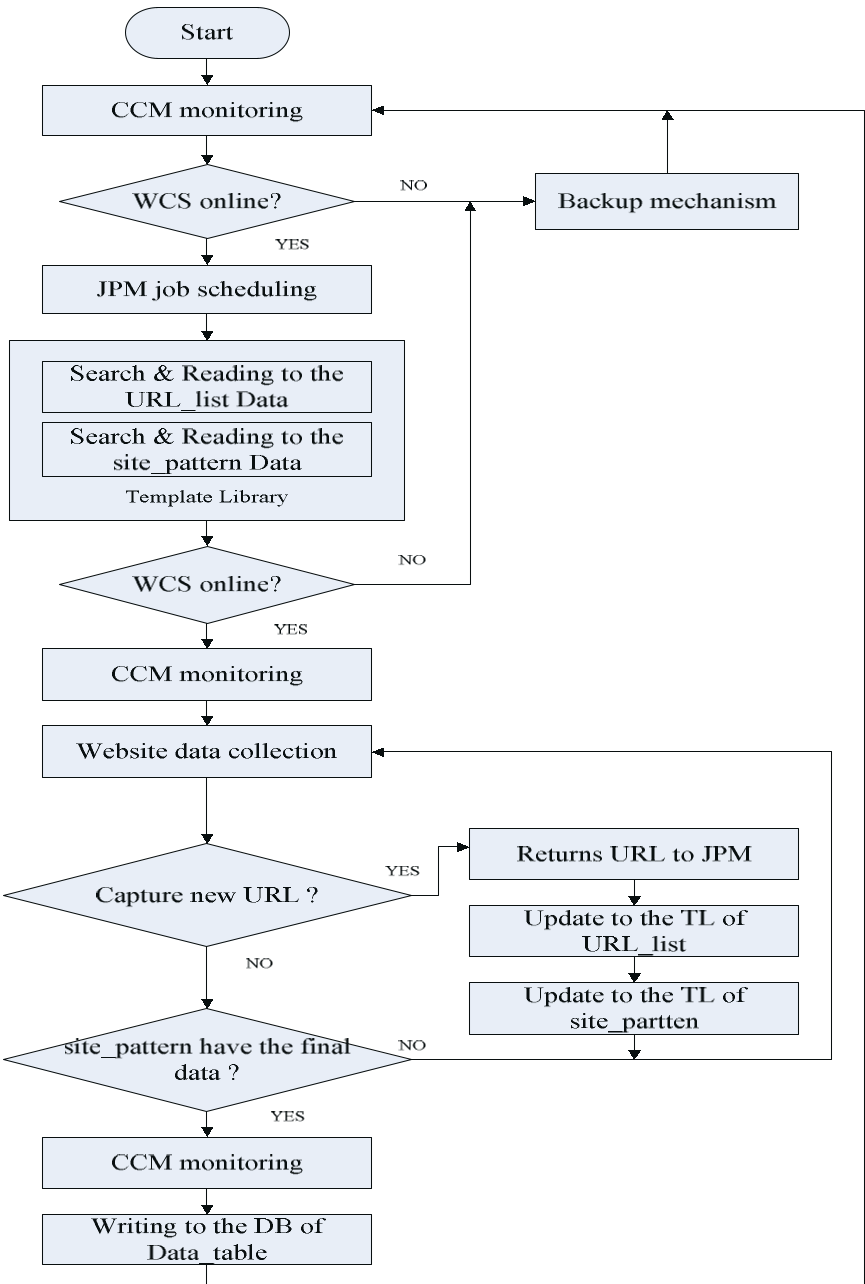
The core of DMJSM lies in its decoupled modularity. It moves away from a linear "crawl-then-process" flow into a continuous distributed cycle:
- Distributed Crawler Module (DCM/WCS): Operates in a passive "service mode," acting as the muscle of the operation.
- Job Pool Module (JPM): The brain. It monitors every crawler's workload and blocking status. If Crawler A discovers a new URL at Level 2, it doesn't process it immediately; it returns it to the JPM, which might assign it to Crawler B, ensuring no single node is overworked.
- Control Center (CCM): Acts as the monitor, implementing a "backup mechanism." If a crawler goes "Miss" (loses connection), CCM instantly re-schedules the task to a healthy node.
Depth-First Distributed Strategy
The system adopts a Depth-First Search (DFS) concept at the architectural level. By passing discovered URLs back to the JPM immediately, the system can "pipe" different levels of a website across different physical machines simultaneously, preventing the idle states shown in Fig 3.2.
Experiments & Results
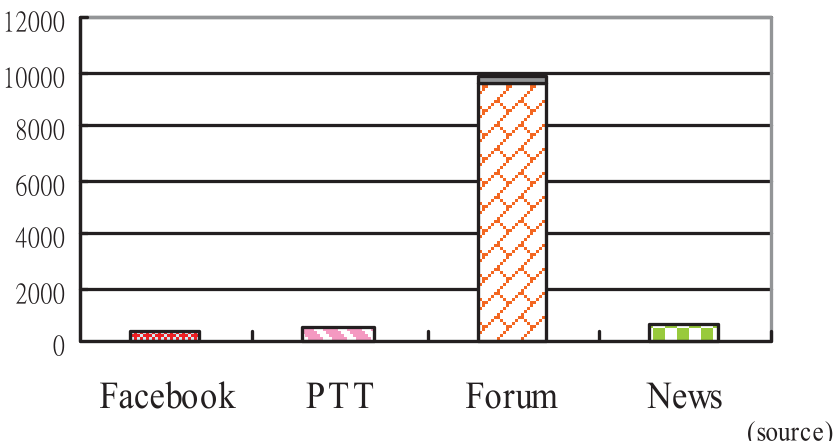
The system was tested on Amazon Cloud against Apache Nutch. Sampling 300 web crawlers over a one-month period across Facebook, PTT (a massive Taiwanese BBS), news sites, and forums, the results were conclusive:
- Massive Throughput: DMJSM collected 26,633,197 items in a month, averaging 10.3 items per second.
- Efficiency Gain: DMJSM outperformed Nutch by 3.1 million items, largely due to the dynamic adjustment of job scheduling which reacts to blocking events in real-time.
- Data Integrity: Despite the volatile nature of social media (where posts are deleted or hidden), the system achieved a 98.3% Precision and 95% Recall.
Critical Analysis & Conclusion
The DMJSM highlights a shifting philosophy in information retrieval: scheduling is as important as parsing. By treating web crawling as a dynamic load-balancing problem rather than a static list of URLs, the authors proved that distributed architectures can significantly mitigate the impact of anti-crawling defenses.
Limitations: The paper notes that platform-level deletions by moderators can still cause discrepancies in recall. Future work might require "temporal snapshots" to capture data that disappears shortly after posting.
Takeaway: For developers building large-scale scrapers, the lesson is clear: build a feedback loop between your crawlers and your scheduler. If your crawler hits a wall, your scheduler should know instantly and reroute the resources.