
SELECT: Optimizing Social Notifications via Social-Aware P2P Overlays
SELECT: A Distributed Publish/Subscribe Notification System for Online Social Networks
SELECT is a distributed peer-to-peer (P2P) publish/subscribe notification system designed for large-scale Online Social Networks (OSNs). It leverages social graph topologies and Locality Sensitive Hashing (LSH) to minimize relay nodes and dissemination latency, achieving up to 89% reduction in relay nodes and 64% fewer hops compared to state-of-the-art systems.
TL;DR
SELECT is a decentralized notification system that solves the "relay node" explosion in social networks. By aligning a P2P ring topology with the actual social graph—placing friends "closer" to each other in the ID space—it slashes relay nodes by 89% and maintains 100% availability even when users frequently go offline.
Background: The Cost of Being Social
Modern Online Social Networks (OSNs) like Twitter and Facebook generate billions of notifications daily. Delivering these via centralized clouds is expensive and requires thousands of servers. Peer-to-Peer (P2P) alternatives exist, but they are often "socially oblivious." In a standard DHT (Distributed Hash Table), your closest "neighbor" in the network might be a complete stranger. When you post a message, it must hop through multiple uninterested "relay nodes" before reaching your friends, leading to high latency and massive redundant traffic.
The Core Insight: Social Proximity = Network Proximity
The authors of SELECT propose a radical shift: Make the network topology a mirror of the social graph.
If User A and User B are close friends (sharing many mutual connections), their Peer IDs in the P2P ring should be numerically close. This creates a "Small-World" effect where greedy routing becomes hyper-efficient.
Methodology: How SELECT Works
The system operates on a three-layer architecture (Social Graph → Topology Construction → Pub/Sub Mechanism) using three key innovations:
- ID Reassignment: Instead of static hashes, peers periodically update their position on the ring. The new ID is centered around the "centroid" of their most important social ties (calculated via a "Social Strength" metric).
- LSH-Based Link Selection: To avoid redundant connections and link overlap, SELECT uses Locality Sensitive Hashing (LSH). It categorizes social friends into buckets and selects one optimal "long-range" link per bucket, ensuring broad but efficient coverage.
- Churn Resilience with CMA: Peer-to-Peer networks are notoriously unstable (churn). SELECT uses Cumulative Moving Average (CMA) to track the historical availability of peers. It prioritizes connections to "stable" friends, ensuring notifications aren't lost when a user dips offline.
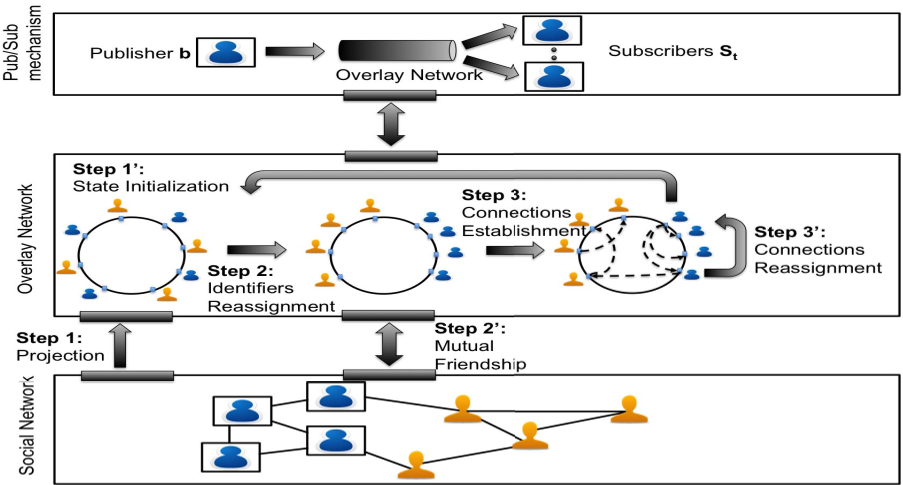 Figure 1: The three-layer architecture of SELECT, mapping social interactions to a ring overlay.
Performance: Crushing the Baselines
The researchers tested SELECT against industry standards like Bayeux, Symphony, and OMen using real-world data from Facebook and Twitter.
- Hops: SELECT requires significantly fewer hops (at least 64% fewer) than Symphony because friends are likely to be direct neighbors or just a few long-range links away.
- Relay Nodes: By ensuring the "Routing Tree" is composed mostly of interested subscribers, SELECT reduces uninterested relay nodes by 98% in some datasets.
- Efficiency: Unlike Vitis, which clusters around high-degree nodes (creating bottlenecks), SELECT distributes load more evenly, preventing "hotspots."
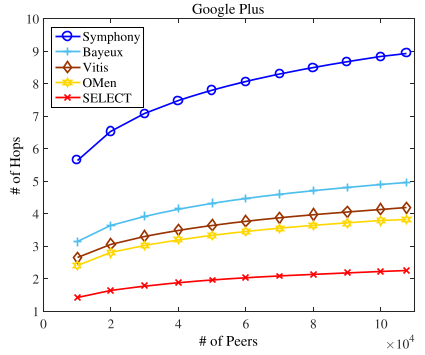 Figure 2: Average hops per social lookup. SELECT maintains a low, stable hop count even as the network grows.
Critical Analysis & Conclusion
SELECT proves that decentralized social networks don't have to be slow. By leveraging the Inductive Bias of social structures—specifically the "Small World" property—the system approximates an NP-hard mapping problem with an elegant heuristic.
Limitations: While efficient, the continuous ID reassignment process requires periodic "gossip" cycles. In extremely high-churn environments or networks with multi-billion users, the overhead of maintaining this "Social Alignment" needs further geographical study (as noted by the authors).
Future Outlook: The integration of WebRTC in their realistic experiments highlights SELECT's potential for browser-based, serverless social platforms. As we move toward a more "DeSoc" (Decentralized Social) future, SELECT provides the blueprint for high-performance, privacy-preserving notification layers.