
Harmonizing the Crowd: Distributed Resource Allocation in Cloud-Based WMSNs
5110_Distributed resource allocation in cloud-based wireless multimedia social networks.
The paper proposes a cloud-based Wireless Multimedia Social Network (WMSN) architecture that leverages desktop users as intermediaries to distribute live streaming to mobile users. It introduces a two-stage resource allocation framework using Stackelberg and Evolutionary games, supplemented by a punishment mechanism to ensure fair bandwidth distribution.
TL;DR
This research introduces a novel architecture for Wireless Multimedia Social Networks (WMSNs) that offloads cloud multimedia distribution to local "desktop users." By modeling user interactions through a combination of Stackelberg and Evolutionary games, and enforcing a cheat-proof punishment mechanism, the authors achieve efficient, decentralized bandwidth allocation that resists selfish manipulation.
The Bottleneck of Mobile Multimedia
As high-definition live streaming becomes ubiquitous, two major hurdles emerge:
- Infrastructure Cost: Content providers pay heavily for wide-area bandwidth, and mobile users face high data charges.
- Device Constraints: Mobile terminals often lack the processing power and battery longevity to handle complex P2P protocols effectively.
The authors argue that the "Social Context"—the relationships and physical proximity between people (family, classmates, colleagues)—is an untapped resource. Why not use high-capacity "Desktop Users" (static devices with better resources) as local cloud relays?
Methodology: A Game of Leaders and Followers
The paper treats resource allocation as a market interaction:
- The Leaders (Desktop Users): They act as sellers, deciding how much bandwidth to share and at what price to maximize their utility.
- The Followers (Mobile Users): They are "semi-rational" players. They observe the satisfaction (utility) of their peers and "evolve" their strategies—re-connecting to different desktop users—until the system reaches an Evolutionary Equilibrium.
Replicator Dynamics
To model how mobile users switch providers, the authors use the following replicator dynamics equation: This captures the "social learning" process: users move toward strategies that offer higher-than-average utility, even when facing information delays ().

Cracking the "Cheating" Problem
In a distributed system, users might be tempted to lie about their minimum bandwidth requirements to pay less while receiving more. The authors find that the standard proportional allocation is vulnerable to this.
The Solution: A Punishment Coefficient. If a mobile user's bid () divided by their reported requirement () falls below 1, the system recognizes potential cheating. The desktop user then artificially reduces the allocated bandwidth for that user, making it impossible for them to watch the live stream smoothly. This forces the optimal strategy back to honesty.
Experimental Validation
The paper provides numerical evidence showing the "Strategic Complement" nature of the game—as one desktop user adjusts, others follow until a unique Nash Equilibrium is reached.
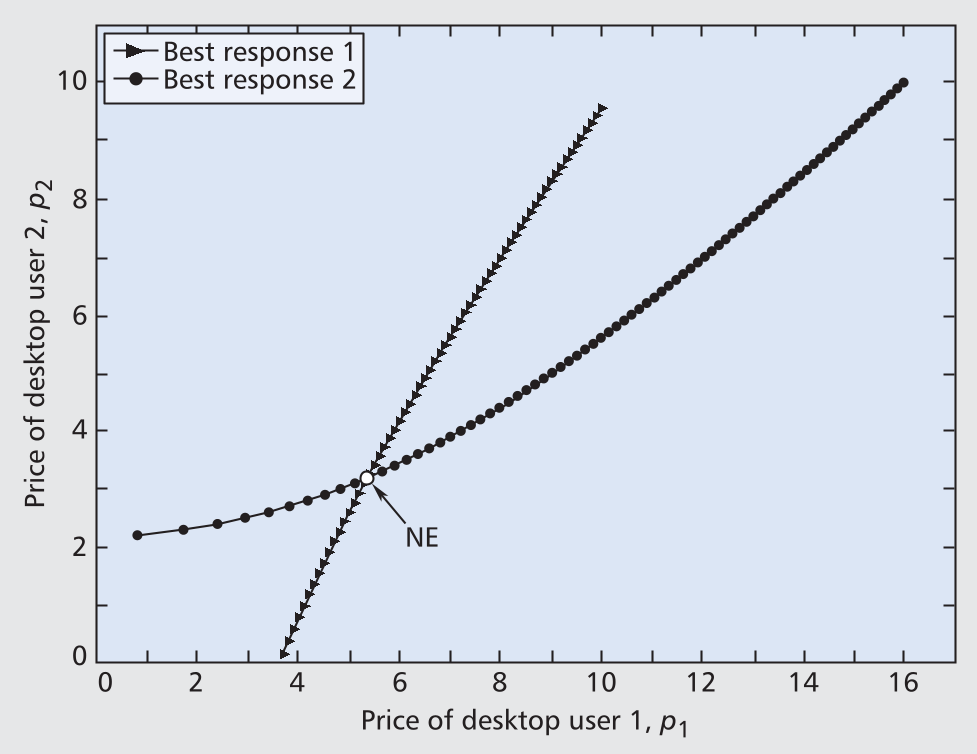
Key findings include:
- Stability: The distributed algorithm converges even with time delays in social learning.
- Effectiveness: The cheat-proof implementation ensures that "honest" bidders always achieve higher residual bonus points and more stable bandwidth than "cheaters" who face heavy penalties.
Critical Insight & Future Outlook
This work elegantly combines Social Contexts with Cloud Computing, shifting the burden of distribution from the core network to the edge. However, the reliance on "Desktop Users" assumes a level of altruism (or simple credit-based incentives) that might require more robust blockchain-based tokenomics in real-world large-scale deployments. The next frontier for this research involves Distributed Elaboration, where mobile users don't just consume, but also contribute to the computation of the multimedia stream itself.
Conclusion
By treating a network as a social organism that learns and punishes, the authors provide a roadmap for the next generation of cost-efficient, resilient multimedia sharing.