
Harmonizing the Social IoT: A Shapley-value Approach to Network Navigability
Using a distributed Shapley-value based approach to ensure navigability in a social network of smart objects
This paper introduces a distributed, game-theoretic friendship selection strategy for the Social Internet of Things (SIoT) using the Shapley-value. The method enables smart objects to autonomously select the most influential social ties to optimize network navigability and service discovery.
TL;DR
As the Internet of Things (IoT) matures into the Social IoT (SIoT), objects must learn to "make friends" autonomously. This paper proposes a distributed strategy using Shapley-value based game theory to ensure that these social ties create a navigable, small-world network. By selecting friends that provide the highest marginal utility for global connectivity, the system reduces search hops and device-level resource consumption.
Problem & Motivation: The Scalability Wall
With billions of smart devices coming online, traditional centralized discovery is dead. The SIoT paradigm treats objects like social entities that search for services through "friends." However, a naive friendship model leads to two failures:
- Explosion of Ties: Too many friends drain an object's memory and battery.
- Navigation Dead-ends: Poorly chosen ties create "echo chambers" (high clustering) where finding a distant service becomes impossible without global knowledge.
The authors' core insight is that navigability (the ability to find short paths using only local info) depends on a delicate balance of local clustering and strategic "bridge" nodes.
Methodology: Game Theory Meets Connectivity
To solve the selection problem, the authors treat candidate friends as players in a Cooperative Coalitional Game.
1. The Utility Function: Why Local Clustering?
The utility of a coalition of friends is defined by . Based on Kleinberg’s principles, nodes with low local clustering are vital because they provide shortcuts to otherwise unreachable parts of the network.
2. The Shapley-value Engine
The Shapley-value measures a node's "fair" contribution to a group. Instead of just looking at how many connections a candidate friend has (degree centrality), the Shapley-value considers how much that node improves the "reach" of a coalition when it joins.
 The Shapley-value () evaluates the average marginal contribution of a node across all possible joining sequences.
3. The Selection Algorithm
When a node hits its maximum friend limit (), it triggers a recalculation. It ranks current and candidate friends by their Shapley-value and retains only the top . This ensures the "social circle" of the object is always optimized for network-wide efficiency.
Experiments and Results
The researchers simulated the strategy on a scale-free network (Barabási-Albert model).
Navigability Gains
By controlling the percentage of "hubs" (nodes with high connectivity), the proposed strategy achieved a lower Average Path Length compared to unrestricted ("no limit") networks. This confirms that a "wise" selection of fewer, more strategic friends is better than a "greedy" selection of many.
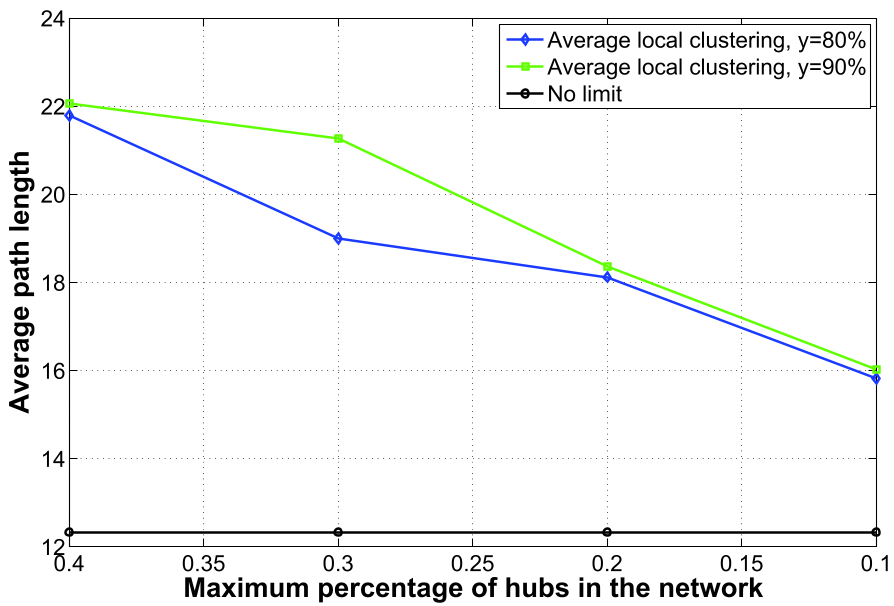 Figure: Average path length decreases as the intelligent hub-selection strategy is refined.
Resource Efficiency
The algorithm drastically reduces the number of contacts a node needs to maintain. This has direct implications for the hardware requirements of IoT sensors, allowing low-power devices to participate in complex social structures without being overwhelmed.
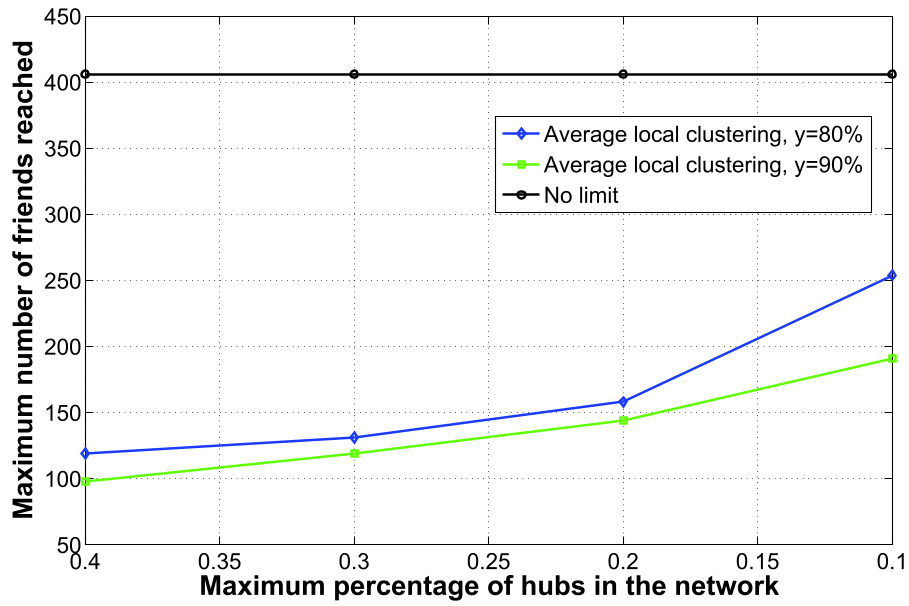 Figure: The strategy limits the maximum number of friends per node, balancing the computational burden.
Critical Insight & Conclusion
The brilliance of this work lies in using Transferable Utility (TU) games to solve a topological problem. While many SIoT papers focus on "trust," this paper focuses on "structure."
Takeaway: Global network efficiency can be an emergent property of local, game-theoretic negotiations. By valuing "bridging" potential over mere "friend count," smart objects can build a truly scalable Internet of Things.
Limitations: The computational cost of calculating Shapley-values grows exponentially with the number of players. Future work must address approximation methods (like Monte Carlo sampling) to keep this running on ultra-constrained edge devices.