
SLP: Decentralizing Location Privacy in Vehicular Social Networks via Social Ties
12766_A Distributed Social-Aware Location Protection Method in Untrusted Vehicular Social Networks.
Summary
Problem
Method
Results
Takeaways
Abstract
This paper presents a distributed Social-Aware Location Protection (SLP) framework for Vehicular Social Networks (VSNs) to safeguard users' location privacy. It introduces three progressively optimized methods—B-SLP, I-SLP, and E-SLP—leveraging social ties and convex hull algorithms to obfuscate sender coordinates without requiring a Trusted Third Party (TTP).
## TL;DR
Researchers have developed a distributed protocol called **Social-Aware Location Protection (SLP)** that hides a vehicle's exact location by blending it with trustworthy neighbors. Unlike previous methods, it doesn't need a central authority and uses a clever "social credit" system (E-SLP) to encourage selfish drivers to help each other, maintaining high query success rates and small, accurate search areas.
## The Core Challenge: The "Selfishness vs. Privacy" Paradox
In Vehicular Social Networks (VSNs), sharing your location to find the "best nearby restaurant" is a double-edged sword. If you reveal your exact coordinates, attackers can track your trajectory. Existing solutions like **k-anonymity** usually require a **Trusted Third Party (TTP)** to "blur" your location. However, in a fast-moving VSN, a TTP becomes a bottleneck or a single point of failure.
Furthermore, while you might want your "friends" in the network to help hide your location, those friends are often selfish. Helping you might reveal *their* location, so they decline to cooperate. This paper tackles the fundamental question: **How do we provide robust location privacy in a decentralized, untrusted environment where participants are inherently selfish?**
## Methodology: Evolution of the SLP Framework
The authors propose three distinct versions of their protocol:
### 1. B-SLP (Basic SLP): The Foundation
B-SLP uses a multi-hop approach where a request is passed through trustworthy users. Each trusted user adds their communication region to a "cloaking area." By the time the request reaches the server, the sender is hidden within a large region of $k$ overlapped areas.
* **Pros**: Works even if no trusted friends are nearby initially.
* **Cons**: The resulting cloaking area is massive, leading to inaccurate query results.
### 2. I-SLP (Improved SLP): Precision via Geometry
To fix the "bloated" area of B-SLP, I-SLP introduces the **GiftWrapping Algorithm**. Instead of just stacking circles, it constructs a **Convex Hull** (the smallest convex polygon) that contains $k$ trusted users.
* **Insight**: This significantly shrinks the "blurred" zone, ensuring that the service provider gives a much more precise answer.
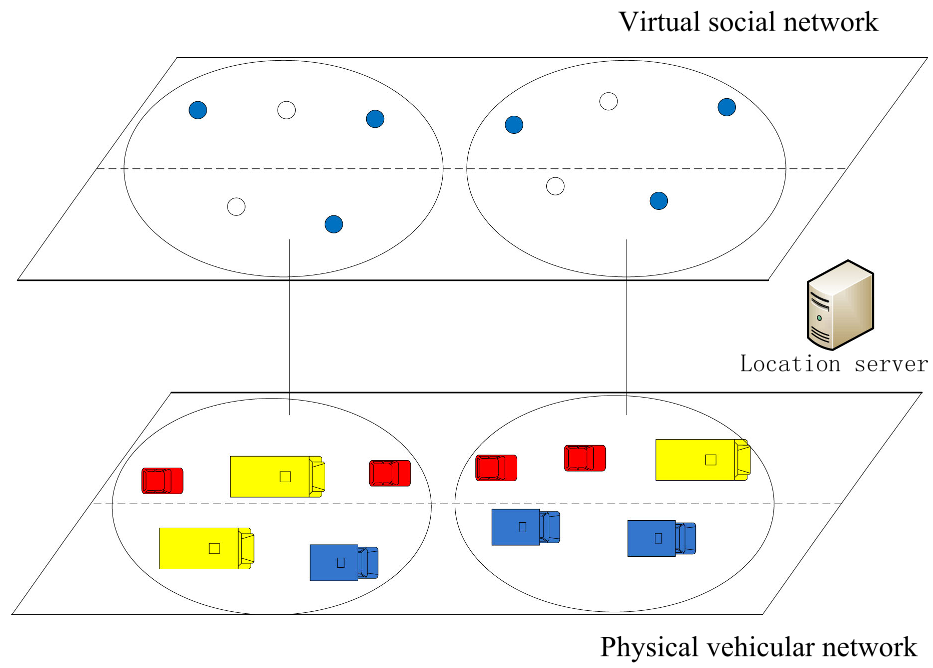
*Fig 1: The dual-layer VSN model: Physical connectivity (V2V) meets Virtual Social Ties.*
### 3. E-SLP (Encouraging SLP): The Social Incentive
This is the most "academic" and innovative part of the paper. Using a **Markov Chain**, the system tracks "Social Ties."
- **Cooperation**: If you help others obfuscate their location, your social tie score increases.
- **Defection**: If you are selfish, your score drops, and eventually, no one will help you when *you* need a query.
- **The Math**: The authors modeled the transition of credits using a probability matrix to ensure that the system reaches a "cooperative equilibrium."
## Experimental Evidence: Success in Action
The researchers tested their methods using **VanetMobiSim** in an urban 5km x 5km map.
### High Success Ratios
While the prior SOTA (HSLP) dropped to a **57% success rate** as privacy requirements ($k$) became more stringent, the SLP methods remained stable above **89%**. This is because SLP isn't forced to find social friends in the first few hops; it can route through untrusted nodes while keeping the payload hidden.
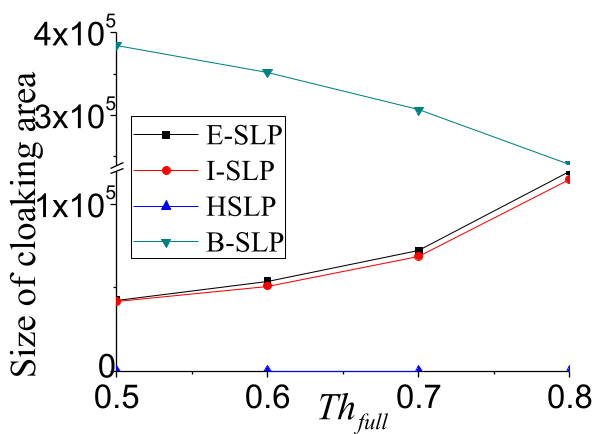
*Fig 2: SLP maintain high success ratios even as k (anonymity set size) increases.*
### Efficiency and QoS
The Improved (I-SLP) version reduced the cloaking area size by nearly **85%** compared to the basic version.
- **B-SLP Area**: ~350,000 m²
- **I-SLP Area**: ~53,000 m² (A much tighter bound for better service accuracy).
## Critical Analysis & Takeaways
The standout contribution here is the **E-SLP incentive model**. It recognizes that privacy in decentralized networks is a **collective action problem**. By linking personal privacy quality to social reputation (Social Ties), they create a self-sustaining ecosystem.
**Limitations**: The model assumes that the "Social Tie" value can be transmitted via ACK/Safety messages and stays consistent across different users. In a real-world scenario, Byzantine attackers might attempt to forge their reputation scores.
**Future Outlook**: This framework sets a precedent for **Trustworthy VSNs**. Future work could integrate **Blockchain or TEEs (Trusted Execution Environments)** to make the "Social Tie" updates tamper-proof, further hardening the system against malicious actors.