
Distributed Social Computation: Why "Good Enough" is Fast, but "Perfect" is Hard
An Instance of Distributed Social Computation: The Multiagent Group Membership Problem
The paper investigates the "Group Membership Problem" using a distributed multiagent system where leaders and followers interact locally to form groups of specific sizes. It proposes a simple, memoryless, and self-stabilizing algorithm that achieves an approximate stable matching in polynomial time, matching the performance patterns observed in human-subject laboratory experiments.
TL;DR
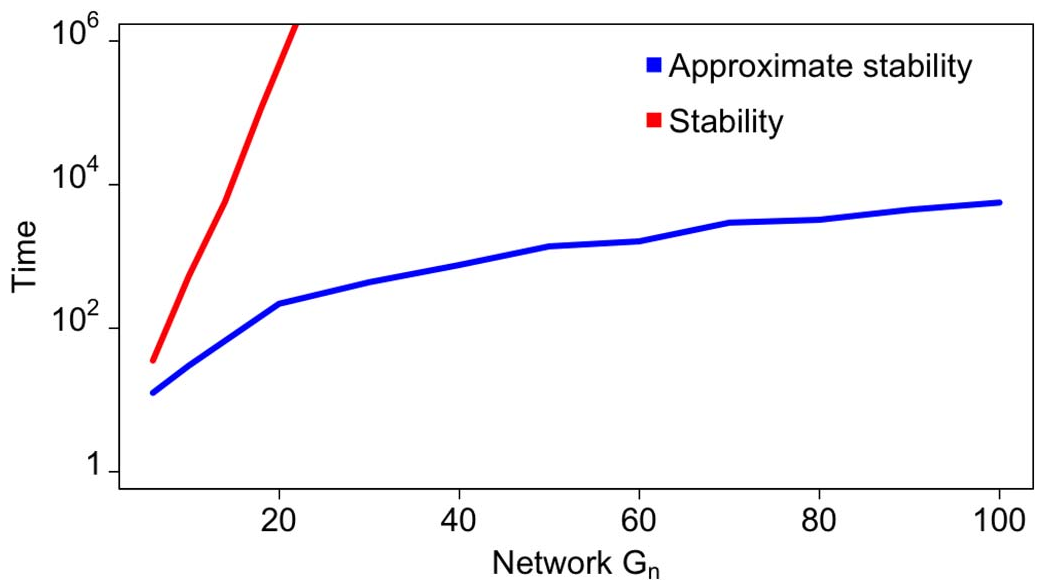
Can simple math predict how a crowd of people solves a complex coordination problem? In this paper, researchers demonstrate that a basic, memoryless distributed algorithm can mimic human behavior in a "group membership" task. The key finding: reaching a 90% solution is mathematically "easy" (polynomial time), but reaching 100% perfection is "hard" (exponential time)—a phenomenon mirrored perfectly by human participants in lab settings.
Background: The Social Matching Problem
Imagine a network of Leaders and Followers. Every leader wants a team of a specific size (e.g., 3 members). They can only recruit followers they are directly connected to. This is the Group Membership Problem.
In the world of Distributed Social Computation, we don't have a central "boss" assigning people to groups. Instead, individuals must interact locally. The authors ask: What simple rules lead to a stable state (Social Welfare) where everyone's requirements are met?
The Problem: The Curse of Perfection
In many multiagent systems, we assume agents are "hyper-rational" or have infinite memory. Real humans are messy, have limited attention, and often act on local incentives. Previous work either proved that stability could be reached (eventually) or focused on specific network types.
The authors identify a critical gap: The Tradeoff between Quality and Time. They hypothesize that "approximate stability" (most leaders are happy) is reached rapidly, but "absolute stability" (everyone is happy) creates a bottleneck that humans and algorithms alike struggle to overcome.
Methodology: Simple Rules, Complex Dynamics
The authors propose a remarkably simple algorithm.
- Leaders: If you don't have enough followers, ask an unmatched one. If none are free, ask a matched one at random.
- Followers: If you get a request, maybe accept it, maybe don't (randomized). If you're already matched, you might switch.
The Mechanism: Deficit-Decreasing Paths
To analyze this, they use the concept of a Deficit. If a leader needs 3 followers but has 2, their deficit is 1. The total deficit of the network is the sum of these gaps.
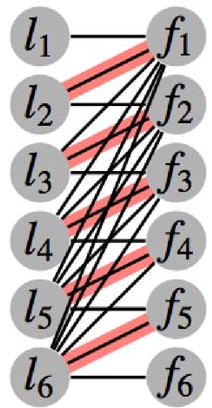
The algorithm works by finding and "solving" these paths (seen above). By flipping the edges along a path, the total deficit of the network drops.
Experiments: Humans vs. Algorithms
The researchers didn't just stop at math; they put 16 humans in a room and gave them a point-and-click interface to solve the same problem on virtual networks for money.
1. Scaling Comparison
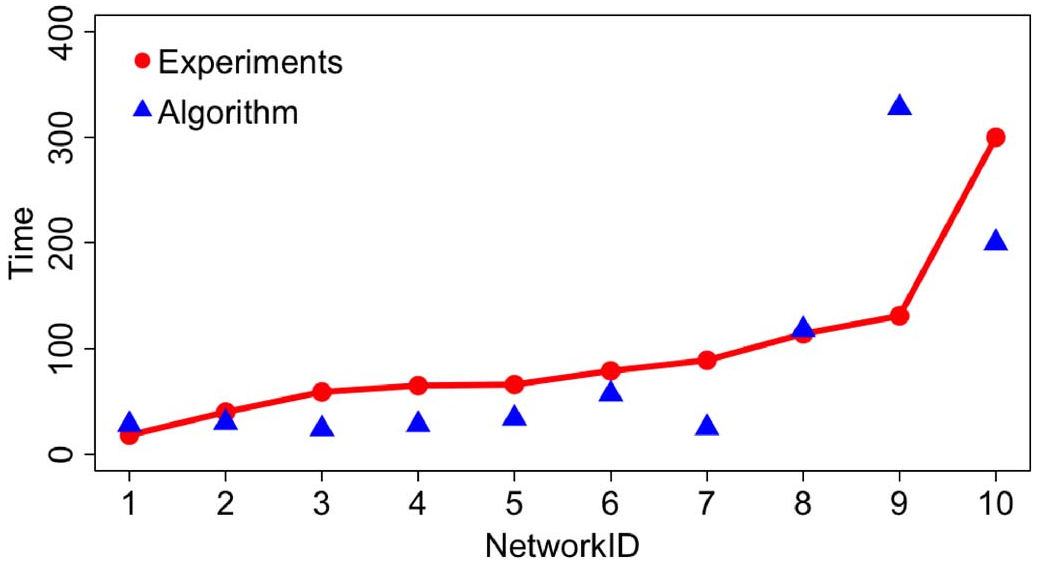
The algorithm predicted that certain "cascade" networks (where one change forces a chain reaction) would be exponentially hard. As seen in the figure below, the human solving time (red) and the algorithm's rounds (blue) aligned significantly across 10 different network architectures.
2. The 90% Rule
One of the most striking findings was that humans reached a state where only one leader was dissatisfied very quickly (within ~7% of the total time). They spent the remaining 93% of their time trying to fix that last single deficit.
Critical Insight: The "Synthetic Agent" Hypothesis
The most profound takeaway here is that you don't need to model every individual human's strategy (some humans "blink" their icons to get attention, others are stubborn). Instead, a uniform strategy—where every agent follows the same simple local rule—can accurately predict the aggregate performance of a heterogeneous crowd.
Limitations & Future Work
While powerful, the model assumes a fixed network. In the real world, social ties change. The authors note that while their "Probability-based" model (PTAS) provides a guarantee for static networks, the "moving target" of a dynamic network remains a frontier for future investigation.
Conclusion
This research bridges the gap between computer science and sociology. It tells us that in large-scale social systems, we can expect "mostly good" solutions to appear almost instantly through local interactions, but achieving global perfection is a fundamentally difficult computational task—regardless of whether the "processors" are silicon chips or human brains.