
Distributed Social Learning: Why Perfect Information is Overrated for Crowd Intelligence
Distributed Social Learning With Imperfect Information
This paper proposes an iterative three-staged algorithm—Sampling, Selection, and Adoption—to solve the social learning problem in multi-hop networks. By utilizing Metropolis-Hastings Random Walks for approximately uniform sampling, the method achieves nearly optimal regret while maintaining polylogarithmic communication and time complexities, even in the presence of malicious nodes.
TL;DR
In the quest for optimal decision-making within social groups, conventional wisdom suggests more information is always better. However, a new study reveals that Distributed Social Learning can be more efficient when nodes rely on "Imperfect Information." By using a three-stage sampling-selection-adoption process, networks can achieve nearly optimal regret with a fraction of the communication cost, even when some nodes are actively lying.
Background Positioning
This work resides at the intersection of Social Learning and Distributed Algorithms. While previous "Full Information" models (like Celis et al., 2017) provided a theoretical baseline, they failed in real-world large networks due to communication requirements. This paper bridges that gap by moving from global broadcasts to local random walks, proving that decentralized systems can be both robust and lean.
The Problem: The High Cost of Knowing Everything
Existing social learning paradigms assume every agent in the network has a bird's eye view of everyone else’s decisions. In a multi-hop graph, this leads to two fatal flaws:
- Congestion: The "broadcast" requirement floors the network under the weight of messages per node.
- Vulnerability: One malicious node can flood the network with falsified signals, poisoning the collective "well" of knowledge.
The authors ask: Can we reach the same level of group intelligence if we only see a small, random slice of the population?
Methodology: The Three-Stage Cycle
The paper introduces a fully distributed algorithm that repeats three stages in every phase :
1. Sampling (The Random Walk)
Instead of waiting for a broadcast, each node initiates Metropolis-Hastings Random Walks (MHRW). This allows nodes to sample the adoptions of peers uniformly across the graph.
- Intuition: In expander graphs, random walks mix very quickly, meaning a few steps are enough to get a representative "poll" of the entire network's state.
2. Selection (Exploration vs. Exploitation)
Using the collected samples, a node calculates the popularity of each option. With probability , it explores randomly; otherwise, it selects an option proportional to its sampled popularity. This mimics the Multiplicative Weights Update (MWU) framework.
3. Adoption (The Quality Filter)
Once an option is selected, the node tests it against a stochastic reward. The node "commits" to the adoption only if the reward signal is strong, using parameters and to control sensitivity to recent feedback.
Theoretical Breakthroughs
The core contribution is a rigorous proof that the Regret (the gap between the chosen strategy and the best possible one) is bounded by for a sufficiently large .
- Key Insight: The authors show a "coupling" between the finite population dynamics (discrete nodes) and infinite population trajectories (fluid dynamics). They prove that the error induced by sampling and malicious nodes stays within a tight bound, allowing the system to converge to the optimal choice.
Performance: Faster, Leaner, Safer
The experimental results are striking. Under a 1000-node expander graph:
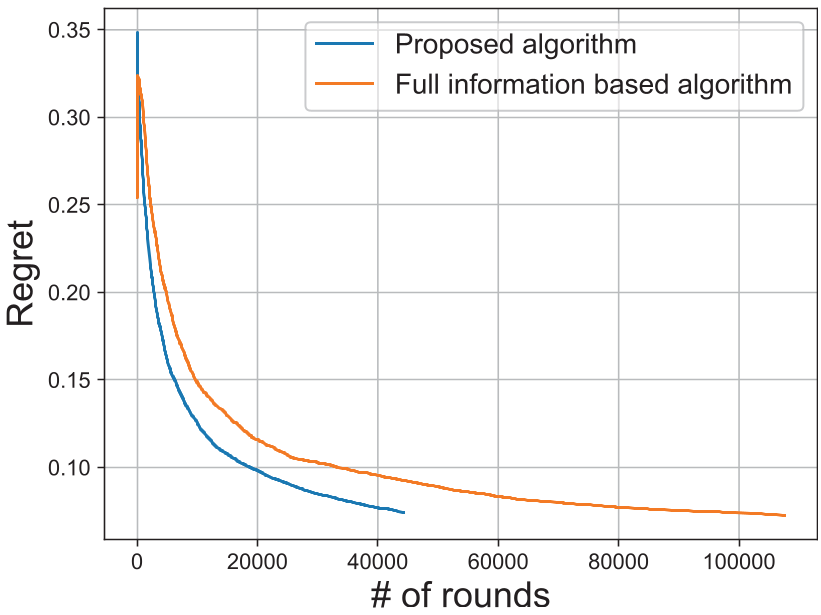
- Speed: The proposed method converged in ~43,000 rounds, whereas the full-information model lagged significantly, requiring ~110,000 rounds.
- Robustness: When the "adversity indicator" was kept below 0.02, the regret remained within theoretical bounds, proving the system can ignore "noise" from malicious actors.
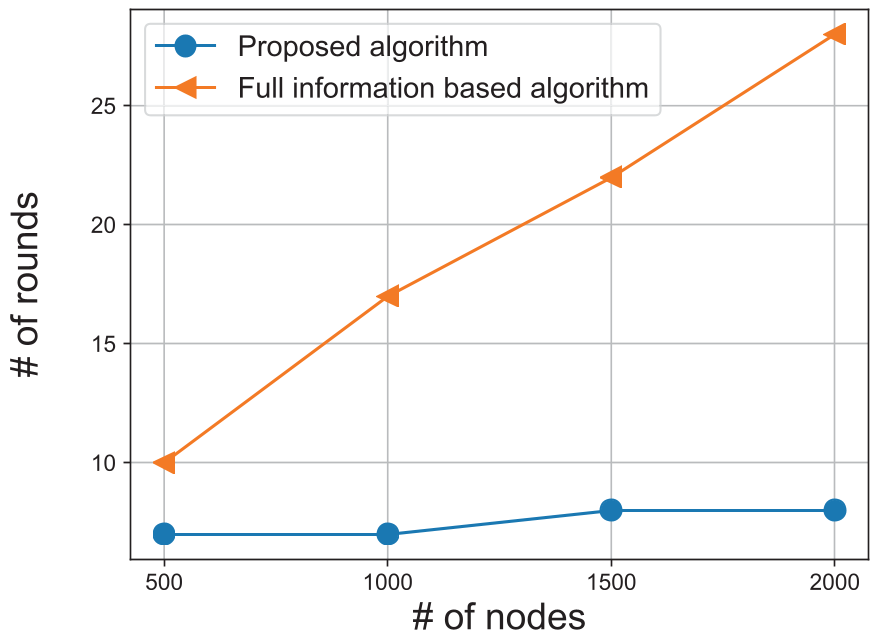 As seen in the figure above, the message complexity (b) and time complexity (a) of the proposed algorithm (solid lines) grow far more gracefully than the full-information baseline (dashed lines).
Critical Analysis & Takeaways
This paper shifts the focus of social learning from centralized data aggregation to decentralized stochastic estimation.
Limitations:
- The results depend heavily on the network being a p-expander. In highly partitioned networks or "silos," the random walk might take much longer to produce a uniform sample, potentially leading to local optima.
- The adversarial model assumes malicious nodes only fake their own data; they do not interfere with the communication protocol itself.
Conclusion: The takeaway for developers of distributed systems and multi-agent AI is clear: Network diameter and mixing time are more important than global state synchronization. By embracing "imperfect" but well-sampled information, we can build social groups that are significantly more scalable and resilient than those relying on total transparency.