
Beyond Grab Sampling: Distributed Wireless Sensors Revolutionizing Salinity Monitoring
5832_Application of Distributed Wireless Chloride Sensors to Environmental Monitoring Initial Results.
This paper presents a low-cost, screen-printed potentiometric chloride sensor integrated into a wireless sensor network for real-time hydrological monitoring. The system achieves high spatial and temporal resolution in detecting salinity levels, demonstrating viability across soil columns, river simulators (fluvariums), and greenhouse environments.
Executive Summary
TL;DR: Researchers from the University of Southampton and the University of Western Australia have developed a low-cost, screen-printed chloride sensor capable of long-term deployment in wireless networks. These sensors provide a "high-definition" view of salt movement in soil and water, revealing complex behaviors like preferential flow and extreme diurnal fluctuations that were previously invisible to standard monitoring techniques.
Positioning: This work bridges the gap between laboratory electrochemistry and field-scale environmental engineering, moving from theoretical sensor design to practical, distributed deployment.
The Problem: The "Snapshot" Limitation
Managing soil salinity is critical for global food security, yet our current "eyes" on the problem are blurry. Conventional monitoring typically uses:
- Grab Sampling: Laborious and provides only a single snapshot in time.
- Conductivity Proxies: Easily fooled by fertilizers or other ions.
- High-End Loggers: Too expensive for high-density distribution.
Without high-resolution data, irrigation with brackish water (a vital strategy for water-scarce regions) remains risky, as localized salt buildup can destroy crop yields before it is detected.
Methodology: High-Tech Printing for Low-Cost Sensing
The core of this research is a potentiometric sensor that generates a voltage proportional to the chloride concentration, following the Nernst equation.
Key Technical Features:
- Screen-Printed Architecture: Uses an alumina substrate with silver layers, making the sensors cost roughly one Euro to produce.
- Self-Generating Potential: Since they are potentiometric, the sensors consume almost no power themselves—only the logging electronics require a battery.
- Temperature Resilience: The team applied linear regression compensation to handle greenhouse swings from 13°C to 35°C.
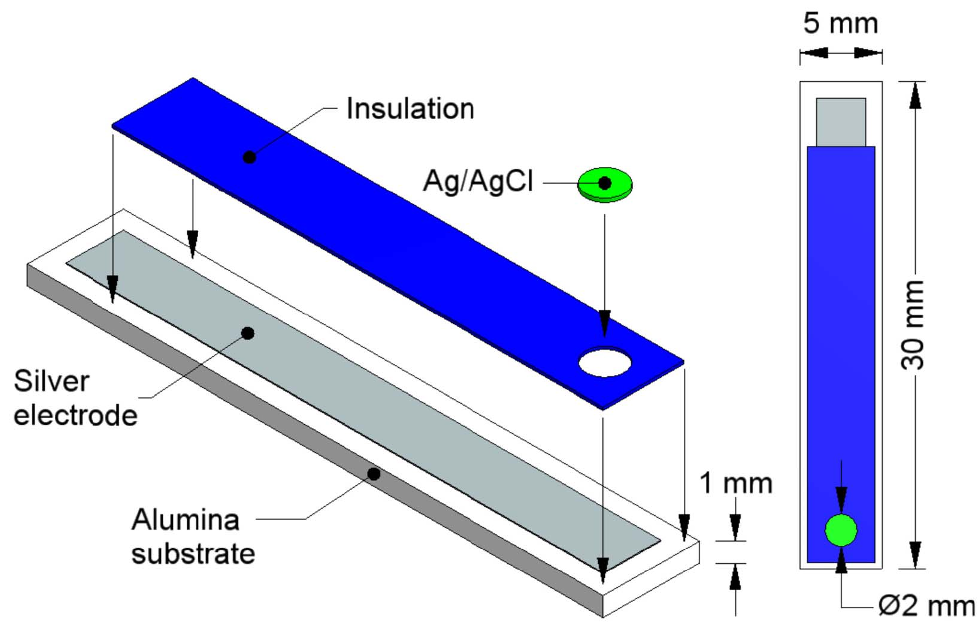 Figure 1: Schematic showing individual layers and dimensions of the screen-printed sensor.
Experiments and Insights
The researchers moved beyond the lab bench to three increasingly complex scenarios:
1. The Soil Column: Revealing "Hidden" Paths
By placing six sensors at 50mm intervals in a soil core, the team matched theoretical "breakthrough curves" perfectly (100% mass recovery). However, they also detected preferential flow pathways—underground "highways" where salt moves faster than predicted by uniform models. This proves that single-point sampling can be dangerously misleading.
2. The Fluvarium: Tracking Stream Transients
In a 20m river simulator, the sensors tracked a chloride pulse moving downstream. Interestingly, they found that chloride diffusion from the surface flow into the river bed was extremely slow—an insight crucial for understanding how pollutants interact with aquatic ecosystems.
3. The Greenhouse: The 24-Hour Salinity Rollercoaster
Over a 12-day trial, the sensors revealed a shocking diurnal variation. As soil dried during the day, chloride concentration at the surface spiked from 100 mM to 1000 mM, only to drop again at night due to capillary movement or condensation.
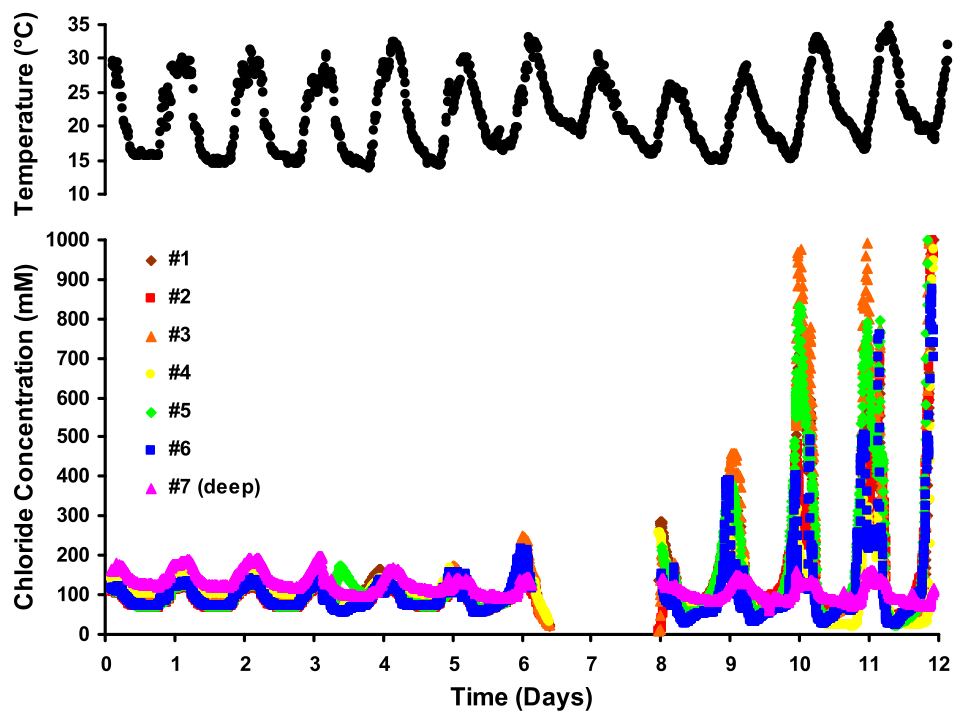 Figure 2: Real-time concentration data showing the massive diurnal swings in salinity related to ambient temperature.
Critical Analysis & Conclusion
Takeaway
The ability to produce "scientific data at high spatial and temporal resolutions" for the price of a few euros marks a turning point. It enables Precision Irrigation, where farmers can mix fresh and salty water safely because they can finally see the salt moving in real-time.
Limitations
- Calibration: Absolute accuracy still requires fine-tuning, especially regarding the drift of reference electrodes.
- Reference Electrodes: The current study used commercial gel electrodes; future work needs to fully integrate a screen-printed reference to keep the form factor small.
The Future
The next step is the integration of these sensors into State Space Models (SSM) or machine learning frameworks to predict salinity trends before they reach toxic levels, potentially saving millions of liters of potable water worldwide.