
Harnessing Social Dynamics: Optimal and Scalable Content Updates in Mobile Networks
Poster Abstract: Distributing Content Updates over a Mobile Social Network *
The paper investigates the dissemination of dynamic content updates (e.g., news, traffic) in Mobile Social Networks (MSNs) using a hybrid approach of service provider injection and opportunistic peer-to-peer sharing. It proposes a convex optimization framework to maximize social welfare and proves that content age scales logarithmically with the number of users in expander-like social graphs.
TL;DR
Information "freshness" is the currency of the digital age. This paper provides a mathematical foundation for distributing content updates (like news or stock prices) over mobile social networks. By combining limited cellular broadcasts with opportunistic peer-to-peer "pushes" when users meet, the authors prove that even with fixed provider bandwidth, the system scales beautifully—keeping content fresh for thousands of users while only targeting a few "social hubs."
The Scalability Bottleneck: Why Centralized Distribution Fails
As the number of mobile subscribers () grows, a service provider faces a dilemma: to keep content fresh at every device, it must either increase total downlink bandwidth linearly with or accept that content will become increasingly stale.
The authors argue that we are overlooking a massive, underutilized resource: opportunistic contacts. When people move through cities or conferences, their devices naturally come into proximity (Bluetooth/WiFi range). If these devices share their most recent updates, the social network itself becomes a distributed caching and forwarding engine.
Methodology: Convexity and Social Welfare
The core contribution is treating content distribution as a Social Welfare Maximization problem.
1. The Optimization Framework
The provider has a total injection rate . It must decide how to split this rate () among users. Each user derives a utility based on the age of their content ().
The breakthrough here is Theorem 1: If the contact process is stationary ergodic, the problem is convex. This means there is a "global best" way to allocate bandwidth that can be found via gradient descent, even in complex social environments.
2. The Scaling Law: The Power of Expanders
How does the content age grow as ? Using spectral graph theory, the authors link the "Edge Expansion" () of the social contact graph to the content age.
- The Result: If the social graph is an "expander" (meaning it lacks isolated bottlenecks), the content age only increases by .
- Physical Intuition: In a well-connected social group, information spreads exponentially fast, counteracting the relative scarcity of the provider's broadcast rate.
 Above: The conceptual model where a provider injects updates into a social fabric.
Empirical Insights: Who Gets the Data?
Using real-world mobility traces (Infocom06 iMotes and MIT RealityMining), several fascinating behaviors emerged:
- The "Social Hub" Strategy: When the provider's bandwidth () is very low, the optimal strategy is to inject all updates into the most "central" or "social" user. This user then acts as the network’s heart, pumping information to everyone else.
- The Transition: As increases, the strategy shifts toward a uniform allocation. Eventually, when the provider has plenty of bandwidth, the benefits of social sharing diminish because users receive updates directly from the source anyway.
- The Middle Ground Phenomenon: At intermediate rates, the optimal strategy is surprisingly complex—sometimes even bypassing the most social nodes because they are already "flooded" with information from peers.
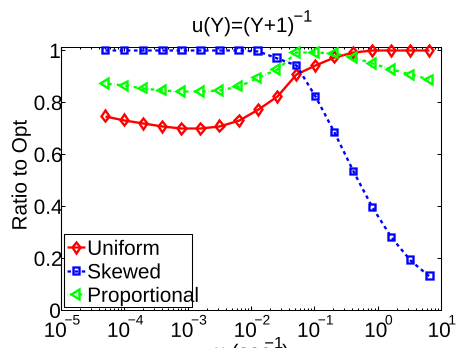 Figure: At small (a-b), injection is concentrated on social leaders. At higher rates (d), it becomes uniform.
Performance Comparison
The authors compared their optimal allocation against simple heuristics like "Uniform" (everyone gets equal share) and "Skewed" (only the most social user gets updates).
| Injection Rate () | No Sharing (Age < ) | Optimal Allocation |
|---|---|---|
| Low (0.0128) | 2.5% | 34% |
| High (0.1024) | 19% | 60% |
The "No-Sharing" baseline (standard cellular distribution) is abysmal compared to the social-aware strategy, providing a nearly 13x improvement in user satisfaction at low bandwidth levels.
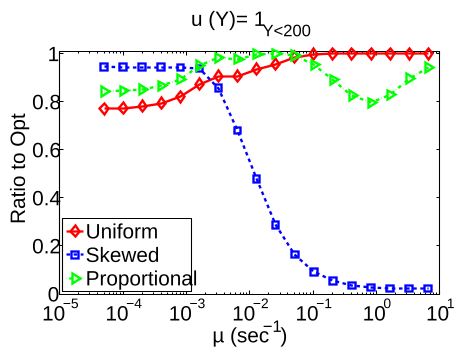 Figure: The optimal strategy significantly outperforms the uniform baseline, especially in bandwidth-constrained scenarios.
Conclusion and Future Outlook
This work provides a rigorous mathematical proof that Mobile Social Networks are naturally scalable. By understanding the "expansion" properties of human movement, we can design content protocols that are robust to population growth.
Limitations & Open Questions:
- Incentives: Why should a user use their battery to push data to others? Future work needs to integrate "Reciprocity" or "Token" rewards.
- Privacy: Sharing updates reveals who you meet and what you are interested in.
- Content Diversity: This model assumes a single stream of updates; how does it change with thousands of competing channels (e.g., personalized TikTok feeds)?
Looking forward, these principles are highly relevant for 5G/6G Device-to-Device (D2D) communication and decentralized "Off-Grid" networks.