
DGPO: Unlocking Deep Reasoning with Distribution-Guided Token-Level Credit Assignment
Distribution-Guided Policy Optimization for Fine-Grained Credit Assignment
The paper introduces Distribution-Guided Policy Optimization (DGPO), a critic-free RL framework designed to align LLMs for complex reasoning. By replacing sequence-level advantage broadcasting with token-level redistribution guided by distribution deviation, it achieves SOTA results including 60.0% Avg@32 on AIME2024 using Qwen2.5-32B.
TL;DR
Researchers from Peking University, SJTU, and Tsinghua have unveiled Distribution-Guided Policy Optimization (DGPO). This novel framework solves the "lazy" credit assignment problem in LLM reasoning by breaking down global sequence rewards into fine-grained token-level signals. By replacing the volatile KL-divergence with the bounded Hellinger distance and adding an entropy gate, DGPO achieves SOTA reasoning performance on AIME benchmarks without the massive memory overhead of traditional Value Networks.
Problem & Motivation: The "Coarse-Grained" Dilemma
In the current RL state-of-the-art (like DeepSeek-R1 or GRPO), models are often rewarded based on the final answer. However, a mathematical proof might be 1,000 tokens long. Standard methods apply the same reward to the "Therefore" (transitional) as they do to the "Pivotal substitution" (the breakthrough). This is Coarse-Grained Credit Assignment.
Furthermore, standard RL uses Reverse KL Divergence to keep the model from straying too far from its original self. The problem? KL is unbounded. If the model finds a brilliant but "low probability" way to solve a problem, the KL penalty explodes, causing gradient spikes and killing the innovation.
Methodology: From Penalty to Guidance
DGPO flips the script: Deviation is not a crime; it is a signal.
1. The Hellinger Advantage
Instead of Kullback-Leibler, DGPO uses the Hellinger Distance. Because this metric is strictly bounded between [0, 1], the model can explore aggressively without risking "gradient explosion."
2. The Entropy Gate: Filtering the Noise
Large deviations aren't always good—sometimes the model is just hallucinating with high confidence. DGPO introduces Entropy Gating. It scales the Hellinger deviation by the model's uncertainty (Shannon Entropy).
- High Deviation + High Uncertainty = Genuine exploratory leap (Rewarded).
- High Deviation + Low Uncertainty = Confident hallucination (Discounted).
3. Smart Redistribution
The sequence reward is then "broadcasted" using a softmax-weighted mechanism across tokens. Tokens that represent genuine cognitive leaps get a massive share of the credit, while filler words get almost none.
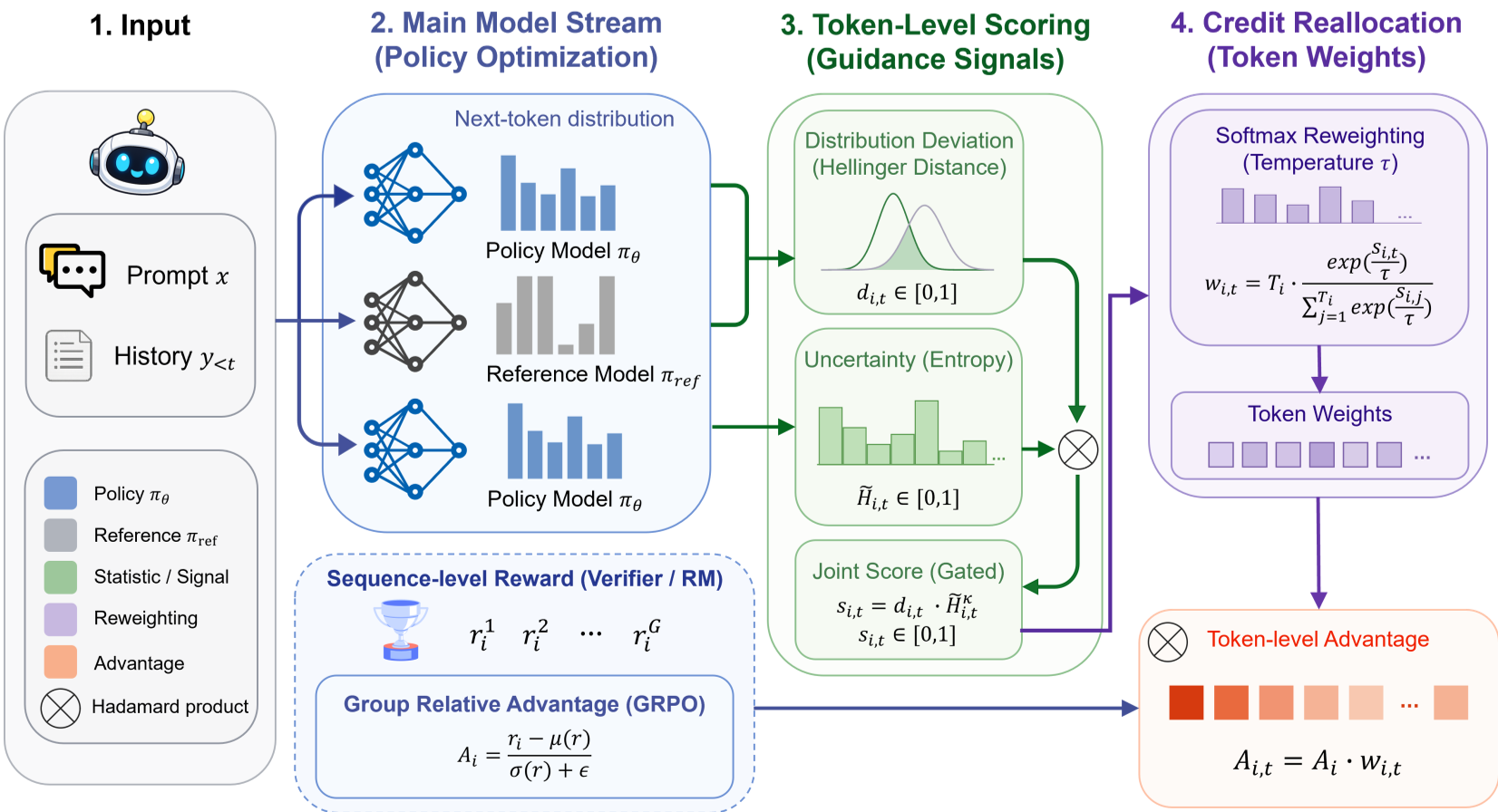 Figure 1: The DGPO computational pipeline showing how global rewards are transformed into token-level guidance.
Experiments & Results: SOTA Performance
The researchers tested DGPO on the grueling AIME (American Invitatory Mathematics Examination) 2024 and 2025 benchmarks.
- Qwen2.5-32B Performance: DGPO reached 60.0% Avg@32 on AIME 2024, leaving the previous SOTA (DAPO) behind at 50.0%.
- Scaling Efficiency: Even on a 7B model, DGPO doubled the performance of vanilla GRPO (43% vs 22%).
- Hardware Friendly: Unlike PPO, which requires an auxiliary "Critic" model (increasing memory by ~60%), DGPO adds a negligible 3.6% time overhead while fitting into the same memory footprint as sequence-level methods.
 Table 1: Main benchmark results on AIME 2024 and 2025 showing clear leads over DAPO and FIPO.
Critical Analysis & Takeaways
The brilliance of DGPO lies in its Inductive Bias. It assumes that the tokens most responsible for a correct answer are those where the model "had to think differently" (deviated from the reference) but "wasn't sure" (high entropy).
Visualizing the Credit
The qualitative results show that "pivotal" steps in equations are highlighted in the gradient landscape, while standard syntax is ignored.
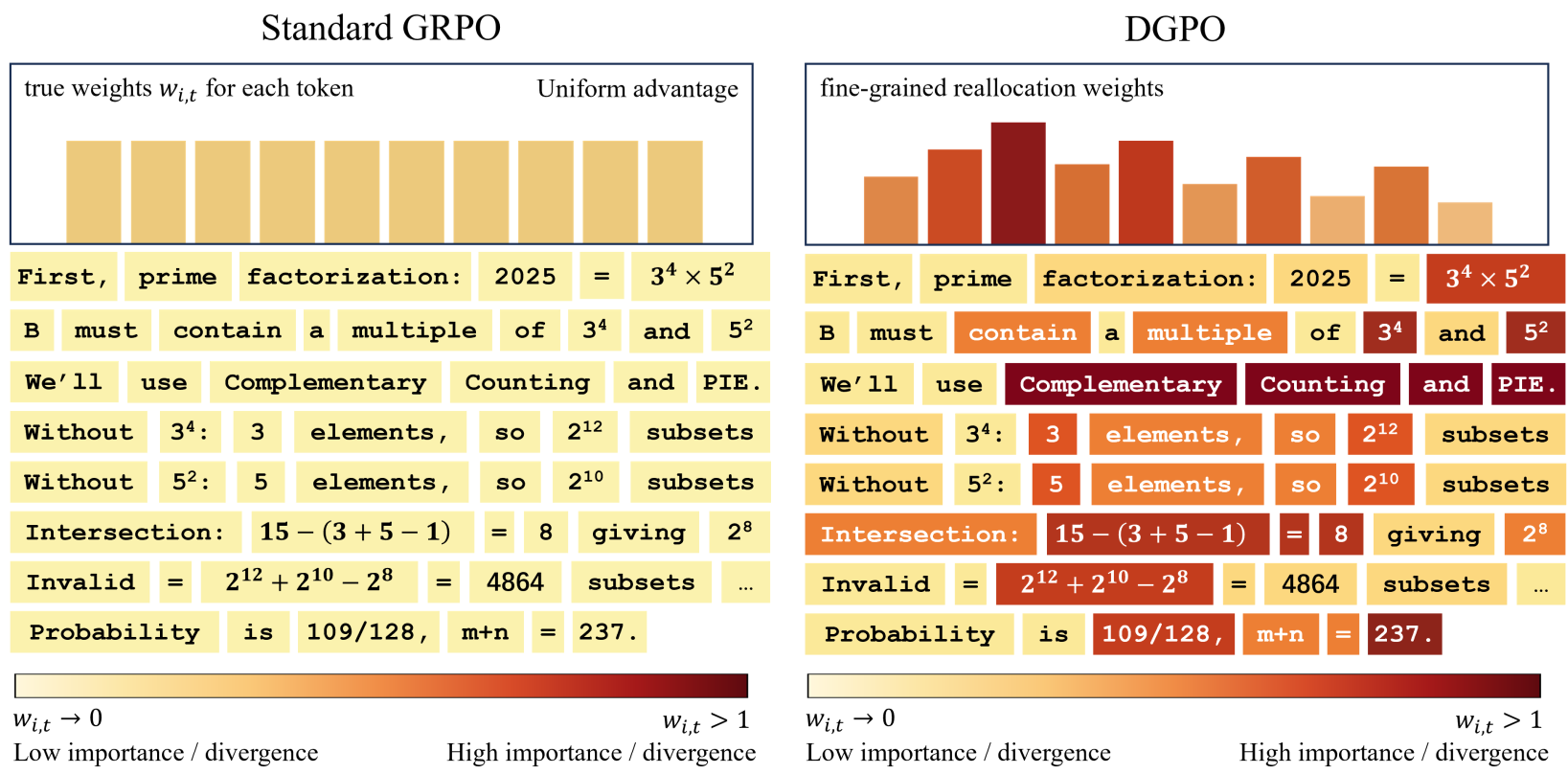 Figure 2: Heatmap of token-level weights—darker colors indicate the "breakthrough" steps favored by DGPO.
Limitations
- Hyperparameters: You still need to tune the temperature () and the gating scale ().
- Domain Focus: This paper heavily focuses on math; its performance in creative writing or coding is yet to be fully stressed.
Conclusion
DGPO represents a significant step towards automated process-level supervision. By mining the internal probability distributions of the language model itself, we no longer need human-labeled step-by-step rewards to achieve deep reasoning. It is stable, efficient, and paves the way for the next generation of "Reasoning Models."