
The Hidden Ethics of Environmental Algorithms: Why "How We Measure" Matters for Justice
The Distributive Eects of Risk Prediction in Environmental Compliance: Algorithmic Design, Environmental Justice, and Public Policy
This paper evaluates the distributive effects of machine learning models used by the U.S. EPA to enforce the Clean Water Act. By comparing classification-based targeting (SNC status) against regression-based targeting (exceedance intensity), the researchers demonstrate how algorithmic design choices directly influence which communities receive environmental protection.
TL;DR
Can a machine learning model designed to protect our water actually exacerbate racial and social inequality? According to a recent study presented at FAccT '21, the answer is a resounding yes. By analyzing the U.S. EPA's National Compliance Initiative, researchers found that focusing on "violation rates" (Classification) rather than "pollution scales" (Regression) shifts environmental protection away from high-minority, urban communities toward whiter, rural areas.
The Friction Between Law and Data
The Clean Water Act is the bedrock of U.S. water protection, but "Significant Noncompliance" (SNC) remains rampant. The EPA's ambitious goal is to halve the SNC rate. To achieve this, they are turning to AI to predict which facilities will fail next.
However, the authors identify a critical Design Gap: The law treats a 41% limit exceedance the same as a 400% exceedance once the "SNC" threshold is crossed. In the world of data science, this translates to a choice between Classification (Is it a violation?) and Regression (How bad is the violation?). This paper argues that this technical choice is actually a profound social choice.
Methodology: Forecasting the Flow
The researchers constructed a sophisticated pipeline to simulate EPA decision-making. They utilized Random Forest models built on 27 features, including:
- Historical Compliance: Past patterns of SNC.
- Facility Metadata: Individual vs. General permits, flow volumes.
- ARIMA Time-Series: Using historical discharge reports to forecast future pollution volumes.
The Model Architecture
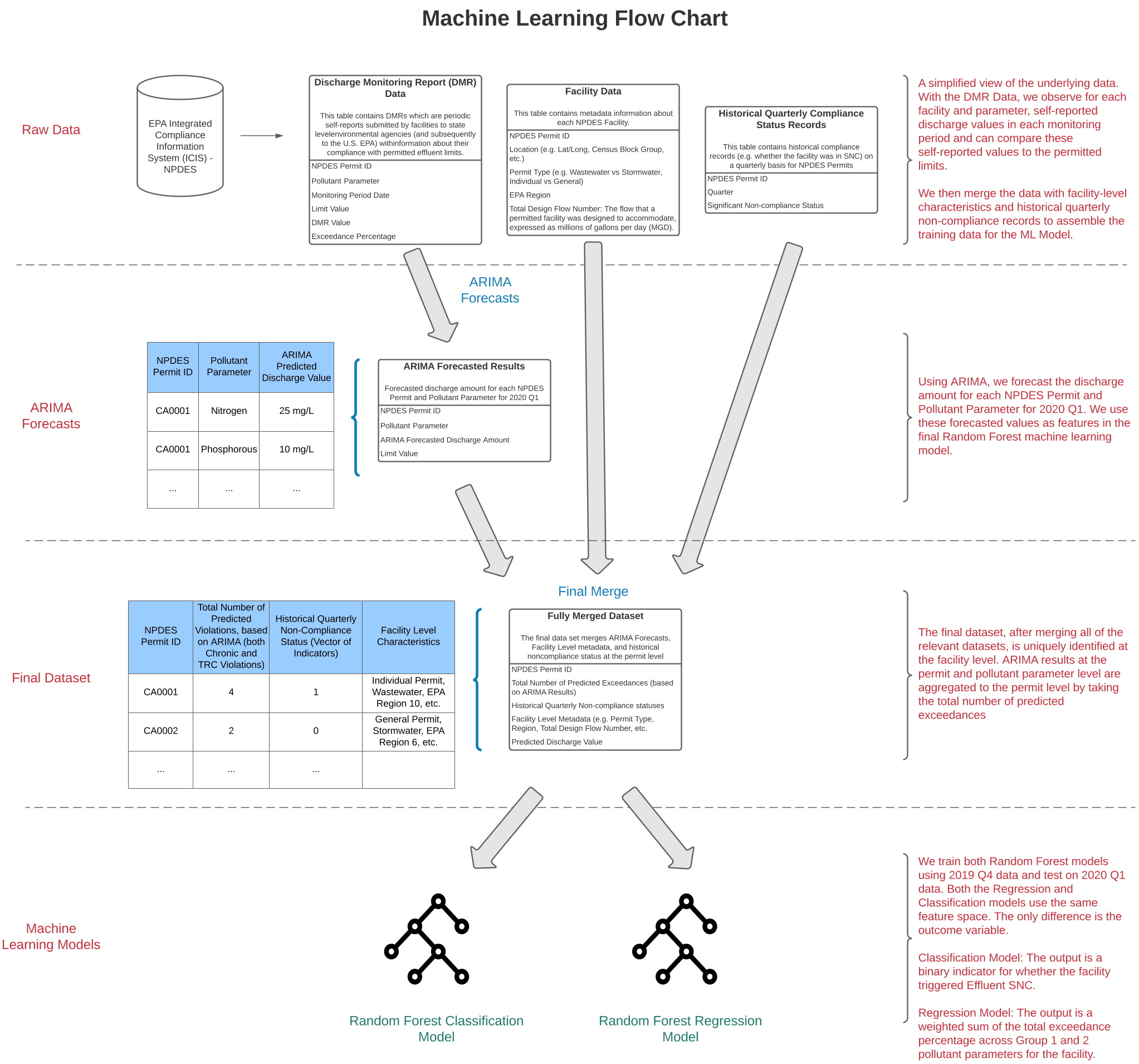 The pipeline integrates raw ICIS-NPDES data through ARIMA forecasting into parallel Random Forest models to compare priority lists.
Experimental Results: The Geography of Injustice
The most striking finding involves the distributive impact. When the model targets the intensity of pollution (the Regression approach), it prioritizes facilities in areas with significantly higher minority populations and higher population density.
Key Evidence: The Oracle Test
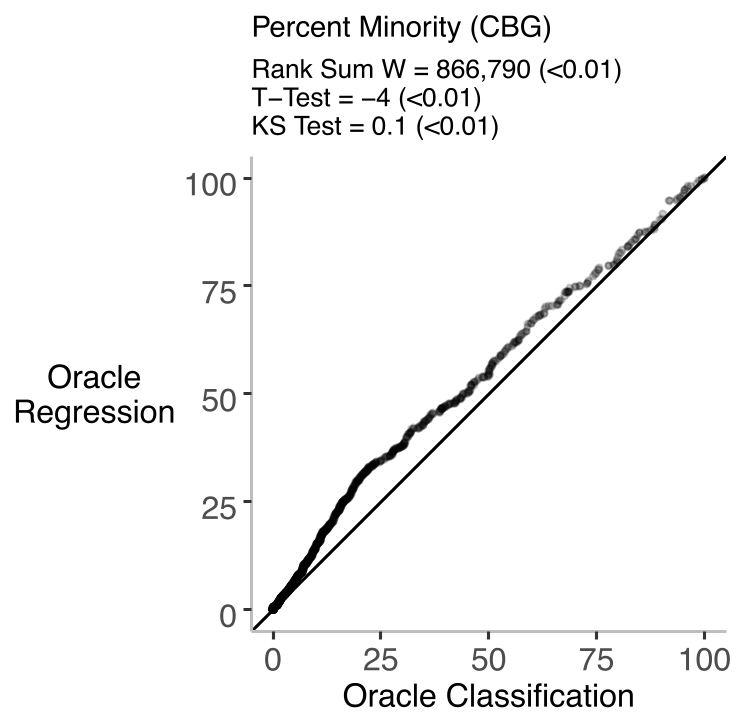 QQ plots show that the Regression model (Y-axis) consistently targets communities with a higher percentage of minority residents and higher density compared to the Classification model (X-axis).
- Environmental Federalism: The study reveals that "General" vs. "Individual" permits are often assigned arbitrarily by states. Since current initiatives ignore "General" permits (which are more common in dense, diverse areas), entire communities are left unprotected by these new AI tools.
- Urban vs. Rural: Classification-based models tend to chase a high number of small violations in rural areas to meet the "50% reduction" metric. Meanwhile, a single massive violator in an urban center—affecting thousands—might be ignored if the metric is just a binary count of violators.
Critical Analysis & Takeaways
This paper serves as a warning for "Algorithmic Federalism." When we optimize for a metric—like a compliance rate—we are implicitly deciding that every violation is equal.
The Takeaway
- Metrics are Policy: If the EPA wants to achieve "Environmental Justice," it must move beyond binary classification. Predicting continuous harm (pollution volume) is a better proxy for social impact than predicting legal status (SNC).
- Inconsistency Breeds Bias: The patchwork of state-level permitting creates "data deserts" in urban areas, effectively blinding AI models to potential crises in minority communities.
Conclusion: Fairness in AI isn't just about tweaking coefficients; it's about making sure your target variable reflects the human reality on the ground. As the authors conclude, we must ensure these tools "elucidate" policy choices rather than "embedding" the biases of the past.