
Is Distrust the Negation of Trust? Unveiling the "Darker" Dimension of Social Media
Is Distrust the Negation of Trust? The Value of Distrust in Social Media
This paper investigates the computational relationship between trust and distrust in social media, proposing a novel framework to determine if distrust is merely the negation of trust. By utilizing Epinions data, the authors develop two key tasks—distrust prediction from trust and trust prediction with distrust—demonstrating that distrust is a distinct, multi-dimensional construct.
TL;DR
For years, we've treated distrust as simply "zero trust." This study by Arizona State University researchers proves that logic wrong. By analyzing real-world data from Epinions, they demonstrate that distrust is an independent dimension of human interaction. More importantly, they show that accounting for distrust can make our AI systems significantly better at predicting who we actually trust.
Academic Position: This is a seminal work in social computing that shifts the paradigm from "unsigned" trust networks to "signed" networks, providing a robust computational bridge for social science theories.
Problem & Motivation: The Negation Fallacy
In social science, there are two competing schools of thought:
- Negation Theory: Distrust and Trust are two ends of a single spectrum. If you don't trust someone, you distrust them.
- Dimensional Theory: Distrust and Trust are separate constructs that can coexist. You might trust a colleague's technical skill but distrust their political motives.
In social media, we've largely ignored the second theory. Why? Because distrust is "unwanted" by platforms and hard to observe. However, as information overload grows, knowing who to avoid is just as critical as knowing who to follow.
Methodology: Testing the Hypothesis
The authors posed two computational challenges to settle the debate:
Task 1: Can we predict distrust from low trust?
If distrust is the negation of trust, then pairs of users with the lowest "trust scores" in a network should be the ones who distrust each other. The authors used Trust Propagation and Matrix Factorization to find these "low-trust" pairs.
Task 2: Does distrust help predict trust? (The disMF Model)
If distrust is a new dimension, it should provide "added value." The authors introduced disMF, a Matrix Factorization framework that incorporates distrust through Balance Theory.
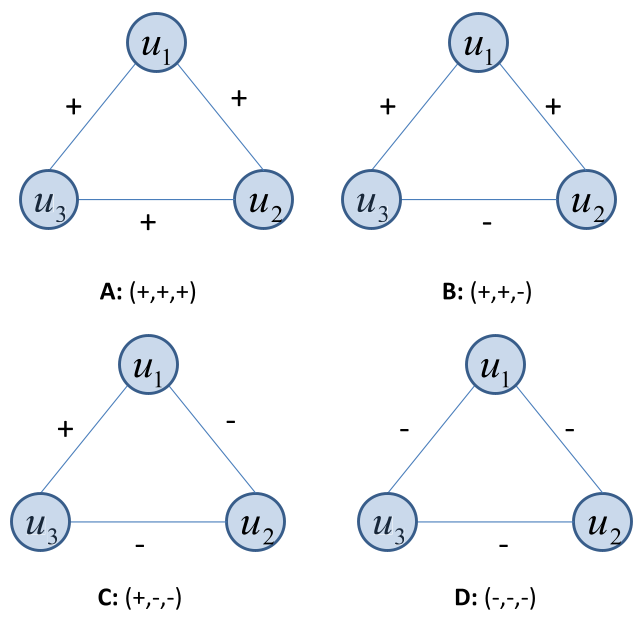
Balance theory suggests that in a triad of users:
- A friend of a friend is a friend.
- An enemy of an enemy is a friend (captured by the term in the optimization objective).
The disMF objective function is defined as: Where is the signed relation matrix (), and captures the latent factors for balance theory.
Experimental Results: The Evidence
The results were striking. In Task 1, predicting distrust from trust scores was less accurate than random guessing. This statistically refutes the idea that distrust is just the negation of trust.
In Task 2, however, the "value of distrust" became clear. By simply adding distrust information to the model, the accuracy of trust prediction spiked.
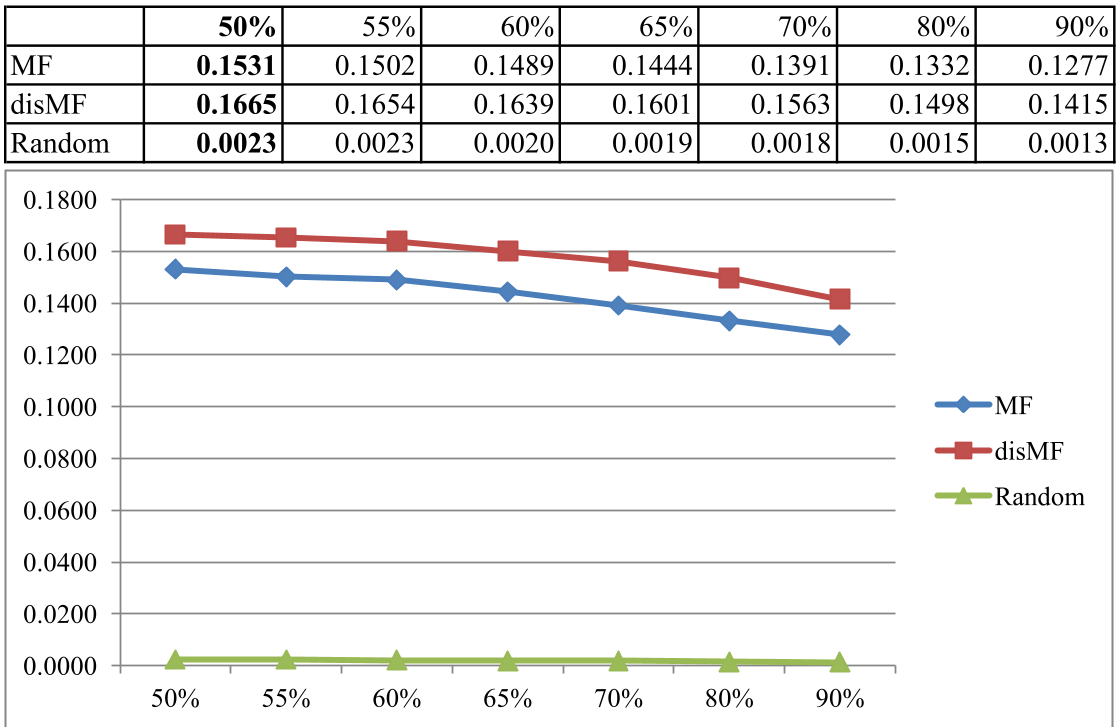
Key Observations:
- disMF outperformed standard MF by up to 10.78%.
- Trust Propagation with Distrust (disTP) showed that even a single step of distrust propagation is more effective than complex trust-only models.
- Balance Theory Matters: Adjusting (the weight of balance theory) showed that the "enemy of my enemy" logic is a powerful predictor for building trust relations.
Critical Insight: Why Does This Matter?
The study concludes that distrust is not a lack of connection, but a specific type of relationship with its own properties. For instance:
- Trust is Asymmetric, but Distrust is even more Asymmetric (nearly double the rate of one-way-only relationships).
- Similarity is not a mirror: While trusted users share many common ratings, distrusted users still share more in common than random strangers. This suggests distrust often arises from informed disagreement rather than a lack of common interests.
Takeaways & Future Work
- For Developers: If you are building a recommendation engine, don't ignore "block" or "hide" actions—they aren't just the absence of a "like"; they are high-signal data points for improving the entire trust graph.
- Limitations: The data is from Epinions (2014). Modern social media lacks explicit "distrust" buttons, requiring us to infer distrust from "unfollows" or "blocks."
- The Horizon: The next step is applying these "signed" network models to combatting viral misinformation and identifying coordinated bot attacks.