
Div-clustering: Bridging the Cold-Start Gap via Active User Dynamics
Div-clustering: Exploring active users for social collaborative recommendation
The paper introduces Div-clustering, a social collaborative recommendation (CR) method that integrates complex clustering of both users and items with the identification of active users. By leveraging the influence of active community members within specific interest clusters, the system significantly alleviates the cold-start problem and enhances recommendation accuracy.
TL;DR
Div-clustering is a refined Social Collaborative Recommendation (CR) framework designed to tackle the notorious cold-start problem. By clustering users and items simultaneously and identifying "Active Users" as lighthouse nodes within these clusters, the system achieves higher recommendation accuracy and faster adaptation to new users compared to traditional Pearson-correlation-based methods.
Problem & Motivation: The Cold-Start Bottleneck
In the era of information overload, Collaborative Filtering (CF) is the gold standard for personalized discovery. However, CF systems face a fundamental "Chicken and Egg" paradox: they need data to provide recommendations, but users won't interact (and generate data) if the recommendations are poor.
The authors identify three critical flaws in existing social CR systems:
- The Sparsity Trap: Insufficient ratings make user-similarity matrices unreliable.
- The Privacy Barrier: Users are reluctant to share detailed profiles, leaving the system with only IDs and minimal metadata.
- The Static Nature of Similarity: Traditional methods often fail to account for the dynamic evolution of user expertise and influence.
Methodology: The Div-Clustering Framework
The core "Insight" of this paper is that users within a cluster share latent interests; thus, the behavior of Active Users (highly engaged or expert users) can serve as a reliable proxy for the entire group.
1. Advanced K-Means for Dual Entities
Unlike standard clustering, the authors utilize a modified K-means that:
- Heuristically calculates : Uses a minimum distance variance method across 10-fold cross-validation to find the "natural" number of clusters.
- Handles Nominal Data: Integrates the YAGO Knowledge Base to convert qualitative attributes (like "Computer Technology") into quantitative distances based on co-appearance frequency.
2. Identifying the "Lighthouse": Active Users
The system calculates a Popularity Score for users. In the context of academic recommendations, for instance, this is derived from:
- Publication frequency (First author vs. co-author).
- Conference prestige.
- Click-through rates from other users.
 (Note: Representation of the graphical model showing the relationship between Web entities and cluster cores.)
Experiments and Results
The authors conducted both offline and online evaluations using MovieLens (standard benchmark), IMDB (sparse data), and a proprietary Academic Paper dataset.
Performance Highlights:
- Accuracy Gains: The Div-clustering approach showed a significantly steeper learning curve in accuracy over a 60-day window compared to the baseline.
- Robustness: On the IMDB dataset, which is traditionally "noisier," Div-clustering maintained stability while the baseline's performance fluctuated.
- User Satisfaction: In online trials with real volunteers, the system achieved an 80%+ match rate between predicted and actual user preferences.
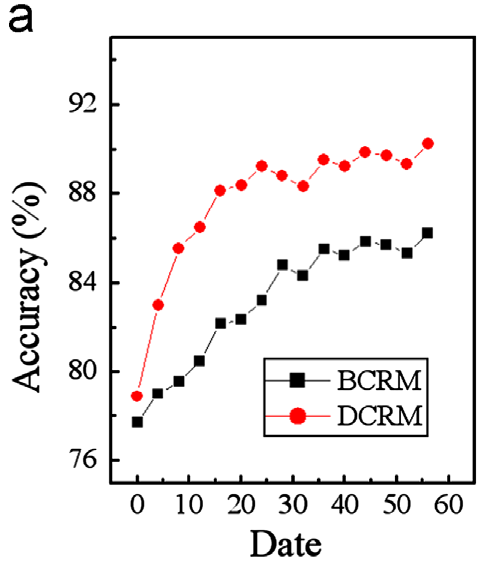 Fig. 5: Comparison showing Div-clustering (DCRM) outperforming the baseline (BCRM) in accuracy over time.
Critical Analysis & Conclusion
Div-clustering serves as a bridge between traditional statistical recommendation and modern social-graph-aware systems.
Takeaways:
- Clustering as a Pre-filter: Pre-clustering significantly reduces the search space for similarity, making the CR algorithm more efficient.
- Human-in-the-loop: By promoting "Active Users," the system leverages the natural social hierarchy of the community to solve data sparsity.
Limitations: While the paper successfully addresses the cold-start problem, the reliance on external knowledge bases like YAGO introduces a dependency on the quality and update frequency of that knowledge base. Furthermore, the "Active User" mechanism might inadvertently lead to filter bubbles, where minority opinions are overshadowed by dominant active users—a common challenge in contemporary social platform design.