
DIVa: Scaling Identity Trust via Community-Aware Decentralized Learning
DIVa: Decentralized Identity Validation for Social Networks
This paper introduces DIVa (Decentralized Identity Validation), a novel framework for verifying user identities in Online Social Networks (OSNs) via decentralized association rule mining. It leverages community-specific attribute correlations (e.g., specific job-education pairs) rather than global trends to identify fake accounts with high precision.
TL;DR
Identities in social networks are usually validated by centralized authorities, which is a privacy nightmare and often inaccurate for niche communities. DIVa (Decentralized Identity Validation) flips the script by allowing communities to define their own "normal." By mining correlations between profile attributes (like Job and Education) at a local level, DIVa detects fakes with up to 50% better accuracy than global models, all while keeping user data strictly among friends.
The "One Size Fits All" Fallacy in Identity Validation
Most current identity validation systems treat social networks as a single, homogeneous entity. They look for global correlations—for instance, "most users with a CS degree are Software Engineers."
However, social networks are naturally clustered. In a community of musicians, "Job" and "Education" might correlate differently than in a community of doctors. Global models create a "Minority Penalty": an artist might be flagged as "fake" simply because their profile doesn't match the statistical average of the millions of corporate employees on the platform. Furthermore, in the era of Decentralized Online Social Networks (DOSNs), moving all user data to a central server for analysis is a fundamental violation of privacy.
Methodology: How DIVa Localizes Trust
DIVa operates through a sophisticated three-step pipeline designed for a node-centric environment:
1. Finding Your Tribe (Community Detection)
Instead of a global map, each node uses a diffusion-based algorithm to find its community boundaries. Crucially, DIVa supports overlapping communities, recognizing that a person can simultaneously be part of a "Family" group and a "Professional" group, each with different identity signatures.
2. Hunting for Correlations (Local ARM)
Each node performs Association Rule Mining (ARM) on the profiles of its direct neighbors. It looks for Local Correlated Attribute Sets (LCAS).
- Physical Intuition: If 40% of my friends who live in "San Francisco" also work in "Tech," my node identifies a local rule.
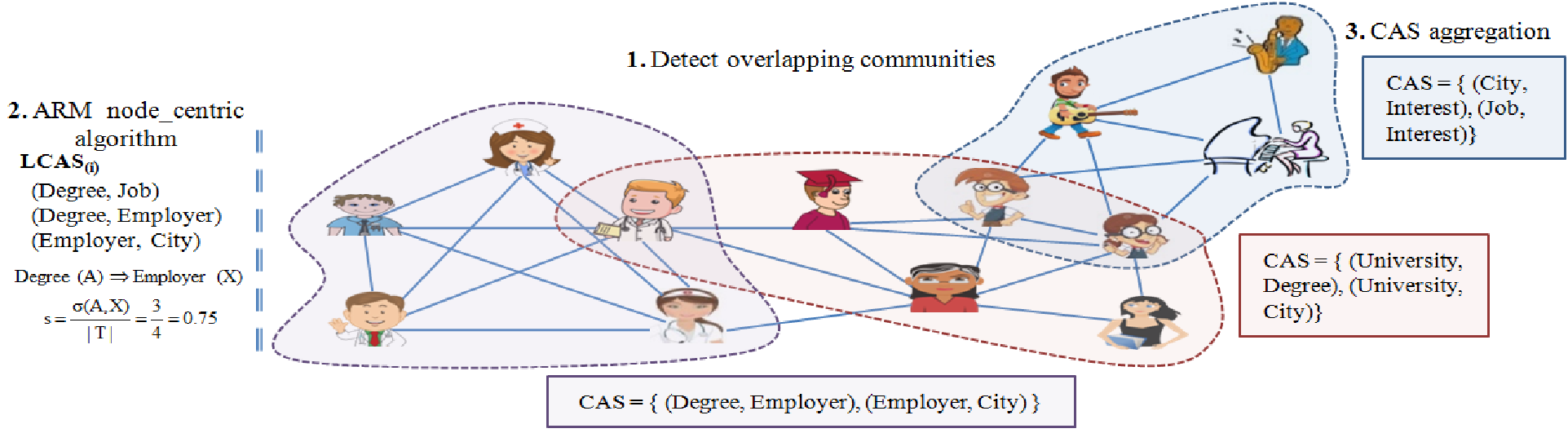
3. Consensus through Delegation (Community Aggregation)
To turn local observations into stable community rules, nodes send their findings to a "diva" node (the leader of that community cluster). The leader aggregates these using a weighted voting mechanism. The result is a set of CAS (Correlated Attribute Sets) that reflect the specific social norms of that group.
Experimental Battleground: Facebook vs. Google+
The authors tested DIVa against a "Global" approach (where one central model learns from everyone).
- Facebook Gains: DIVa showed a 52.5% improvement in capturing meaningful attributes.
- Google+ Scalability: In tests with millions of nodes, DIVa's incremental execution proved that it doesn't need to re-run the whole network when a new user joins; only approximately 6-17% of the local graph needs a refresh.

The chart above demonstrates the "Penalty" of global learning: many valid users in niche communities (the 20% of communities overlooked by global trends) are effectively "misunderstood" by universal models but correctly validated by DIVa.
Critical Insight: The Security of Crowds
Can a malicious actor "poison" these community rules? The paper provides a security analysis showing that to introduce a fake rule (e.g., making a fake university look "real" for a specific job), an attacker would need to inject a number of Sybil nodes proportional to the size of the community. In small, tight-knit communities, this is nearly impossible because established members are selective about who they friend.
Conclusion
DIVa proves that decentralization isn't just a political or privacy-centric choice—it's a technical advantage. By respecting the modular structure of human society, we can build identity systems that are more robust, more private, and significantly more accurate than the "big data" monoliths of the past.
Future Outlook: The next step for this tech is moving toward Gossip protocols, removing the need for even a temporary "leader" or diva node, achieving 100% peer-to-peer trust.