
Inside Claude Code: The "Thick Harness" Philosophy of Production AI Agents
Dive into Claude Code: The Design Space of Today's and Future AI Agent Systems
This paper provides a comprehensive source-level architectural analysis of Claude Code, a production-grade AI agentic coding tool. It identifies a "Minimal Scaffolding, Maximal Operational Harness" design pattern and compares it with OpenClaw to map the design space of modern agent systems.
TL;DR
Claude Code isn't just a wrapper around an LLM; it’s a sophisticated "operational harness" where 98.4% of the code is deterministic infrastructure and only 1.6% is AI logic. This deep dive into its architecture reveals why the secret to reliable agents lies in graduated safety layers, a 5-stage context-management pipeline, and a "deny-first" permission set that prioritizes human authority over raw autonomy.
Problem & Motivation: The Scaffolding vs. Harness Debate
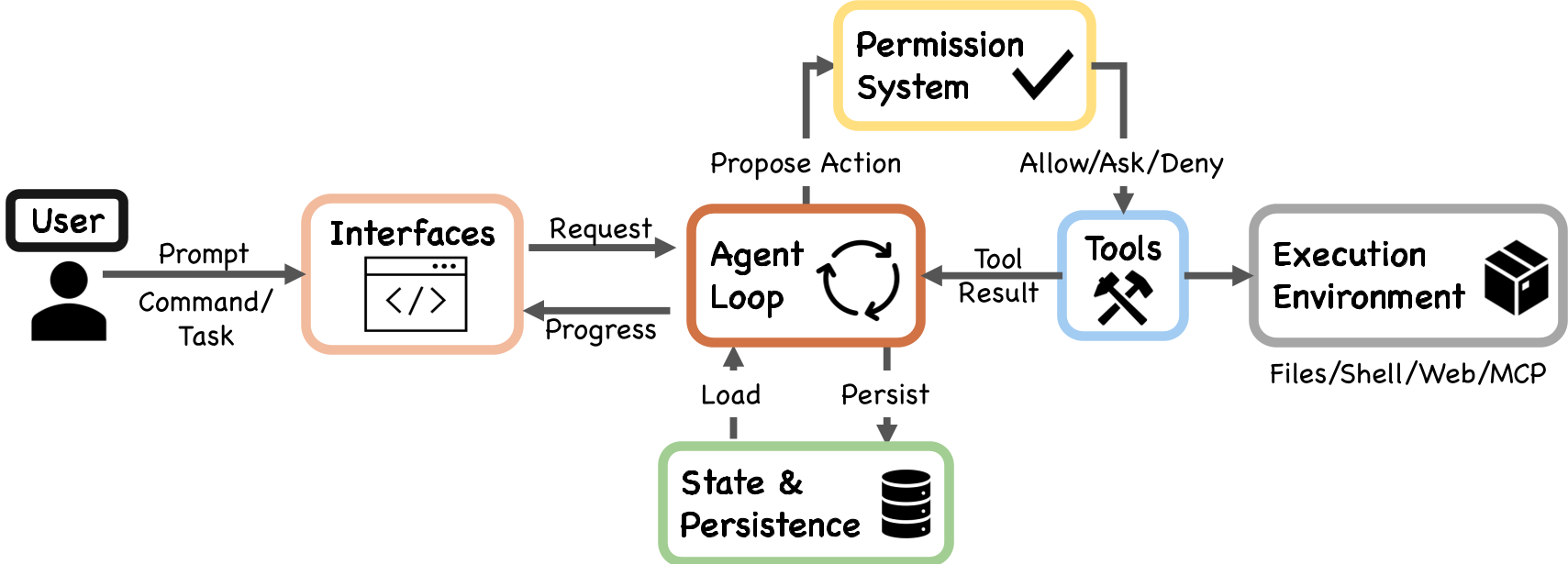
In the world of AI agents, there are two schools of thought. The first, Scaffolding, tries to constrain the model using rigid state machines (think LangGraph). The second, which Claude Code champions, is the Operational Harness.
The problem with scaffolding is that as models get smarter, rigid graphs become bottlenecks. However, giving an LLM "raw" access to a terminal is a safety nightmare. Claude Code solves this by building a massive, deterministic "safety and context shell" around a simple reactive loop. The goal? Let the model reason freely, but make it impossible for it to break the "physical" laws of the system.
Methodology: The Core Architecture
The system is built as a while-true cycle implementing the ReAct pattern. But the magic happens in the subsystems surrounding this loop.
1. The 5-Layer Context Compaction Pipeline
Because the context window is the "binding resource constraint," Claude Code doesn't just truncate old messages. It uses a graduated pipeline:
- Budget Reduction: Caps oversized tool outputs.
- Snip: Trims very old history.
- Microcompact: A cache-aware fine-grained compression.
- Context Collapse: A "virtual" projection of history that only the model sees.
- Auto-compact: A final LLM-generated summary when all else fails.
2. "Deny-First" Safety & Permission System
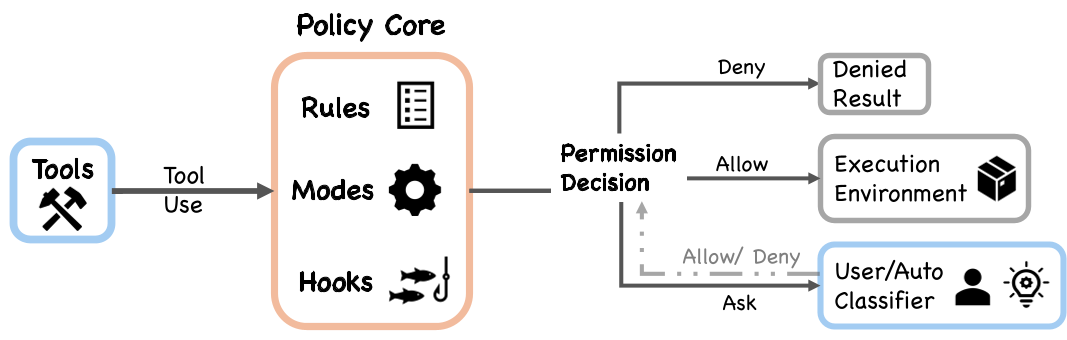
Claude Code implements a Defense in Depth strategy. A request to run a command (like npm test) must pass through seven independent gates:
- Tool Pre-filtering: Stripping forbidden tools before the model even sees them.
- Deny-First Rules: A
denyrule always overrides anallowrule. - ML Classifier: A secondary "YOLO" model that predicts if a tool call is malicious.
- Shell Sandboxing: Isolating the execution environment at the OS level.
Experiments & Comparison: Claude Code vs. OpenClaw
To understand the design space, the authors compared Claude Code with OpenClaw (a multi-channel assistant gateway). The findings are striking:
| Dimension | Claude Code | OpenClaw |
|---|---|---|
| Trust Model | Per-action safety classification | Perimeter-level access control |
| Scope | Ephemeral CLI Process | Persistent WebSocket Daemon |
| Memory | Transparent CLAUDE.md files | "Dreaming" & Long-term Fact Promotion |
This comparison highlights that agent architecture is highly context-dependent. Claude Code ignores long-term "identity" to focus on repository-level precision, while OpenClaw prioritizes persistent relationships across messaging channels like Slack or Discord.
Deep Insights: The Evaluative Lens
One of the most profound sections of the paper explores the "Paradox of Supervision."
- The Risk: As agents become more capable (Amplify), the human supervisor’s skills may atrophy (Atrophy).
- The Findings: Developers using these tools scored 17% lower on comprehension tests in some studies.
Claude Code currently optimizes for short-term capability amplification. The authors argue that the next frontier for agent systems isn't "more autonomy," but "capability preservation"—ensuring that humans actually understand the code the agent is writing.
Conclusion: Lessons for Agent Architects
- Build a Thick Harness: Spend 90% of your time on the "boring" stuff—permission logic, context window management, and error recovery.
- Context-Cost Partitioning: Organize extensions (MCP, Skills, Hooks) by how many tokens they consume.
- Values Over Rules: Instead of hardcoding every behavior, create a value-based hierarchy (Human Authority > Safety > Reliability).
Claude Code represents a shift from "AI products" to "Agentic Operating Systems," where the LLM is the CPU and the harness is the kernel.