
Beyond the Comfort Zone: Balancing Social Capital and Diversity via Genetic Algorithms
Forming Diverse Teams Based on Members’ Social Networks: A Genetic Algorithm Approach
This paper introduces a novel optimization algorithm for the team formation problem that simultaneously maximizes member diversity and social connectivity (familiarity). Utilizing the NSGA-II genetic algorithm, the method identifies Pareto-optimal team assignments within an organizational social network, outperforming human self-assembly in both communication efficiency and demographic variety.
TL;DR
Researchers have developed a Pareto-optimal genetic algorithm based on NSGA-II that solves the age-old dilemma of team formation: choosing between people we know (familiarity) and people different from us (diversity). By analyzing underlying social networks, the algorithm identifies team structures that are both more diverse and better connected than those students create for themselves.
The "Homophily Trap" in Team Assembly
In academic and corporate settings, the "self-assembly" of teams often leads to homophily—the tendency of individuals to associate with similar others. While this makes the group feel "comfortable," it stifles innovation and limits the cross-pollination of skills. On the flip side, "forced" diversity by managers often ignores the social fabric, leading to high communication costs and friction.
The problem is computationally daunting. For a class of just 50 students being split into teams of 5, there are over 2.1 million possible combinations. Finding the one that balances social ties with diversity is an NP-hard challenge.
Methodology: The NSGA-II Approach
The authors propose a bi-objective optimization model that looks at two primary metrics:
- Communication Cost (): Calculated as the sum of the shortest paths between all members within a team based on their pre-existing social network.
- Diversity Metric (): A composite score using the Blau Index (for categorical traits like gender/race) and the Coefficient of Variation (for continuous traits like age or skill levels).
The Genetic Engine
Instead of a brute-force search, the algorithm uses the Non-dominated Sorting Genetic Algorithm-II (NSGA-II).
 The algorithm initializes a population of random team assignments (chromosomes) and evolves them through selection, crossover, and non-dominated sorting.
The core innovation lies in the Crossover step (Algorithm 1), which ensures that every student is assigned to exactly one team while shuffling members to explore new "Pareto-optimal" solutions—where no single team can be made more diverse without harming its social connectivity.
Experimental Results: Machines vs. Humans
The algorithm was tested against real-world data from the MyDreamTeam platform. Two courses (60 and 48 students) were evaluated.
The Diversity-Connection Frontier
The results were striking. As shown in the figure below:
- Self-Assembled Teams (Orange Triangles): Showed high familiarity but surprisingly low diversity—even lower than random assignments.
- Optimized Solutions (Blue Circles): Pushed the boundary outward, achieving lower communication costs (better connectivity) AND significantly higher diversity.
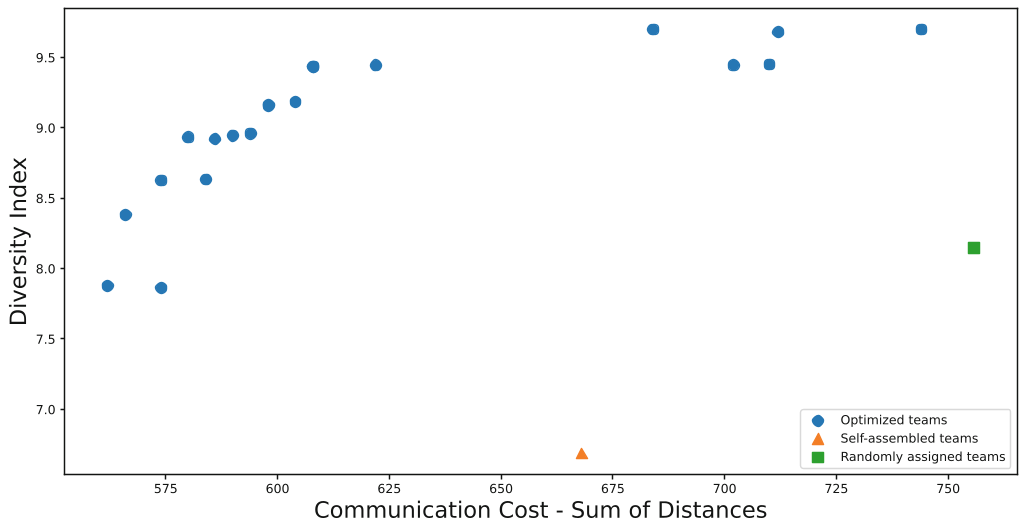 Figure 1: The blue circles represent the "Pareto Front" found by the algorithm, clearly outperforming the human-selected teams (orange) on both axes.
Why the Algorithm Wins
The authors suggest that while humans have an intuition for their immediate friends, they lack visibility into high-order connections (friends of friends). The algorithm, having a "God's eye view" of the entire network, can find a teammate who is diverse in background but only "two handshakes away" from other team members. This preserves social capital while shattering the echo chamber of homophily.
Critical Analysis & Future Outlook
Takeaway: This work proves that algorithmic intervention in social dynamics doesn't have to be "socially blind." By incorporating social network graphs into the fitness function, we can build teams that are both inclusive and functionally cohesive.
Limitations:
- The diversity metric is aggregate; in some cases, specific "types" of diversity (e.g., skill vs. ethnicity) might be more critical than others.
- The model currently treats all social ties as equal (unweighted), whereas in reality, a "best friend" tie is more valuable than a "met once" tie.
Future Work: The logical next step is exploring weighted networks and incorporating skill constraints (e.g., ensuring every team has at least one Python expert), moving from purely social/demographic diversity to functional expertise optimization.