
Beyond the Bubble: Diversifying Urban Recommendations through Category-Aware xQuAD
Diversifying contextual suggestions from location-based social networks
The paper introduces a novel framework for Contextual Suggestion in Location-Based Social Networks (LBSNs) that addresses redundancy by diversifying recommendations based on venue categories. Utilizing an adaptation of the xQuAD diversification framework and a custom textual category classifier, the authors achieve superior performance in personalizing urban venue suggestions.
TL;DR
Researchers from the University of Glasgow have tackled the "redundancy trap" in location-based recommendations. By adapting web search diversification techniques (xQuAD) to the world of Foursquare and Yelp, they’ve created a system that doesn't just suggest what you like, but suggests a balanced variety of what you like, even when venue metadata is missing.
The "Zero-Query" Dilemma and the Redundancy Trap
Imagine you are in a new city. You open an app for a recommendation. You haven't typed a search term (Zero-Query), so the app looks at your history. You've liked three museums in the past, so the app shows you five more museums. While technically "accurate," this is a failure of user experience. You might also like a local bar or a park, but because your "museum" signal is strongest, the system enters a feedback loop of redundancy.
Existing SOTA (State-of-the-Art) methods focus on Low-Level Interests—matching the text of a venue description to your past likes. This paper argues we must move to High-Level Interests (Categories) and explicitly diversify the results to cover the spectrum of a user's personality.
Methodology: Personalizing Diversity
The authors break the problem into two parts: a Recommender and a Diversifier.
1. The Baseline Recommender (Language Modeling)
They build a "Positive Profile" and a "Negative Profile" for each user using the content of venues they’ve rated. The similarity of a new venue to these profiles determines its initial relevance score.
2. The xQuAD Diversifier
Inspired by web search, they adapt the xQuAD (Explicit Query Aspect Diversification) framework. In this context, "Query Aspects" are "Venue Categories." The system iteratively picks venues that:
- Are highly relevant to the user.
- Belong to categories not yet well-represented in the top-5 list.
3. Bridging the Metadata Gap: Category Prediction
What if a venue is from a random website and not Foursquare? There’s no "Category" tag. The authors built a textual classifier trained on the ClueWeb12 corpus. By using a Learning-to-Rank (LambdaMART) approach to find representative pages for venues, they trained a model to accurately predict whether a website describes a "Nightlife Spot" or a "Great Outdoor" location.
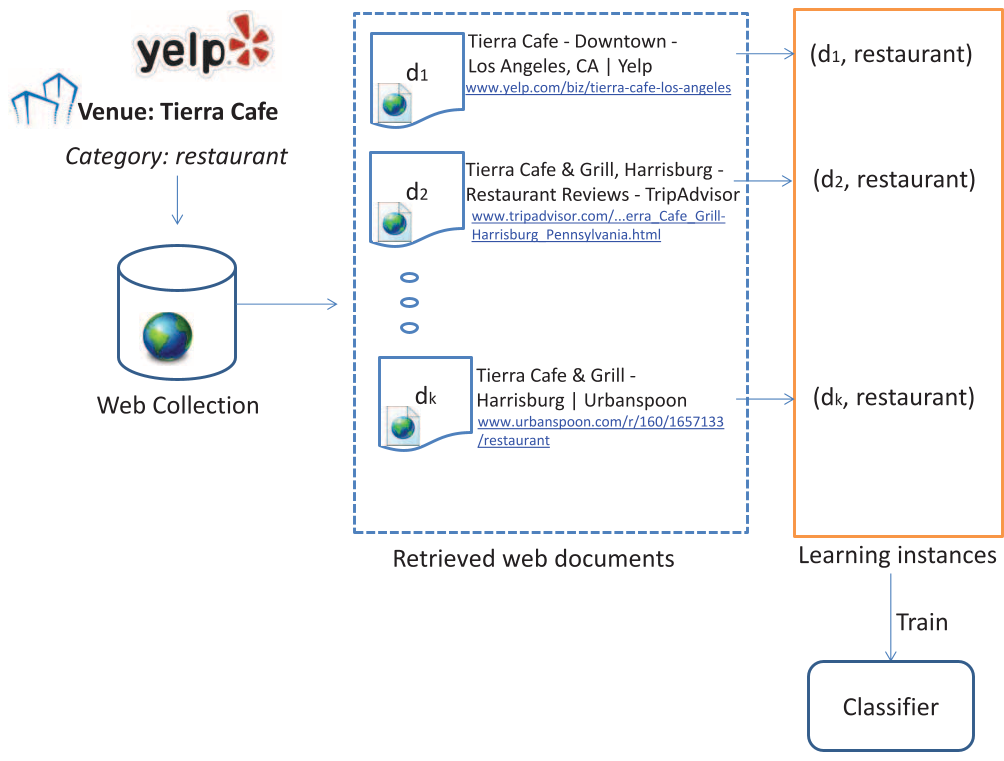 Figure 1: The workflow for training a classifier to bridge the gap between LBSNs and the open web.
Experimental Results: Variety is the Spice of Life
Using the TREC 2013 Contextual Suggestion dataset, the authors proved that "Personalized Diversification" consistently beats standard similarity matches.
| Metric | Baseline (LM) | Personalized Diversification | Improvement |
|---|---|---|---|
| P@5 (Foursquare) | 0.360 | 0.385 | +6.9% |
| P@5 (ClueWeb12) | 0.081 | 0.089 | +10.0% |
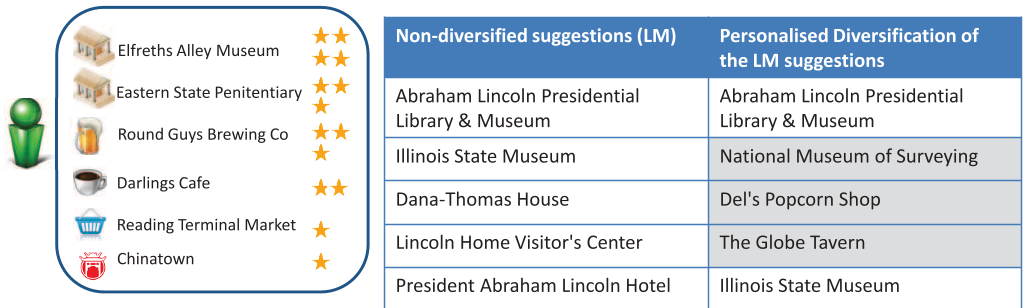 Figure 2: A concrete example showing how diversification replaces redundant "Museum" suggestions with "Food" and "Parks" that match the user's broader profile.
Critical Insight: Who Benefits Most?
The study highlights a crucial Inductive Bias: diversification is not a "one size fits all" solution. Users with High Entropy (diverse tastes) see massive gains from this method. For users with very narrow, specific interests (Low Entropy), the system is smart enough to maintain a lower level of diversity, preventing the "dilution" of relevance.
Conclusion & Future Look
Albakour et al. successfully demonstrated that urban discovery is as much about exploration as it is about matching. While the paper was written in 2014, its core logic remains incredibly relevant in the age of LLMs—how do we ensure that "AI assistants" don't just echo our most frequent habits, but instead suggest the hidden gems we didn't know we were looking for?
The limitation remains the trade-off parameter (); future systems might use Reinforcement Learning to dynamically adjust how much "diversity" a user needs in real-time based on their current "vibe" or context.